
📖 Digital Marketing Encyclopedia – Chapter 3
Core Principles of Marketing (4Ps → 7Ps → Digital Mix)

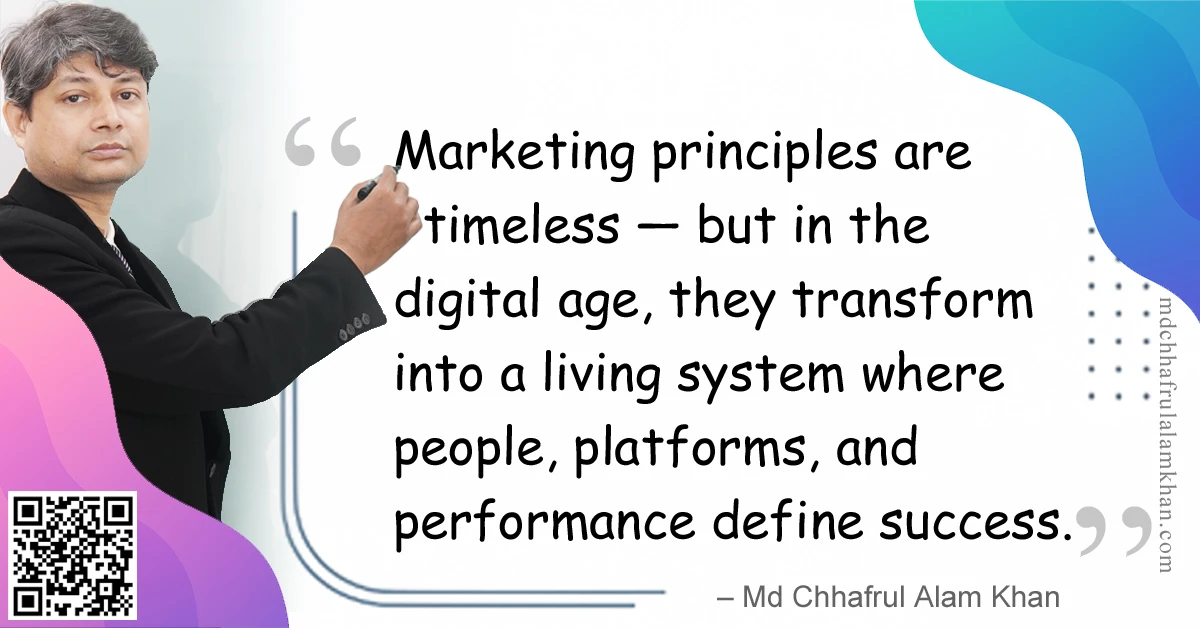
“Marketing principles are timeless — but in the digital age, they transform into a living system where people, platforms, and performance define success.”
– Md Chhafrul Alam Khan
Introduction
At the foundation of all marketing strategies lie the core principles. These principles started as the 4Ps of Marketing, later evolved into the 7Ps, and today extend further into the Digital Marketing Mix, reflecting the complexity of modern online ecosystems.
Understanding these frameworks helps marketers create campaigns that are strategic, customer-centric, and adaptable across traditional and digital channels.
🔎 The 4Ps of Marketing
The 4Ps were first introduced by E. Jerome McCarthy in the 1960s as the Marketing Mix. They remain the foundation of marketing.
- Product – What you are offering: features, design, packaging, quality.
- Price – The cost to the customer: pricing strategies, discounts, payment models.
- Place – Distribution channels: physical stores, online shops, marketplaces.
- Promotion – How the product is marketed: advertising, PR, digital campaigns.
Purpose of the 4Ps: To align a product with customer needs and market expectations.
🧩 The 7Ps of Marketing
In the 1980s, the model expanded to the 7Ps to address service industries and customer experience.
- People – Employees, brand ambassadors, and customers themselves.
- Process – The systems and workflows delivering the product or service.
- Physical Evidence – Tangible proof that supports trust: packaging, design, reviews, testimonials, case studies.
Why it matters: In service-driven and digital economies, people, processes, and evidence are as important as product and price.
💻 The Digital Marketing Mix
The digital era has extended the marketing mix beyond 7Ps into a more dynamic system.
Additional Elements in the Digital Mix:
- Personalization – Customizing experiences using AI, data, and analytics.
- Performance – Real-time metrics: KPIs, ROI, CTR, engagement rates.
- Platforms – Channels like Google, YouTube, LinkedIn, TikTok, Amazon, apps.
- Participation – Encouraging user-generated content, reviews, community engagement.
- Partnerships – Influencers, affiliates, sponsorships, collaborations.
- Privacy – Data ethics, compliance with GDPR, CCPA, and cookie-less tracking.
Why it matters: The Digital Mix reflects the shift from one-way communication to interactive, measurable, and trust-based engagement.
📊 Comparison Table – Evolution of the Marketing Mix
| Model | Elements |
|---|---|
| 4Ps (1960s) | Product, Price, Place, Promotion |
| 7Ps (1980s) | + People, Process, Physical Evidence |
| Digital Mix (2000s → today) | + Personalization, Performance, Platforms, Participation, Partnerships, Privacy |
🎯 Application in Digital Marketing
- Product → Optimized with customer reviews, UX, feature updates.
- Price → Transparent, dynamic pricing (subscriptions, freemium, bundles).
- Place → Websites, e-commerce stores, global marketplaces.
- Promotion → SEO, SEM, content, social, email, paid ads.
- People → Customer support, online communities, brand advocacy.
- Process → Automation workflows, CRM systems, chatbots.
- Physical Evidence → Website design, social proof, testimonials, case studies.
- Personalization → AI-driven recommendations, dynamic content.
- Performance → GA4, dashboards, attribution models.
- Platforms → Multi-channel strategies (Google, Amazon, TikTok, LinkedIn).
- Participation → Reviews, UGC, influencer collaborations.
- Partnerships → Affiliates, joint ventures, sponsorships.
- Privacy → Ethical data usage, cookie-less strategies.
❓ Frequently Asked Questions
Q1: Why are the 4Ps still relevant today?
Because they represent timeless fundamentals of aligning products, pricing, distribution, and promotion with customer needs.
Q2: Why did the model expand to 7Ps?
To include service quality, customer experience, and trust-building — critical for industries beyond physical goods.
Q3: What makes the Digital Marketing Mix different?
It reflects modern realities like personalization, data performance, platforms, partnerships, and privacy.
Q4: Which mix should marketers use?
A blended approach — the 4Ps remain the foundation, the 7Ps adapt to customer experience, and the Digital Mix enables online relevance.
✨ Final Thoughts
The Marketing Mix has evolved from the 4Ps to the 7Ps, and now to the Digital Mix, but its core principle remains the same:
“Align your offering with customer needs, deliver value, and build trust across every touchpoint.”
– Md Chhafrul Alam Khan
“In Digital Marketing, success comes from integrating timeless fundamentals with modern elements like personalization, performance, and privacy.”
– Md Chhafrul Alam Khan
Want to apply the full Digital Marketing Mix to your brand?
👉 Work with me to create strategies that are timeless, digital-first, and future-proof.
Boost Your Knowledge & Skills 🚀
Master SEO from Beginner to Expert with our Free Online Self-Learning Course on SEO Mastery.
You might like↴
- Content Creation Checklist (CCC)
- SEO Encyclopedia
- What Is SEO – Search Engine Optimization? [A Comprehensive Guide]
- How to Become an SEO Expert? A Step-by-Step Guide
- SEO Starter Guide: From Web Whispers to Search Engine Screams
- On-Page SEO Overview
- Title Tag Optimization
- Meta Description Optimization
- Meta Robots Tag Optimization
- Canonical URL Optimization
- Viewport Meta Tag Optimization
- Heading Tag H1 Optimization
- Heading Tags H2–H6 Optimization
- Heading Structure Best Practices
- Keyword Targeting in Content
- Content Structure & Readability
- Content Depth & Word Count
- Multimedia Optimization
- Content Freshness & Updates
- Internal Link Structure
- Anchor Text Optimization
- Fixing Orphan Pages
- SEO-Friendly URL Structure
- URL Parameters & Tracking Codes
- Image File Naming for SEO
- Image Compression & Formats
- Image Alt Text & Title Attributes
- Schema Markup Overview
- Common Schema Types
- Testing & Validating Schema
- Outbound Link Quality & Relevance
- Nofollow, Sponsored & UGC Attributes
- Core Web Vitals Optimization
- Mobile Friendliness
- Accessibility Standards for SEO
- Robots Meta Tag Usage
- Hreflang Implementation
- Manual On-Page SEO Audit Checklist
- On-Page SEO Tools & Software
- Competitor On-Page SEO Analysis
- Technical SEO
- Meta Charset Tag Optimization
- Pagination SEO
- Google Search Algorithm
- The future of SEO in a ChatGPT-dominated world
- SEO Mastery: Complete Course Content
- Lesson 01: What is SEO and Why Does It Matter?
- Lesson 02: Keyword Research Made Simple
- Lesson 03: On-Page SEO Basics
- Lesson 04: Technical SEO