
📖 Digital Marketing Encyclopedia – Chapter 4
Digital Marketing Strategy & Planning

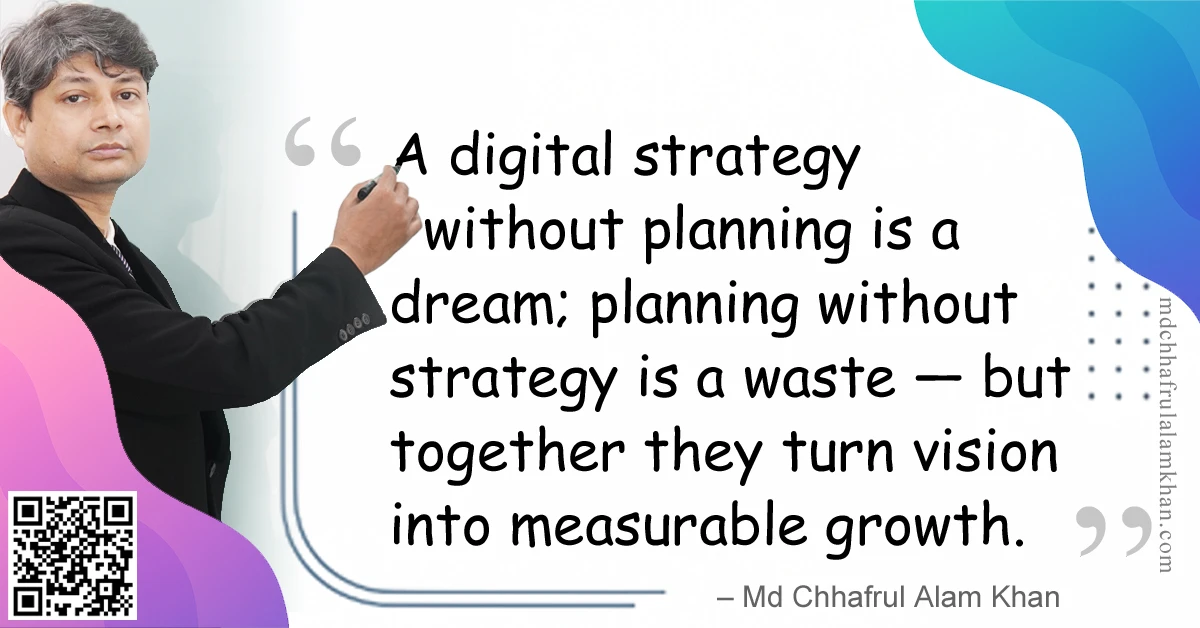
“A digital strategy without planning is a dream; planning without strategy is a waste — but together they turn vision into measurable growth.”
– Md Chhafrul Alam Khan
Introduction
Digital Marketing is not a random set of activities — it is a structured strategy combined with detailed planning.
- Strategy defines the vision and direction: goals, target audience, positioning, and value proposition.
- Planning defines the execution and process: tactics, timelines, resources, and measurement.
Together, they ensure that every marketing effort is aligned, purposeful, and optimized for results.
🔎 What is a Digital Marketing Strategy?
A Digital Marketing Strategy is the blueprint for achieving business goals using digital channels and tools.
It answers:
- Who is the target audience?
- What are the goals (awareness, leads, sales, loyalty)?
- Where will campaigns run (search, social, email, marketplaces)?
- How will success be measured (KPIs, ROI, metrics)?
🧩 Key Elements of a Digital Marketing Strategy
- Business Objectives
- Growth goals: revenue, market share, customer retention
- Marketing goals: brand awareness, engagement, lead generation
- Audience Analysis
- Buyer personas
- Customer journey mapping
- Behavioral segmentation
- Market Research & Competitor Analysis
- Benchmarking competitors
- Identifying opportunities and gaps
- SWOT analysis (Strengths, Weaknesses, Opportunities, Threats)
- Channel Selection
- SEO & SEM
- Social Media Marketing
- Content Marketing
- Email campaigns
- Paid Advertising
- Influencer/Partnerships
- Value Proposition & Messaging
- Clear differentiation from competitors
- Compelling storytelling
- Measurement & KPIs
- Web traffic, leads, conversions, CAC (Customer Acquisition Cost), CLV (Customer Lifetime Value), ROI
🗂️ What is a Digital Marketing Plan?
A Digital Marketing Plan is the execution framework for implementing the strategy.
It includes:
- Campaign timelines
- Content calendars
- Budgets & resource allocation
- Tools & technology stack
- Reporting structures
📊 Comparison Table: Strategy vs. Planning
| Aspect | Strategy | Planning |
|---|---|---|
| Definition | Blueprint, vision, direction | Execution, process, details |
| Focus | Long-term goals & positioning | Short-term actions & tasks |
| Questions Answered | Who? What? Why? | How? When? Where? |
| Output | Marketing strategy document | Campaign calendar, budget, workflows |
| Timeframe | 1–3 years | Weekly, monthly, quarterly |
🎯 Frameworks for Strategy & Planning
1. SOSTAC Model
- Situation Analysis → Where are we now?
- Objectives → Where do we want to be?
- Strategy → How will we get there?
- Tactics → What tools will we use?
- Action → Who does what, when?
- Control → How do we measure success?
2. RACE Framework
- Reach → Attract audiences
- Act → Encourage interactions
- Convert → Turn into leads/customers
- Engage → Build loyalty & advocacy
🛠️ Tools for Strategy & Planning
- Analytics: Google Analytics 4, Search Console
- SEO Tools: SEMrush, Ahrefs, Moz
- Content Tools: WordPress, HubSpot, Canva
- Social Tools: Buffer, Hootsuite, Sprout Social
- Email Tools: Mailchimp, ConvertKit, ActiveCampaign
- Project Management: Trello, Asana, Monday.com
- CRM & Automation: HubSpot, Salesforce, Zoho
❓ Frequently Asked Questions
Q1: What is the difference between strategy and planning?
Strategy sets the vision and goals; planning organizes execution.
Q2: Can small businesses have a digital strategy?
Yes — strategies can be simple but must exist, even if limited to 1–2 channels.
Q3: What happens if planning exists without strategy?
Efforts become scattered and disconnected, leading to wasted resources.
Q4: How often should a digital strategy be updated?
At least annually, but reviewed quarterly for market shifts and AI-driven changes.
✨ Final Thoughts
A strong Digital Marketing Strategy gives direction, and a well-structured Plan ensures execution.
- Strategy = the why and what.
- Planning = the how and when.
“The key to success lies in combining both, guided by data, powered by creativity, and optimized by technology.”
– Md Chhafrul Alam Khan
Need help building a digital strategy with actionable planning?
👉 Work with me to align vision, execution, and measurable growth.
Boost Your Knowledge & Skills 🚀
Master SEO from Beginner to Expert with our Free Online Self-Learning Course on SEO Mastery.
You might like↴
- Content Creation Checklist (CCC)
- SEO Encyclopedia
- What Is SEO – Search Engine Optimization? [A Comprehensive Guide]
- How to Become an SEO Expert? A Step-by-Step Guide
- SEO Starter Guide: From Web Whispers to Search Engine Screams
- On-Page SEO Overview
- Title Tag Optimization
- Meta Description Optimization
- Meta Robots Tag Optimization
- Canonical URL Optimization
- Viewport Meta Tag Optimization
- Heading Tag H1 Optimization
- Heading Tags H2–H6 Optimization
- Heading Structure Best Practices
- Keyword Targeting in Content
- Content Structure & Readability
- Content Depth & Word Count
- Multimedia Optimization
- Content Freshness & Updates
- Internal Link Structure
- Anchor Text Optimization
- Fixing Orphan Pages
- SEO-Friendly URL Structure
- URL Parameters & Tracking Codes
- Image File Naming for SEO
- Image Compression & Formats
- Image Alt Text & Title Attributes
- Schema Markup Overview
- Common Schema Types
- Testing & Validating Schema
- Outbound Link Quality & Relevance
- Nofollow, Sponsored & UGC Attributes
- Core Web Vitals Optimization
- Mobile Friendliness
- Accessibility Standards for SEO
- Robots Meta Tag Usage
- Hreflang Implementation
- Manual On-Page SEO Audit Checklist
- On-Page SEO Tools & Software
- Competitor On-Page SEO Analysis
- Technical SEO
- Meta Charset Tag Optimization
- Pagination SEO
- Google Search Algorithm
- The future of SEO in a ChatGPT-dominated world
- SEO Mastery: Complete Course Content
- Lesson 01: What is SEO and Why Does It Matter?
- Lesson 02: Keyword Research Made Simple
- Lesson 03: On-Page SEO Basics
- Lesson 04: Technical SEO