
📖 Digital Marketing Encyclopedia – Chapter 5
The Digital Customer Journey

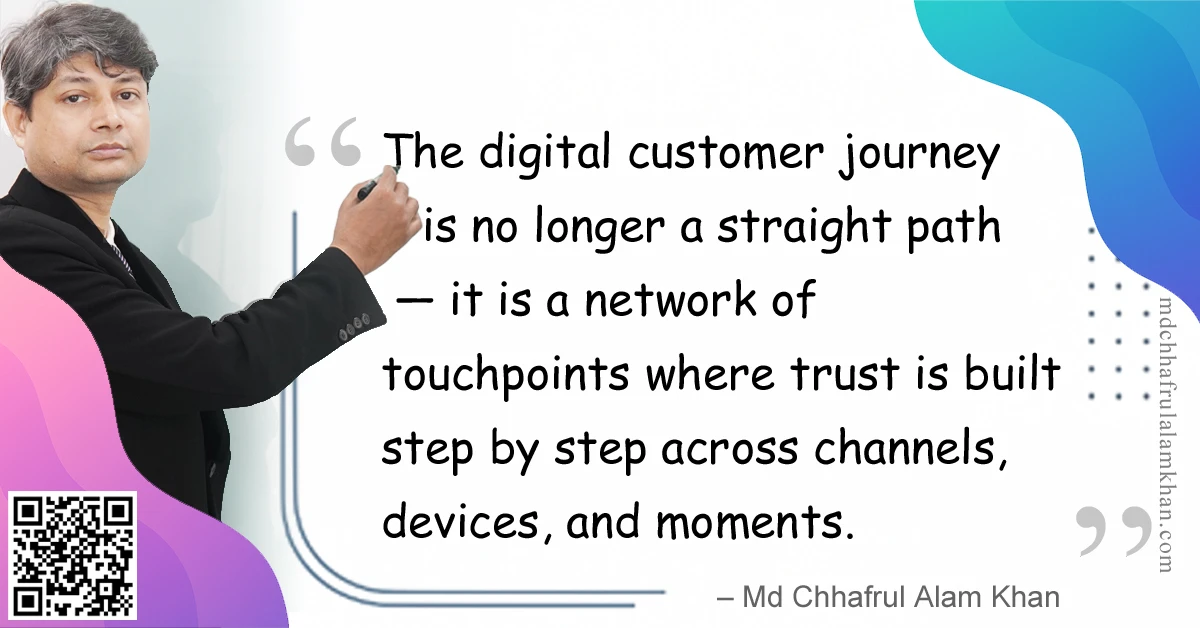
“The digital customer journey is no longer a straight path — it is a network of touchpoints where trust is built step by step across channels, devices, and moments.”
– Md Chhafrul Alam Khan
Introduction
The digital customer journey describes the complete process a person goes through from first awareness of a brand to becoming a loyal advocate.
Unlike traditional funnels, today’s journey is non-linear. Customers switch between devices, platforms, and channels — influenced by search engines, social media, reviews, ads, and personal recommendations.
Understanding this journey helps businesses create strategies that are customer-centric, data-driven, and optimized for every touchpoint.
🔎 Stages of the Digital Customer Journey
- Awareness
- The customer discovers a need or becomes aware of a brand.
- Channels: SEO, social media, PR, display ads.
- Consideration
- Customers research, compare, and evaluate options.
- Channels: content marketing, reviews, case studies, webinars.
- Conversion
- The customer takes action (purchase, sign-up, download).
- Channels: landing pages, CRO strategies, checkout optimization.
- Retention
- Building relationships to encourage repeat purchases.
- Channels: email marketing, loyalty programs, personalization.
- Advocacy
- Customers recommend the brand to others.
- Channels: referral programs, reviews, UGC (user-generated content).
🧩 Key Characteristics of the Digital Journey
- Multi-Channel: Customers move between search engines, websites, social media, apps, and marketplaces.
- Device-Switching: Journeys often start on mobile and end on desktop or vice versa.
- Trust-Based: Reviews, social proof, and transparency heavily influence decisions.
- Non-Linear: Customers may jump back and forth between stages before converting.
📊 Example: Customer Journey in Action
| Stage | Example Action | Digital Channel |
|---|---|---|
| Awareness | Searches “best running shoes” | Google SEO results |
| Consideration | Reads reviews & watches YouTube unboxings | Blogs, YouTube |
| Conversion | Buys shoes online | E-commerce website |
| Retention | Receives personalized training tips | Email marketing |
| Advocacy | Shares photo wearing shoes | Instagram UGC |
🎯 Mapping the Customer Journey
To optimize campaigns, businesses should:
- Create buyer personas to represent ideal customers.
- Map all touchpoints (search, social, ads, website, email, customer support).
- Identify pain points and friction areas.
- Design seamless omnichannel experiences.
🛠️ Tools for Customer Journey Mapping
- Analytics Platforms: Google Analytics 4, Adobe Analytics
- CRM Systems: HubSpot, Salesforce, Zoho
- Heatmaps & Behavior Tools: Hotjar, Crazy Egg
- Journey Mapping Software: Miro, Smaply, Lucidchart
- Customer Feedback: Surveys, NPS (Net Promoter Score), reviews
❓ Frequently Asked Questions
Q1: What is the difference between the marketing funnel and customer journey?
The funnel is a linear model; the customer journey is dynamic, multi-channel, and non-linear.
Q2: Why is customer journey mapping important?
Because it helps businesses understand how customers make decisions and where they face obstacles.
Q3: How has digital changed the customer journey?
It added more channels, more complexity, and more opportunities for personalization.
Q4: Can small businesses map a customer journey?
Yes — even a simple journey map provides clarity on how to attract, convert, and retain customers.
✨ Final Thoughts
The Digital Customer Journey is the foundation of customer-centric marketing.
- It begins with awareness, flows through consideration and conversion, and extends to retention and advocacy.
- It is multi-channel, non-linear, and trust-driven.
“Success lies in optimizing every touchpoint — ensuring that customers feel valued at every stage of their journey.”
– Md Chhafrul Alam Khan
Want to design seamless journeys that guide your customers from awareness to advocacy?
👉 Work with me to map and optimize your digital customer experience.
Boost Your Knowledge & Skills 🚀
Master SEO from Beginner to Expert with our Free Online Self-Learning Course on SEO Mastery.
You might like↴
- Content Creation Checklist (CCC)
- SEO Encyclopedia
- What Is SEO – Search Engine Optimization? [A Comprehensive Guide]
- How to Become an SEO Expert? A Step-by-Step Guide
- SEO Starter Guide: From Web Whispers to Search Engine Screams
- On-Page SEO Overview
- Title Tag Optimization
- Meta Description Optimization
- Meta Robots Tag Optimization
- Canonical URL Optimization
- Viewport Meta Tag Optimization
- Heading Tag H1 Optimization
- Heading Tags H2–H6 Optimization
- Heading Structure Best Practices
- Keyword Targeting in Content
- Content Structure & Readability
- Content Depth & Word Count
- Multimedia Optimization
- Content Freshness & Updates
- Internal Link Structure
- Anchor Text Optimization
- Fixing Orphan Pages
- SEO-Friendly URL Structure
- URL Parameters & Tracking Codes
- Image File Naming for SEO
- Image Compression & Formats
- Image Alt Text & Title Attributes
- Schema Markup Overview
- Common Schema Types
- Testing & Validating Schema
- Outbound Link Quality & Relevance
- Nofollow, Sponsored & UGC Attributes
- Core Web Vitals Optimization
- Mobile Friendliness
- Accessibility Standards for SEO
- Robots Meta Tag Usage
- Hreflang Implementation
- Manual On-Page SEO Audit Checklist
- On-Page SEO Tools & Software
- Competitor On-Page SEO Analysis
- Technical SEO
- Meta Charset Tag Optimization
- Pagination SEO
- Google Search Algorithm
- The future of SEO in a ChatGPT-dominated world
- SEO Mastery: Complete Course Content
- Lesson 01: What is SEO and Why Does It Matter?
- Lesson 02: Keyword Research Made Simple
- Lesson 03: On-Page SEO Basics
- Lesson 04: Technical SEO