
🌍 The Artificial Intelligence Encyclopedia
🌐 Responsible AI Development — Frameworks for Ethical Innovation

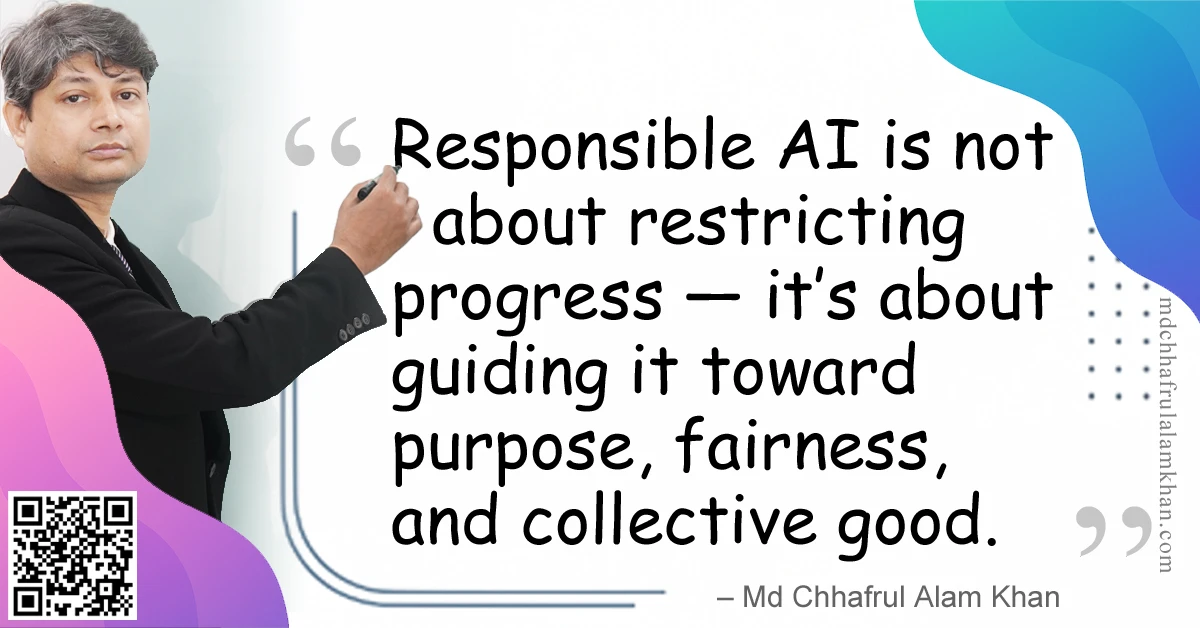
“Responsible AI is not about restricting progress — it’s about guiding it toward purpose, fairness, and collective good.”
– Md Chhafrul Alam Khan
🔹 Overview
Responsible AI Development ensures that Artificial Intelligence systems are designed, deployed, and managed in ways that benefit humanity while minimizing harm.
It is the practice of aligning innovation with ethics, combining technological excellence with moral responsibility.
As AI becomes integral to governance, business, and daily life, responsible frameworks protect people from bias, misinformation, inequality, and misuse — while empowering innovation that strengthens society.
This article provides a complete encyclopedia-style guide to Responsible AI: definitions, global frameworks, key principles, industry practices, and reader benefits — all designed to help organizations, leaders, and individuals implement ethical intelligence across the world.
🔹 1. What Is Responsible AI?
Responsible Artificial Intelligence refers to the set of principles, policies, and processes that ensure AI systems are:
- Ethical: Fair, transparent, and unbiased.
- Safe: Reliable, secure, and resilient.
- Accountable: Governed by clear rules and human oversight.
- Inclusive: Accessible and beneficial to all people, cultures, and communities.
“AI must not only be intelligent — it must also be just.” — Md Chhafrul Alam Khan (RAJ)
🔹 2. Why Responsible AI Matters
| Reason | Impact |
|---|---|
| Trust | Builds public confidence in AI systems and organizations. |
| Accountability | Ensures humans remain responsible for outcomes. |
| Fairness | Reduces bias and discrimination in automated decisions. |
| Sustainability | Encourages energy-efficient and eco-conscious models. |
| Global Stability | Prevents misuse in warfare, misinformation, and surveillance. |
Responsible AI is not a limitation; it is the foundation for sustainable progress.
🔹 3. The Core Principles of Responsible AI
| Principle | Description | Example |
|---|---|---|
| Transparency | AI decisions must be explainable and documented. | Model cards, algorithmic logs |
| Fairness & Equity | No group should face discrimination. | Removing demographic bias in hiring AI |
| Accountability | Humans must remain legally and ethically responsible. | CEO/Developer liability for system errors |
| Privacy & Security | Protect user data and maintain confidentiality. | GDPR-compliant data pipelines |
| Reliability & Safety | Systems must be robust and fail-safe. | Red-teaming before public launch |
| Inclusivity | Represent diverse data, languages, and perspectives. | Multilingual AI assistants |
| Sustainability | Minimize computational and environmental footprint. | Green AI initiatives |
🔹 4. Global Responsible AI Frameworks
| Framework | Organization | Key Focus |
|---|---|---|
| OECD AI Principles (2023) | OECD | Transparency, accountability, fairness |
| UNESCO AI Ethics Recommendation (2021) | UNESCO | Human rights, peace, cultural diversity |
| EU AI Act (2025) | European Union | Risk-based compliance & safety categories |
| NIST AI Risk Management Framework (2023) | United States | Standards for trustworthy AI systems |
| GPAI (Global Partnership on AI) | Multinational | Collaborative AI governance |
| ISO/IEC 42001 (2024) | ISO Standards | Organizational AI management certification |
These frameworks help governments and industries design policies that promote safe innovation and international alignment.
🔹 5. Industry Implementation Strategies
- Ethical Review Committees:
Companies establish boards to evaluate project risks and biases. - Model Documentation (“Model Cards”):
Include data sources, purpose, and known limitations. - Algorithmic Impact Assessments (AIA):
Measure social and ethical impacts before deployment. - Bias Testing Pipelines:
Automatically flag data imbalances during training. - Human-in-the-Loop (HITL) Controls:
Maintain human oversight in decision-making processes. - Transparent Communication:
Clearly disclose when content or interaction is AI-generated.
🔹 6. Reader Benefits
- Professional Growth: Understand how ethical AI improves career credibility.
- Strategic Insight: Apply frameworks to build safer AI systems or products.
- Legal Readiness: Stay compliant with global standards and upcoming regulations.
- Social Leadership: Promote fairness and inclusion in innovation.
- Long-Term Vision: Learn how responsible AI drives sustainable transformation.
Readers who apply these frameworks can lead the world toward technology with conscience.
🔹 7. The Lifecycle of Responsible AI
| Stage | Responsibility |
|---|---|
| Design | Embed fairness, safety, and user-centric values. |
| Development | Use verified datasets and bias-testing tools. |
| Deployment | Monitor outputs for unintended effects. |
| Operation | Collect feedback, perform audits, retrain responsibly. |
| Decommissioning | Retire outdated or unsafe models safely. |
This lifecycle ensures that ethics are maintained from prototype to production.
🔹 8. Challenges in Responsible AI
- Ambiguous Accountability: Who is responsible — developer, company, or regulator?
- Hidden Bias: Even diverse datasets can contain cultural imbalances.
- Economic Pressure: Startups may prioritize speed over safety.
- Global Disparity: Ethics standards vary by country.
- AI Arms Race: Rapid innovation may outpace regulation.
Solutions require cooperation between engineers, ethicists, and lawmakers.
🔹 9. The Future of Ethical Innovation
- AI Ethics-as-a-Service (EaaS): Third-party audits for AI ethics compliance.
- Explainable-by-Design Systems: Algorithms that justify every decision.
- Cultural AI Models: Built with inclusive, multilingual data.
- AI Accountability Laws: Clear penalties for misuse or negligence.
- Sustainability Mandates: Energy metrics included in AI performance KPIs.
The future of AI will be measured not only in intelligence — but in integrity.
🔹 Quick Glossary
- Responsible AI: AI developed and deployed ethically and transparently.
- Bias Audit: Evaluation to detect and mitigate unfair outcomes.
- Explainability: Ability to interpret AI decisions.
- Algorithmic Impact Assessment: Pre-launch ethics evaluation.
- Human-in-the-Loop (HITL): Human oversight in AI decision-making.
🔹 References
- OECD (2023) AI Principles for Responsible Innovation
- UNESCO (2021) Ethics of Artificial Intelligence
- EU AI Act (2025) Regulatory Overview
- NIST (2023) AI Risk Management Framework
- ISO/IEC 42001 (2024) AI Governance Standard
🧭 Related Articles
- Ethics of Generative AI — Truth, Consent, and Creativity
- AI and Copyright — Who Owns AI-Generated Content?
- AI and Law — Global Regulations Shaping Digital Intelligence
- What Is Artificial Intelligence (AI)? — The Complete Definitive Guide
- AI and Sustainability — Building a Greener Digital Future
Boost Your Knowledge & Skills 🚀
Digital Marketing Encyclopedia: The Complete Reference to Every Concept, Channel, and Strategy in Digital Marketing
You might like↴
- Artificial Intelligence in Marketing
- Prompt Engineering: The Art and Science of Talking to AI
- Instruction-Based Prompts: Mastering Clear Communication with AI
- Role-Playing Prompts: Unlocking Creative AI Interactions
- Few-Shot Prompts: Enhancing AI Performance with Context
- How to Become a Prompt Engineer: The Ultimate Guide
- Complete List of Prompt Engineering Job Titles
- AI Content Strategist Job Description | Skills, Salary & Career Outlook
- How to Become an AI Content Strategist
- AI Model Fine-Tuning Engineer Job Description | Skills, Salary & Career Outlook
- How to Become an AI Model Fine-Tuning Engineer
- Prompt Engineering Manager Job Description | Skills, Salary & Career Outlook
- How to Become a Prompt Engineering Manager
- Director of Prompt Engineering Job Description | Skills, Salary & Career Outlook
- How to Become a Director of Prompt Engineering
- AI Research Scientist Job Description | Skills, Salary & Career Outlook
- How to Become an AI Research Scientist
- VP of AI Experience Job Description | Skills, Salary & Career Outlook
- How to Become a VP of AI Experience
- Chief AI Interaction Officer Job Description | Skills, Salary & Career Outlook
- How to Become a Chief AI Interaction Officer
- Chief AI Officer Job Description | Skills, Salary & Career Outlook
- How to Become a Chief AI Officer
- Legal Prompt Engineer Job Description | Skills, Salary & Career Outlook
- How to Become a Legal Prompt Engineer
- Healthcare AI Prompt Engineer Job Description | Skills, Salary & Career Outlook
- How to Become a Healthcare AI Prompt Engineer
- Financial AI Prompt Developer Job Description | Skills, Salary & Career Outlook
- How to Become a Financial AI Prompt Developer
- Gaming AI Narrative Engineer Job Description | Skills, Salary & Career Outlook
- How to Become a Gaming AI Narrative Engineer
- E-commerce AI Content Engineer Job Description | Skills, Salary & Career Outlook
- How to Become an E-commerce AI Content Engineer
- Types of Prompts: Unlock Your Creativity with 80 Inspiring Categories for Every Thought, Reflection, and Imagination
- Is Artificial Intelligence Advancing Too Fast for Society to Keep Up?
- AI Encyclopedia
- What Is Artificial Intelligence (AI)?
- AI vs Machine Learning vs Deep Learning
- Generative AI
- Large Language Models (LLMs)
- Ethics of Generative AI
- AI and Copyright Ownership
- Responsible AI Development Frameworks
- AI and Law — Global Regulations
- AI and Human Rights — Ensuring Dignity in the Age of Automation
- AI and Society — Human-Centered Future
- AI and Education — Transforming Learning
- AI and the Future of Work — Jobs and Skills
- Search Ecosystem Optimization: Strategy & Discovery Framework
Leave a Reply