
🌍 The Artificial Intelligence Encyclopedia
⚖️ AI and Law — Global Regulations Shaping Digital Intelligence

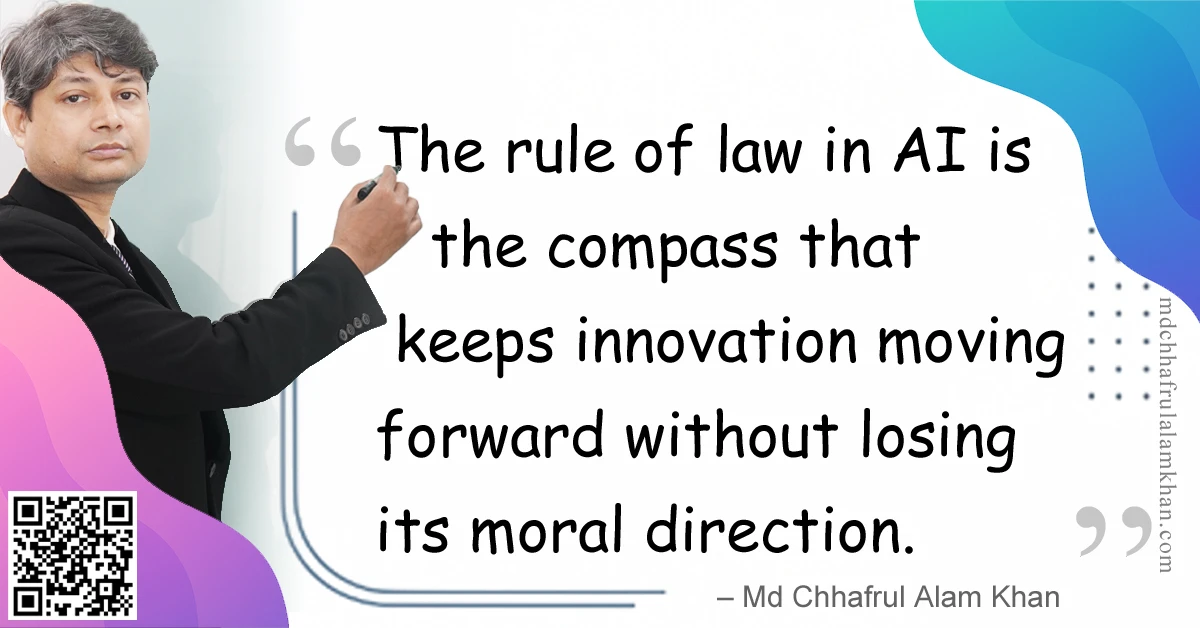
“The rule of law in AI is the compass that keeps innovation moving forward without losing its moral direction.”
– Md Chhafrul Alam Khan
🔹 Overview
As Artificial Intelligence becomes the backbone of global economies and societies, lawmakers are racing to define how it should be governed. From data privacy to algorithmic transparency, nations are creating frameworks that balance innovation with accountability.
This article provides a comprehensive overview of AI-related laws, regulations, and global governance trends, helping readers understand how different regions regulate digital intelligence — and how organizations and individuals can stay compliant in a rapidly changing legal landscape.
🔹 1. The Need for AI Regulation
AI laws are emerging for one simple reason: power without principles invites misuse.
Without clear legal boundaries, AI could cause:
- Biased decisions in employment, finance, and justice.
- Privacy violations through mass data collection.
- Deepfakes and misinformation threats to democracy.
- Economic disruption without worker protection.
“Law gives technology its conscience.” — Md Chhafrul Alam Khan (RAJ)
Regulation ensures AI development remains trustworthy, transparent, and human-centered.
🔹 2. The Global Landscape of AI Regulation
| Region | Law / Framework | Key Features |
|---|---|---|
| European Union (EU) | EU Artificial Intelligence Act (2025) | World’s first comprehensive AI law. Classifies AI by risk levels — unacceptable, high, limited, minimal. Enforces transparency, human oversight, and fines for noncompliance. |
| United States (US) | AI Bill of Rights (2023) and Executive Order on Safe, Secure AI (2025) | Focuses on data privacy, algorithmic discrimination, and safety. Encourages innovation through voluntary frameworks like NIST. |
| United Kingdom (UK) | Pro-Innovation AI Regulation Framework (2024) | Sector-based regulation emphasizing flexibility and innovation over strict compliance. |
| China | Generative AI Regulation (2023) and Cybersecurity Law | Requires content alignment with socialist values, real-identity verification, and government registration of AI tools. |
| Canada | Artificial Intelligence and Data Act (AIDA) | Balances innovation with harm prevention, particularly for high-impact systems. |
| Japan & South Korea | Guidelines on AI Utilization and Human Rights (2024) | Voluntary ethical standards with strong government oversight. |
| India | Digital India AI Policy (2025) | Focus on responsible innovation, data localization, and inclusive access. |
| Australia | Responsible AI Action Plan | Emphasizes human rights, transparency, and indigenous inclusion. |
🔹 3. Key Legal Principles Across Nations
⚖️ Human Oversight
AI must always remain under human control — no fully autonomous decision-making in critical domains.
🔍 Transparency and Explainability
Developers must disclose how models work, which data they use, and how decisions are made.
🔐 Data Protection
AI must comply with privacy laws such as GDPR (Europe) or CCPA (California).
📊 Accountability
Companies are liable for damage caused by their AI systems — civil, consumer, and employment laws apply.
🌍 International Cooperation
Cross-border data transfers, model training, and AI deployment require global standards to avoid fragmentation.
🔹 4. Landmark Cases & Legal Debates
| Case / Issue | Description | Outcome / Trend |
|---|---|---|
| Zarya of the Dawn (US, 2023) | AI-generated images denied copyright protection. | Reinforced “human authorship” requirement. |
| COMPAS Algorithm Bias (US) | Predictive policing tool accused of racial bias. | Sparked calls for algorithmic transparency laws. |
| GDPR Enforcement (EU) | Multiple AI companies fined for improper data use. | Stronger consent and deletion policies mandated. |
| Deepfake Regulation (China, 2023) | Criminalized malicious synthetic media. | Global trend toward digital authenticity laws. |
| EU AI Liability Directive (2025) | Establishes liability rules for AI-related harm. | Clarifies accountability for developers and users. |
🔹 5. Emerging International Initiatives
- GPAI (Global Partnership on AI) — 29 nations collaborating on ethical and sustainable AI governance.
- UNESCO Global AI Ethics Recommendation (2021) — Sets human rights as the core of AI policy.
- OECD AI Principles (2023) — Framework adopted by 50+ countries.
- WIPO (World Intellectual Property Organization) — Drafting rules for AI and intellectual property.
- UN AI Governance Summit (2025) — Proposed creation of an International AI Council to monitor compliance globally.
🔹 6. Reader Benefits
- Legal Awareness: Understand international laws governing AI.
- Compliance Readiness: Build AI products aligned with global standards.
- Policy Insight: Anticipate how upcoming regulations affect industries.
- Ethical Confidence: Apply laws to ensure responsible innovation.
- Career Advancement: Gain literacy in AI law — one of the fastest-growing professions of the decade.
Knowing the law of AI empowers innovators to create without fear, and protect without bias.
🔹 7. Challenges in Global AI Regulation
- Fragmentation: Different laws across countries cause compliance complexity.
- Innovation Risk: Overregulation may slow startups and researchers.
- Jurisdictional Conflicts: AI systems operate globally; laws remain local.
- Enforcement Gaps: Small nations may lack resources to regulate effectively.
- Ethical Relativism: Cultural differences shape what “responsible” means.
Future governance must focus on collaboration, not competition.
🔹 8. The Future of AI Law
- Global AI Charter: A unified declaration defining digital rights and AI responsibilities.
- AI Liability Insurance: Protects organizations from AI-caused damages.
- Algorithmic Passports: Legal certificates validating safety and transparency.
- Cross-Border Data Treaties: Standardized international data flow agreements.
- AI Justice Systems: Court tools for digital evidence, bias auditing, and automated compliance checks.
The next decade will see the birth of a new legal field: Digital Jurisprudence — where technology and justice evolve together.
🔹 Quick Glossary
- AI Act: Legal framework governing AI development and use.
- Algorithmic Accountability: Holding AI creators responsible for outcomes.
- Explainability: Legal requirement to justify AI decisions.
- Deepfake Regulation: Laws targeting synthetic media misuse.
- Cross-Border Data Flow: Movement of AI-related data between nations.
🔹 References
- European Parliament (2025) EU AI Act Official Text
- White House (2025) Executive Order on Safe, Secure AI
- UNESCO (2021) Ethics of AI Recommendation
- OECD (2023) AI Principles and Governance Toolkit
- WIPO (2024) AI and Intellectual Property Policy Report
🧭 Related Articles
- Responsible AI Development — Frameworks for Ethical Innovation
- Ethics of Generative AI — Truth, Consent, and Creativity
- AI and Copyright — Who Owns AI-Generated Content?
- What Is Artificial Intelligence (AI)? — The Complete Definitive Guide
- AI and Human Rights — Ensuring Dignity in the Age of Automation
Boost Your Knowledge & Skills 🚀
Digital Marketing Encyclopedia: The Complete Reference to Every Concept, Channel, and Strategy in Digital Marketing
You might like↴
- Artificial Intelligence in Marketing
- Prompt Engineering: The Art and Science of Talking to AI
- Instruction-Based Prompts: Mastering Clear Communication with AI
- Role-Playing Prompts: Unlocking Creative AI Interactions
- Few-Shot Prompts: Enhancing AI Performance with Context
- How to Become a Prompt Engineer: The Ultimate Guide
- Complete List of Prompt Engineering Job Titles
- AI Content Strategist Job Description | Skills, Salary & Career Outlook
- How to Become an AI Content Strategist
- AI Model Fine-Tuning Engineer Job Description | Skills, Salary & Career Outlook
- How to Become an AI Model Fine-Tuning Engineer
- Prompt Engineering Manager Job Description | Skills, Salary & Career Outlook
- How to Become a Prompt Engineering Manager
- Director of Prompt Engineering Job Description | Skills, Salary & Career Outlook
- How to Become a Director of Prompt Engineering
- AI Research Scientist Job Description | Skills, Salary & Career Outlook
- How to Become an AI Research Scientist
- VP of AI Experience Job Description | Skills, Salary & Career Outlook
- How to Become a VP of AI Experience
- Chief AI Interaction Officer Job Description | Skills, Salary & Career Outlook
- How to Become a Chief AI Interaction Officer
- Chief AI Officer Job Description | Skills, Salary & Career Outlook
- How to Become a Chief AI Officer
- Legal Prompt Engineer Job Description | Skills, Salary & Career Outlook
- How to Become a Legal Prompt Engineer
- Healthcare AI Prompt Engineer Job Description | Skills, Salary & Career Outlook
- How to Become a Healthcare AI Prompt Engineer
- Financial AI Prompt Developer Job Description | Skills, Salary & Career Outlook
- How to Become a Financial AI Prompt Developer
- Gaming AI Narrative Engineer Job Description | Skills, Salary & Career Outlook
- How to Become a Gaming AI Narrative Engineer
- E-commerce AI Content Engineer Job Description | Skills, Salary & Career Outlook
- How to Become an E-commerce AI Content Engineer
- Types of Prompts: Unlock Your Creativity with 80 Inspiring Categories for Every Thought, Reflection, and Imagination
- Is Artificial Intelligence Advancing Too Fast for Society to Keep Up?
- AI Encyclopedia
- What Is Artificial Intelligence (AI)?
- AI vs Machine Learning vs Deep Learning
- Generative AI
- Large Language Models (LLMs)
- Ethics of Generative AI
- AI and Copyright Ownership
- Responsible AI Development Frameworks
- AI and Law — Global Regulations
- AI and Human Rights — Ensuring Dignity in the Age of Automation
- AI and Society — Human-Centered Future
- AI and Education — Transforming Learning
- AI and the Future of Work — Jobs and Skills
- Search Ecosystem Optimization: Strategy & Discovery Framework
Leave a Reply