
🌍 The Artificial Intelligence Encyclopedia
🌍 AI and Society — Building a Human-Centered Digital Future

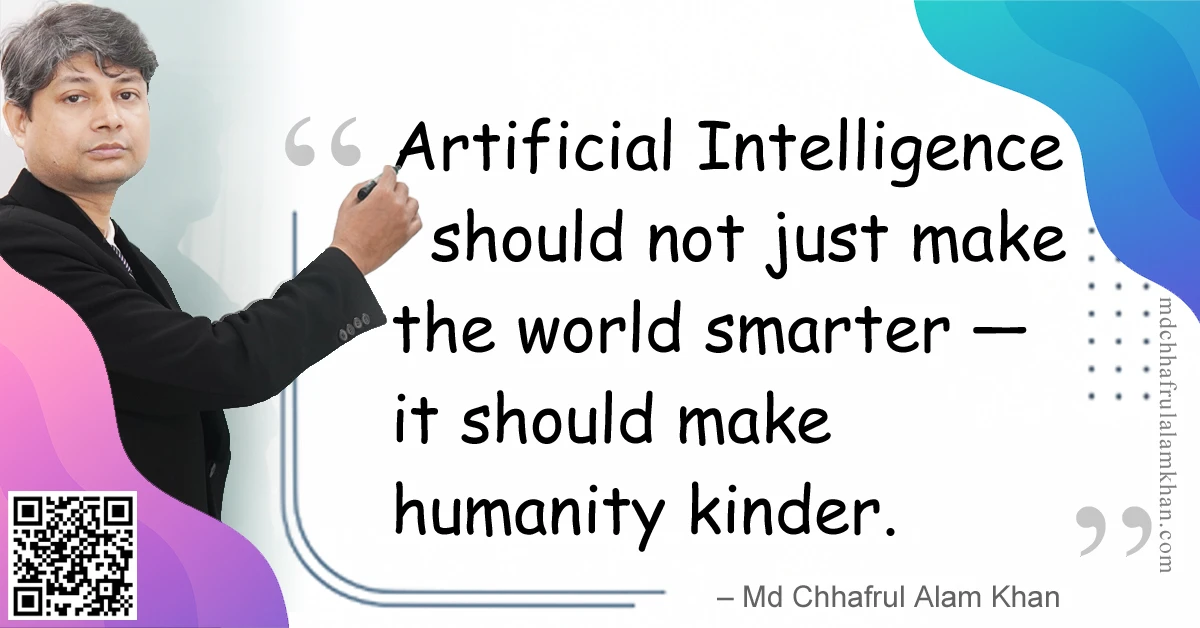
“Artificial Intelligence should not just make the world smarter — it should make humanity kinder.”
– Md Chhafrul Alam Khan
🔹 Overview
Artificial Intelligence (AI) is not just a technological revolution — it’s a social transformation.
From how we learn, work, communicate, and create, AI is rewriting the patterns of daily life. Yet the question remains: will this transformation serve people or control them?
AI and Society explores how we can design, deploy, and adapt AI in ways that strengthen communities, promote inclusion, protect values, and empower humanity.
This article provides a 360° perspective on the societal impacts of AI — highlighting opportunities, challenges, and the collective responsibility to ensure that technology enhances human well-being rather than diminishing it.
🔹 1. The Relationship Between AI and Society
AI systems are now embedded in every layer of civilization — from public health to governance, from agriculture to art.
They influence opinions, automate industries, and even help shape democracy.
But technology is never neutral:
“AI reflects the values of those who build it — and affects the lives of those who use it.” — Md Chhafrul Alam Khan (RAJ)
To build a better society, AI must align with human values, cultural diversity, and social fairness.
🔹 2. Positive Impacts of AI on Society
| Area | Transformation | Benefit |
|---|---|---|
| Healthcare | Predictive diagnosis, telemedicine, drug discovery | Health equity, early disease prevention |
| Education | Personalized learning, AI tutors, universal access | Inclusive and scalable education |
| Agriculture | Precision farming, climate prediction | Food security and sustainability |
| Public Safety | Disaster management, emergency detection | Lives saved through proactive systems |
| Economy | Automation and optimization | Efficiency and new job opportunities |
| Environment | Smart grids, pollution tracking | Climate action and resource conservation |
| Accessibility | Voice assistants, captioning, translation | Empowerment of persons with disabilities |
AI has the power to democratize opportunity if applied ethically and inclusively.
🔹 3. Challenges and Social Risks
| Challenge | Description | Example |
|---|---|---|
| Job Displacement | Automation replacing repetitive human roles | Factory or call-center jobs automated |
| Inequality | Tech-rich countries outpacing developing nations | Global digital divide |
| Bias & Discrimination | Data reflecting societal prejudice | Hiring or credit bias |
| Surveillance & Privacy | AI-powered mass monitoring | Facial recognition misuse |
| Misinformation | Deepfakes and fake news | Trust erosion in democracy |
| Cultural Homogenization | Western AI dominance in language and culture | Local identity loss |
The challenge is not just what AI can do, but how we choose to use it.
🔹 4. Human-Centered AI — The Path Forward
Human-Centered AI (HCAI) ensures that systems are designed around human needs, values, and experiences.
Key Principles of HCAI
- Empathy by Design: Technology must understand human emotion and context.
- Accessibility for All: No one should be excluded from the AI revolution.
- Transparency: Systems must be explainable and accountable.
- Collaboration: Humans and AI must complement each other’s strengths.
- Sustainability: Minimize environmental footprint.
“Human-centered AI doesn’t replace people; it amplifies their purpose.” — Md Chhafrul Alam Khan (RAJ)
🔹 5. The Role of Culture and Education
To make AI beneficial to society, digital literacy and ethical education are essential.
- Schools should teach AI ethics, data literacy, and responsible creativity.
- Cultural preservation programs should use AI to protect languages, art, and history.
- Governments must support AI literacy initiatives for all citizens.
When people understand AI, they stop fearing it — and start shaping it.
🔹 6. Reader Benefits
- Civic Awareness: Understand how AI affects social justice, equality, and governance.
- Empowerment: Learn to participate actively in shaping AI-driven societies.
- Cultural Appreciation: Use AI to preserve diversity rather than erase it.
- Innovation Leadership: Apply AI for social good, sustainability, and inclusion.
- Future Readiness: Prepare for the next digital era through knowledge and ethics.
Readers become digital citizens — informed, empowered, and responsible in the age of AI.
🔹 7. Global Initiatives for AI and Society
| Initiative | Led By | Objective |
|---|---|---|
| UNESCO AI for Society Program | UNESCO | Promote inclusive, sustainable AI development |
| AI for Good Summit | ITU & UN | Collaboration for global humanitarian AI use |
| GPAI (Global Partnership on AI) | OECD Countries | Shared research on AI’s societal impact |
| AI for Humanity Declaration | France | Ethical AI for democracy and education |
| AI4SDGs (AI for Sustainable Development Goals) | UNDP | AI as a tool to achieve global goals |
These global movements prove that AI’s true potential lies in collective benefit, not competition.
🔹 8. The Future — Society in the Age of Intelligence
The next phase of civilization will be co-intelligent, not just intelligent.
- AI Citizens: Human-like digital entities contributing to service and creativity.
- Participatory Governance: AI-driven transparency in policymaking.
- Digital Empathy Systems: AI that understands emotion and context.
- Collaborative Creativity: Artists and AIs co-authoring culture.
- Ethical Automation: Balancing efficiency with compassion.
“The future society will not be ruled by machines — it will be guided by wisdom.” — Md Chhafrul Alam Khan (RAJ)
🔹 Quick Glossary
- Human-Centered AI (HCAI): Design philosophy prioritizing human welfare and dignity.
- Digital Citizenship: Responsible and ethical participation in the digital ecosystem.
- Algorithmic Bias: Unfair outcomes resulting from skewed training data.
- AI for Good: Global movement using AI to achieve social and humanitarian goals.
- Digital Divide: The gap between those with and without access to modern technology.
🔹 References
- UNESCO (2021) Recommendation on the Ethics of Artificial Intelligence
- United Nations (2025) AI for Sustainable Development Reports
- OECD (2023) AI and Society Policy Framework
- Stanford HAI (2024) Human-Centered AI Initiative
- World Economic Forum (2024) Future of Jobs & AI Impact Report
🧭 Related Articles
- AI and Human Rights — Ensuring Dignity in the Age of Automation
- Responsible AI Development — Frameworks for Ethical Innovation
- What Is Artificial Intelligence (AI)? — The Complete Definitive Guide
- AI and Education — Transforming Learning for the Next Generation
- AI and Culture — Preserving Diversity in a Digital World
Boost Your Knowledge & Skills 🚀
Digital Marketing Encyclopedia: The Complete Reference to Every Concept, Channel, and Strategy in Digital Marketing
You might like↴
- Artificial Intelligence in Marketing
- Prompt Engineering: The Art and Science of Talking to AI
- Instruction-Based Prompts: Mastering Clear Communication with AI
- Role-Playing Prompts: Unlocking Creative AI Interactions
- Few-Shot Prompts: Enhancing AI Performance with Context
- How to Become a Prompt Engineer: The Ultimate Guide
- Complete List of Prompt Engineering Job Titles
- AI Content Strategist Job Description | Skills, Salary & Career Outlook
- How to Become an AI Content Strategist
- AI Model Fine-Tuning Engineer Job Description | Skills, Salary & Career Outlook
- How to Become an AI Model Fine-Tuning Engineer
- Prompt Engineering Manager Job Description | Skills, Salary & Career Outlook
- How to Become a Prompt Engineering Manager
- Director of Prompt Engineering Job Description | Skills, Salary & Career Outlook
- How to Become a Director of Prompt Engineering
- AI Research Scientist Job Description | Skills, Salary & Career Outlook
- How to Become an AI Research Scientist
- VP of AI Experience Job Description | Skills, Salary & Career Outlook
- How to Become a VP of AI Experience
- Chief AI Interaction Officer Job Description | Skills, Salary & Career Outlook
- How to Become a Chief AI Interaction Officer
- Chief AI Officer Job Description | Skills, Salary & Career Outlook
- How to Become a Chief AI Officer
- Legal Prompt Engineer Job Description | Skills, Salary & Career Outlook
- How to Become a Legal Prompt Engineer
- Healthcare AI Prompt Engineer Job Description | Skills, Salary & Career Outlook
- How to Become a Healthcare AI Prompt Engineer
- Financial AI Prompt Developer Job Description | Skills, Salary & Career Outlook
- How to Become a Financial AI Prompt Developer
- Gaming AI Narrative Engineer Job Description | Skills, Salary & Career Outlook
- How to Become a Gaming AI Narrative Engineer
- E-commerce AI Content Engineer Job Description | Skills, Salary & Career Outlook
- How to Become an E-commerce AI Content Engineer
- Types of Prompts: Unlock Your Creativity with 80 Inspiring Categories for Every Thought, Reflection, and Imagination
- Is Artificial Intelligence Advancing Too Fast for Society to Keep Up?
- AI Encyclopedia
- What Is Artificial Intelligence (AI)?
- AI vs Machine Learning vs Deep Learning
- Generative AI
- Large Language Models (LLMs)
- Ethics of Generative AI
- AI and Copyright Ownership
- Responsible AI Development Frameworks
- AI and Law — Global Regulations
- AI and Human Rights — Ensuring Dignity in the Age of Automation
- AI and Society — Human-Centered Future
- AI and Education — Transforming Learning
- AI and the Future of Work — Jobs and Skills
- Search Ecosystem Optimization: Strategy & Discovery Framework
Leave a Reply