
On-Page SEO Fundamentals↴
Core HTML & Metadata Optimization
>Title Tag Optimization
>Meta Description Optimization
>Meta Robots Tag Optimization
>Canonical URL Optimization
>Meta Charset Tag Optimization
>Viewport Meta Tag Optimization
Heading Structure Optimization
>Heading Tag H1 Optimization
>Heading Tags H2–H6 Optimization
>Heading Structure Best Practices
Content Optimization
>Keyword Targeting in Content
>Content Structure & Readability
>Content Depth & Word Count
>Multimedia Optimization
>Content Freshness & Updates
Internal Linking Optimization
>Internal Link Structure
>Anchor Text Optimization
>Fixing Orphan Pages
URL & Slug Optimization
Image Optimization
>Image File Naming for SEO
>Image Compression & Formats
>Image Alt Text & Title Attributes
Schema Markup & Structured Data
>Schema Markup Overview
>Common Schema Types
>Testing & Validating Schema
External & Outbound Links
>Outbound Link Quality & Relevance
>Nofollow, Sponsored & UGC Attributes
Page Experience & Engagement
>Core Web Vitals Optimization
>Mobile Friendliness
>Accessibility Standards for SEO
Crawl & Indexing Controls (On-Page)
>Robots Meta Tag Usage
>Pagination SEO
>Hreflang Implementation
⭐ The Ultimate Universal Content Creation Master Checklist (2025–2030): How to Create High-Ranking Content for SEO, AI Search, and Social Search

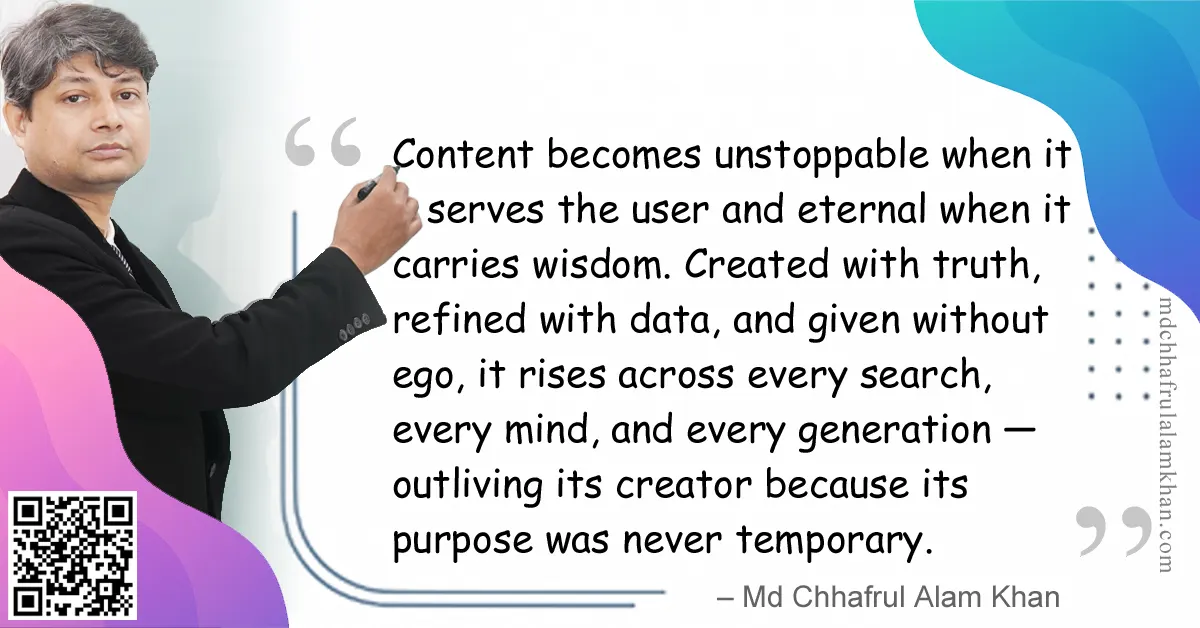
“Content becomes unstoppable when it serves the user and eternal when it carries wisdom. Created with truth, refined with data, and given without ego, it rises across every search, every mind, and every generation — outliving its creator because its purpose was never temporary.”
– Md Chhafrul Alam Khan
The world’s most complete, future-proof checklist for creating content that ranks, engages, converts, and wins across all search ecosystems.
Introduction
Content today exists in a world where search behavior has changed forever.
People search on Google, YouTube, TikTok, Pinterest, Reddit, Amazon — and increasingly through AI platforms like ChatGPT, Gemini, Claude, Meta AI, and voice assistants such as Siri and Alexa.
Creating content is no longer just about keywords or long paragraphs.
It’s about building indexable, visible, AI-friendly, user-focused content that performs everywhere.
This pillar checklist is designed to be your complete guide — covering pre-writing, writing, optimization, UX, authority, conversion, AI readiness, and long-term performance monitoring.
Use this checklist for:
- Blog articles
- Service pages
- Landing pages
- Product descriptions
- Tutorials
- How-to guides
- Social content scripts
- Generative AI-friendly content
This is your 2025–2030 standard for content that outranks competitors, earns featured snippets, appears in AI summaries, and drives conversions.
🔵 SECTION 1 — Pre-Writing Research Ecosystem
Before writing a single word, set your foundation with strong research.
1.1 Determine User Intent
Understanding intent ensures your content satisfies exactly what the user wants.
- Informational
- Commercial / comparative
- Transactional / buyer-intent
- Navigational
- Problem–Solution
- How-to
- Beginner–Advanced
- Conversational / GAI-style intent
1.2 Audience Persona Research
Profile your readers properly:
- Level of expertise
- Emotional triggers and motivations
- What they expect on SERP and AI platforms
- Demographic & psychographic data
- Key pain points
- Desired outcomes
- Buying or decision behavior
1.3 Multi-Ecosystem Keyword Research
Your keyword research must include:
- Google Search
- Bing Search
- YouTube Search
- TikTok Search
- Reddit Search
- Pinterest Search
- ChatGPT, Gemini, Claude, Perplexity queries
- Voice search variations
- Amazon search (if product-based)
Keyword sets to prepare:
- Primary keywords
- Secondary keywords
- LSI keywords
- Semantic clusters
- Long-tail keywords
- Conversational and natural language keywords
- “Answer keywords” (What/Why/How/When)
- Emotional/story-based keywords
- GAI-triggered prompt-style queries
1.4 Content Type Selection
Choose the most effective format:
- Blog article
- How-to guide
- Case study
- Video script
- Infographic
- Landing page
- Service page
- Social carousel
- Whitepaper
- Q&A conversational piece
1.5 Outline Creation
Your outline should include:
- Title
- H1
- Complete H2–H6 hierarchy
- Key points for each section
- Example and scenario placements
- CTA positions
- FAQ section
- Tables, lists, diagrams
1.6 Resource & Workflow Planning
Clarify:
- Roles (writer, editor, designer)
- Tools required (SEO, AI, analytics, design)
- Time estimate
- Budget (optional)
🔥 SECTION 2 — Structural SEO Requirements
Structure is the backbone of performance.
2.1 Title Optimization
- Unique
- Benefit-driven
- Under ~51 characters
- Primary keyword included
- Emotional or curiosity angle
- Human-friendly
2.2 URL Slug
- Short
- Hyphenated
- Keyword included
- No unnecessary words
2.3 Meta Description
- 140–155 characters
- Primary keyword included
- Clear and actionable
- Benefit-based value hook
2.4 Essential Meta Tags
- OG Title
- OG Description
- OG Image
- Twitter card tags
- Article schema in JSON-LD
🔥 SECTION 3 — On-Page Content Optimization
3.1 Heading & Content Architecture
- Unique H1 with main keyword
- Strong, keyword-supported first sentence
- Logical H2–H6 hierarchy
- Each H2 followed by a 155+ character paragraph
- Each section should answer What, Why, How
- Add depth under H3/H4 (examples, frameworks, steps)
3.2 Keyword Density Standards
- Primary keyword: ≈ 1.5%–3% (ideal: 2.9–3.1%)
- Secondary keywords: 1%–2.5%
- LSI keywords: natural usage
- Focus keyphrase: used naturally
- Strictly avoid keyword stuffing
3.3 Section-Level Requirements
Include:
- Definitions
- Importance
- Steps or frameworks
- Real examples
- Use-cases
- Mistakes
- Pro insights
🔥 SECTION 4 — Generative AI Optimization (GAIO)
Optimizing for AI platforms is now essential.
4.1 Core Requirements for AI Visibility
- Clear, direct statements
- Short answer summaries
- Q&A-style subheadings
- Problem → solution logic
- Conversational long-tail queries
- Bullet-based clarity for extraction
- Expert on-page signals (E-E-A-T)
- Practical examples and evidence
- Mini-conclusions after each section
4.2 Micro-Answer Blocks
Add after each major section:
- One-sentence summary
- One-sentence benefit
AI engines use these as instant responses.
4.3 Featured Snippet Block
Place near the top:
- 40–60 word clear definition or answer
- Written in simple, direct language
🔵 SECTION 5 — Social Search Optimization (SSO)
For visibility on TikTok, YouTube, Instagram, Reddit, Pinterest, LinkedIn.
Include:
- Social-friendly punchlines
- Quote-ready insights
- Emotional hooks
- Infographic-friendly bullets
- Suggested hashtags (optional)
- Short-form content ideas
🔥 SECTION 6 — Internal & External Linking Strategy
6.1 Internal Links
- Link 4–8 relevant pages
- Use meaningful anchor text
- Connect cluster → pillar pages
- Improve link depth for SEO
6.2 External Links
Link to:
- Trusted .gov / .edu sources
- Research-based authority sites
- Industry publications
- Reputable studies
Anchor text must be relevant and descriptive.
🔵 SECTION 7 — Readability, Clarity & Engagement
Ensure:
- Simple language
- Short sentences
- 2–3 line paragraphs
- Bullet points
- Active voice
- Smooth transitions
- Storytelling (when relevant)
Readability targets:
- Flesch score: 60–85
- Grade level: 6–8
🔥 SECTION 8 — UX, UI & Behavioral Optimization
- Fully mobile-responsive layout
- CTA buttons placed after major sections
- Ample spacing and padding
- Highlighted or bolded key thoughts
- Scannable formatting
Behavioral ranking signals:
- Higher scroll depth
- Increased dwell time
- Reduced bounce rate
🔵 SECTION 9 — Multimedia Optimization
Images
- Unique featured image
- Accurate, keyword-supported filename
- ALT text
- Title text
- Lightweight (<300 KB)
Videos
- Compressed and optimized
- Clear, keyword-included title
- Search-friendly description
- Attractive thumbnail
🔥 SECTION 10 — E-E-A-T (Expertise, Experience, Authority, Trust)
Include:
- Author bio
- Experience references
- Case studies
- Testimonials
- Citations
- Unique expert insights
Recommended author line:
Written by Md Chhafrul Alam Khan — Digital Growth Leader & Marketing Strategist
🔵 SECTION 11 — Answer Engine Optimization (AEO)
For:
- Google Answer Box
- Featured Snippets
- People Also Ask
- AI Overview blocks
Include:
- Direct definitions
- Step-by-step lists
- Comparison tables
- Q&A blocks
- Short summary answers
🔥 SECTION 12 — Conversion Optimization
- CTA after each major section
- Value-driven CTA text
- Trust elements near CTAs
- Internal service/product links
- Low-friction conversion paths
🔵 SECTION 13 — Content Quality Standards
Content must be:
- 100% unique
- Factually correct
- Up-to-date
- Plagiarism-free
- Human-readable
- Insight-driven
- Filled with real examples and value
🔥 SECTION 14 — Post-Writing Audit
Ask yourself:
- Is this the best content on the entire internet for this topic?
- Does it satisfy user intent completely?
- Is it GAI-friendly?
- Is it SERP-ready?
- Is it social-friendly?
- Is it technically optimized?
- Is it conversion-ready?
- Is the content scannable and engaging?
- Can this outperform all competitors?
If “no” — revise before publishing.
🔵 SECTION 15 — Publishing, Monitoring & Refinement
Publishing
- Upload to CMS
- Format spacing
- Insert media
- Add internal/external links
- Add schema
- Add featured image
- Write excerpt
Promotion
- Social media distribution
- Newsletter inclusion
- Community sharing
- Short-form repurposing
Monitoring
Track:
- Keyword rankings
- Featured snippet appearances
- AI visibility
- Scroll depth
- Time on page
- Bounce rate
- New search queries
- CTR
- Conversion data
Refinement
- Minor update every 3 months
- Major update every 6–12 months
- Add new examples, stats, FAQs
- Expand based on SERP/AI changes
⭐ Conclusion
This master checklist is a complete, future-ready, multi-ecosystem content creation blueprint.
It helps you create content that:
- Ranks on Google
- Wins featured snippets
- Appears in ChatGPT, Gemini, Claude summaries
- Performs well on TikTok, YouTube, Pinterest, and Reddit
- Converts readers into leads and buyers
- Builds long-term brand authority
This is your content empire framework for 2025–2030 and beyond.
Perfect it, use it, and dominate every search ecosystem.
Learn> >On-Page SEO >Off-Page SEO >Technical SEO >Local SEO >Next-Gen SEO
Remember:
“SEO is a journey, not a destination.”
– Md Chhafrul Alam Khan
Next Step 🚀
Master SEO from Beginner to Expert with our Free Online Self-Learning Course on SEO Mastery.
Learn> >On-Page SEO >Off-Page SEO >Technical SEO >Local SEO >Next-Gen SEO
Leave a Reply