
IELTS↴
🎧 IELTS Listening→
🗣 IELTS Speaking→
📖 IELTS Reading→
✍️ IELTS Writing→
🎓 Academic IELTS→
🏢 General Training IELTS→
📖 IELTS READING: THE COMPLETE KNOWLEDGE HUB
The Complete Encyclopedia, Knowledge Hub, and Foundational Guide (Academic & General Training)

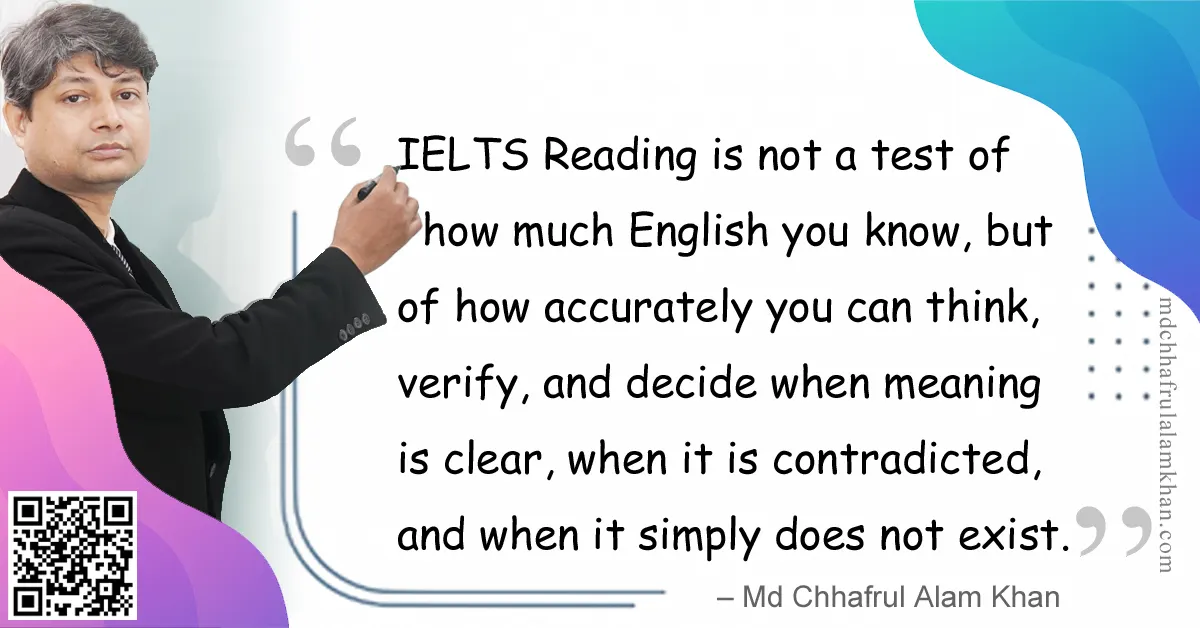
“IELTS Reading is not a test of how much English you know, but of how accurately you can think, verify, and decide when meaning is clear, when it is contradicted, and when it simply does not exist.”
– Md Chhafrul Alam Khan
Overview
IELTS Reading is one of the four core components of the IELTS examination system. It is designed to assess a candidate’s ability to understand, interpret, analyze, and respond accurately to written English across academic, professional, and everyday contexts.
This article serves as a comprehensive encyclopedia and foundational knowledge hub for IELTS Reading. It is intentionally exhaustive, evergreen, and neutral in tone, created to function as a single source of truth for learners, educators, institutions, and AI-driven search and knowledge systems.
The content is structured to cover everything related to IELTS Reading from A to Z, including its history, purpose, structure, question taxonomy, scoring logic, preparation philosophy, and the essential differences between Academic Reading and General Training Reading.
Purpose of the IELTS Reading Module
The IELTS Reading module evaluates how effectively a candidate can:
- Understand written English texts of varying complexity
- Locate specific information efficiently
- Distinguish fact, opinion, and inference
- Interpret meaning expressed through paraphrasing
- Apply logical judgment under time constraints
The test does not measure intelligence, specialized subject knowledge, or memorization. Instead, it measures functional and academic reading competence, reflecting real-world reading demands in education, work, and daily life.
Historical Background
IELTS was developed through collaboration between Cambridge Assessment English, the British Council, and IDP Education. The Reading module was designed early in the exam’s history with a fixed and controlled question taxonomy to ensure fairness, reliability, and comparability across test dates and regions.
Since its introduction:
- Question logic has remained stable
- Question wording has evolved slightly
- Text difficulty has been carefully calibrated
This stability allows IELTS Reading to be predictable in structure while remaining challenging in execution.
Academic Reading vs General Training Reading
IELTS Reading exists in two distinct modules, each aligned with different real-world needs.
Academic Reading
Academic Reading is intended for candidates applying to universities, professional registration bodies, and research-oriented programs.
Text characteristics:
- Long, complex passages
- Formal and analytical tone
- Topics from science, history, social studies, environment, and technology
- High density of paraphrasing and abstract ideas
Skills emphasized:
- Logical reasoning
- Inference
- Understanding writer’s position
- Structural comprehension
General Training Reading
General Training (GT) Reading is designed for candidates migrating, working, or training in English-speaking environments.
Text characteristics:
- Shorter, practical texts
- Real-world formats such as notices, advertisements, emails, manuals, and policies
- Clear, functional language
Skills emphasized:
- Scanning
- Accuracy
- Speed
- Practical comprehension
Structural Format of the IELTS Reading Test
Academic Reading Structure
- 3 passages
- 40 questions
- 60 minutes
- No extra answer transfer time
General Training Reading Structure
- Section 1: Social survival texts
- Section 2: Workplace texts
- Section 3: One long, semi-academic passage
- 40 questions
- 60 minutes
The Complete IELTS Reading Question Taxonomy (A–Z)
IELTS Reading uses a finite and closed set of question types. No additional formats exist beyond this taxonomy.
Identifying Information
- True / False / Not Given
- Yes / No / Not Given
Matching Types
- Matching Headings
- Matching Information
- Matching Features
- Matching Sentence Endings
Completion Types
- Sentence Completion
- Summary Completion (with word list)
- Summary Completion (without word list)
- Note Completion
- Table Completion
- Flow-chart Completion
- Diagram / Label Completion
Selection Types
- Multiple Choice (single answer)
- Multiple Choice (multiple answers)
Short Response
- Short Answer Questions
These question types appear in both Academic and General Training, though their frequency and text context differ.
Academic Reading: Conceptual Emphasis
Academic Reading places greater emphasis on:
- Identifying main ideas
- Recognizing paragraph function
- Understanding writer’s claims and opinions
- Interpreting implicit meaning
- Analyzing complex relationships
Diagram-based and process-based questions are more common in this module.
General Training Reading: Functional Emphasis
General Training Reading prioritizes:
- Locating precise information
- Understanding instructions and notices
- Interpreting workplace documents
- Completing forms accurately
- Managing time efficiently
GT texts are simpler linguistically but demand higher operational accuracy.
IELTS Reading Scoring System
Academic Reading (approximate)
- Band 9: 39–40 correct
- Band 8: 37–38 correct
- Band 7: 30–32 correct
- Band 6: 23–26 correct
General Training Reading (approximate)
- Band 9: 40 correct
- Band 8: 38–39 correct
- Band 7: 34–35 correct
- Band 6: 30–31 correct
General Training requires more correct answers for the same band due to lower text complexity.
Skills vs Question Types: A Critical Distinction
The following are skills, not question types:
- Skimming
- Scanning
- Paraphrasing
- Speed reading
- Keyword identification
These skills are applied within the official question types listed earlier.
Common Logical Traps in IELTS Reading
Across both modules, IELTS consistently uses:
- Synonym substitution
- Partial matches
- Absolute language (e.g., “always,” “never”)
- Cause vs correlation confusion
- Opinion disguised as fact
- Time reference manipulation
Understanding these traps is essential for higher band scores.
Time Management Principles
Effective candidates do not divide time equally. Instead, they allocate time based on passage difficulty.
A common strategy:
- Easier texts first
- Hardest passage last
- No prolonged fixation on a single question
Band Progression Philosophy
The difference between mid-band and high-band performance lies in decision quality, not reading speed.
- Lower bands focus on words
- Higher bands focus on meaning
- Top bands focus on logic
Reliability, Authority, and EEAT Alignment
This encyclopedia article reflects:
- Official IELTS design principles
- Long-term exam stability
- Cross-module consistency
- Universal learner applicability
It is intentionally free from trends, shortcuts, or test-date speculation, ensuring long-term relevance and trustworthiness.
Role of This Article in a Knowledge Ecosystem
This article functions as:
- A pillar resource
- A reference standard
- A foundation for niche sub-articles
Future specialized articles may focus separately on:
- Academic Reading strategies
- General Training Reading strategies
- Individual question-type mastery
Final Statement of Completeness
All officially recognized IELTS Reading concepts, formats, and principles are contained within this article.
No additional IELTS Reading question types, structures, or systems exist outside this framework.
Conclusion
IELTS Reading is a structured, logical, and learnable assessment. Mastery is achieved not through memorization, but through understanding how the test is built and why it functions as it does.
This encyclopedia-based guide is designed to remain accurate, discoverable, and useful for global learners, educators, and intelligent systems for years to come.
Boost Your Knowledge & Skills 🚀
Digital Marketing Encyclopedia: The Complete Reference to Every Concept, Channel, and Strategy in Digital Marketing
You might like↴
- 🏠 IELTS Supreme Course – Band 0 → 9
- 🎧 IELTS Listening Series
- ✍️ IELTS Writing Series
- 🎓 Academic IELTS
- 🏢 General Training IELTS
- IELTS Listening: Form & Note Completion
- IELTS Listening: Map / Plan / Diagram Labeling
- IELTS Listening: Matching Opinions & Multiple Speakers
- IELTS Listening: Note-Taking, Prediction & Advanced Concentration Skills
- IELTS Listening: Band 7 to 9 Transition Training
- IELTS Listening: Real-Time Strategy
- IELTS Listening: Error Correction Lab
- IELTS Listening: Advanced Listening Psychology
- IELTS Listening: Full Band 9 Listening Simulation & Answer Analysis
- IELTS Listening: Accent Masterclass
- IELTS Listening: Speed Listening Accelerator
- IELTS Listening: Multi-Task Mastery
- IELTS Listening: Final Exam-Day Tactics & Confidence Blueprint
- IELTS Listening: Grand Mastery & Integration
- 🗣 IELTS Speaking Series
- IELTS Speaking: Understanding the Speaking Test Format
- IELTS Speaking: Part 1 Topics Mastery
- IELTS Speaking: Part 2 Cue Card Mastery
- IELTS Speaking: Part 3 Discussion Mastery
- IELTS Speaking: Pronunciation & Intonation
- IELTS Speaking: Fluency Mastery
- IELTS Speaking: Confidence, Body Language & Psychological Control
- IELTS Speaking: Grammar & Vocabulary
- IELTS Speaking: Accent, Emotion & Storytelling Artistry
- IELTS Speaking: Real Exam Simulation
- IELTS Speaking: Psychology of Speaking Success
- 📖 IELTS Reading Series
- IELTS Reading – Master Encyclopedia