
Case Study · Product Architecture · Cross-App Ecosystem
One reusable ecosystem layer for a growing portfolio of digital products.
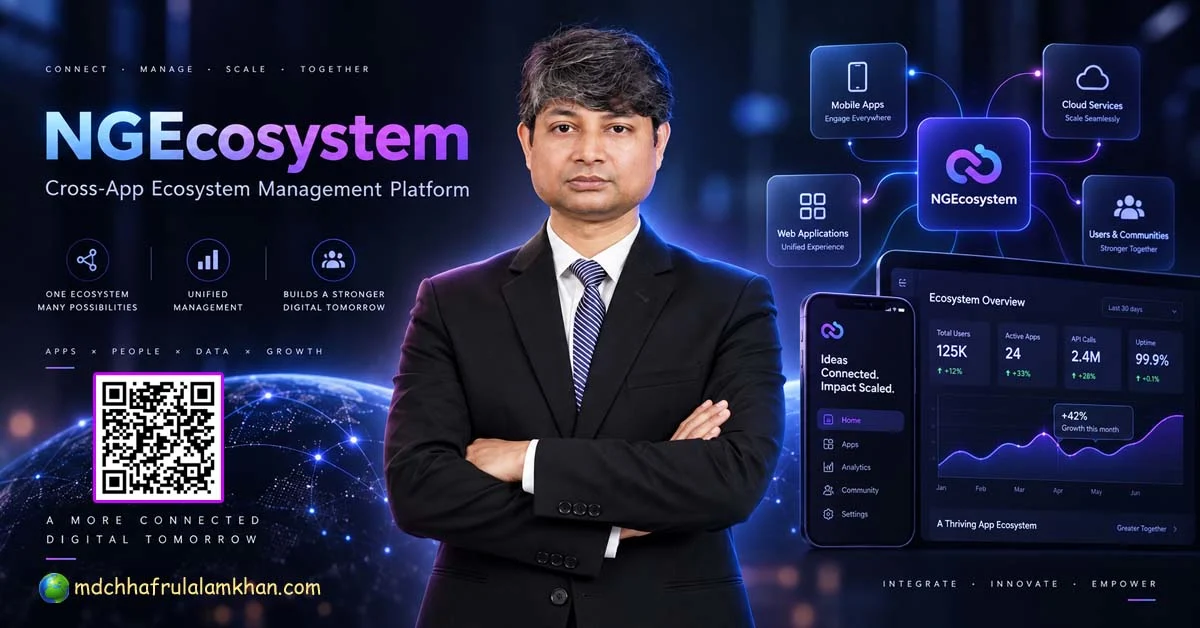
NGEcosystem is a centralized cross-app ecosystem architecture I conceived and am developing to coordinate selected shared capabilities across multiple digital products while preserving product independence, user experience, security and operational resilience.
01 · Context
Executive Summary
Managing one digital product is primarily a product problem. Managing a growing portfolio introduces a broader architectural problem: company information, developer information, product discovery, user guidance, notifications, review prompts, monetization rules, configuration, security and other recurring requirements can quickly become duplicated across applications.
I designed NGEcosystem to create a reusable coordination layer for those recurring needs. Instead of treating every application as a completely isolated system, NGEcosystem provides a foundation through which approved shared information and selected services can be governed centrally while each product retains control over its own functionality, interface and user journey.
The project brings together product strategy, software architecture, Flutter/Dart, WordPress, security, digital growth, user experience, monetization governance and project management.
02 · Problem
The Challenge
As my digital product portfolio expanded, the same operational requirements began appearing repeatedly across different applications. Implementing and maintaining each requirement separately creates unnecessary duplication and makes long-term governance increasingly difficult.
Repeated Development
The same supporting capabilities can otherwise be designed, coded, tested and maintained repeatedly.
Inconsistent Information
Company, developer or product metadata can become inconsistent across applications.
Maintenance Overhead
A simple ecosystem-wide information change may otherwise require updates to several independent products.
Fragmented Discovery
Users of one useful product may never discover another relevant product within the same ecosystem.
Governance Risk
Notifications, review prompts, monetization and remote information need consistent standards rather than isolated decisions.
Scaling Complexity
An approach that works for a few products can become difficult to operate as the portfolio grows.
03 · Strategy
The Solution: NGEcosystem
NGEcosystem is designed as a controlled coordination layer between centrally managed ecosystem information and participating digital products.
The individual applications remain independent. The architecture does not attempt to force every product into one interface or workflow. Instead, it centralizes selected information, rules and reusable capabilities where consistency creates genuine value.
Simplified Architecture Flow
04 · System Design
Architecture Overview
The architecture is based on structured administration, machine-readable configuration, client-side validation and product-specific presentation.
Management Layer
A WordPress-based administrative foundation provides a practical way to manage approved ecosystem information during the current stage of development.
Structured Configuration
Shared information can be represented through structured JSON-based manifests or API responses that participating products can validate and interpret.
Reusable Client Integration
Flutter applications can consume approved configuration through reusable logic while presentation decisions remain within each product.
Local Resilience
Remote configuration should enhance the application without making essential functionality dependent on permanent server availability.
05 · Reusable Services
Shared Ecosystem Capabilities
Identity & Product Discovery
Designed to support centrally managed company information, developer information, product metadata, official links, Recommended Apps and More Apps by the Developer.
Each application can present approved information according to its own context and interface.
User Engagement & Guidance
Establishes reusable standards for user guides, contextual sharing, review prompts and notifications without making them mandatory or intrusive.
The core product experience remains the priority.
Monetization Governance
Designed to accommodate policy-conscious advertising, relevant affiliate content and optional sponsorship capabilities.
Commercial mechanisms remain subordinate to usability, privacy, security and applicable platform policies.
06 · Defensive Architecture
Security & Resilience
Centralized configuration creates an important responsibility: the remote source must not become an uncontrolled source of failure, corruption or unsafe configuration.
NGEcosystem therefore follows defensive principles around configuration validation, controlled administration, secure transport, limited exposure of management functions and separation between public configuration and private administrative capabilities.
Intended Configuration Lifecycle
- Retrieve authorized configuration from the approved source.
- Validate structure, required fields and expected values.
- Reject malformed, incomplete or unacceptable configuration.
- Preserve the most recent known-good local version.
- Replace local configuration only after a new response passes validation.
- Continue safe operation when the remote source is temporarily unavailable.
07 · Management Foundation
Why WordPress for the Management Layer?
WordPress provides an economical and extensible administrative foundation for the current stage of NGEcosystem. Existing hosting infrastructure, authentication capabilities, REST support, plugin extensibility and familiar management workflows allow the system to evolve without introducing unnecessary infrastructure complexity too early.
The dedicated NGEcosystem plugin is intended to provide structured section-based administration so authorized management does not depend on manually editing raw configuration.
In this architecture, WordPress is being used as more than a traditional publishing CMS. It forms part of a practical management and configuration layer for a wider product ecosystem.
Extensible
Custom plugin development allows the management experience to evolve with ecosystem requirements.
Practical
Existing infrastructure reduces unnecessary operational complexity during the early growth stage.
Manageable
Structured controls can replace direct modification of raw configuration for normal administration.
08 · Real Product Context
Designed Around a Real Product Portfolio
NGEcosystem is being designed around a growing portfolio of real digital products rather than as a purely theoretical architecture.
These applications serve substantially different user needs. That diversity is valuable because an effective shared ecosystem should provide common governance without forcing unrelated products into the same interface, workflow or product model.
Creative photo and video editing product.
View on Google Play →IELTS learning and AI-assisted preparation product.
View on Google Play →Casual Android puzzle game.
View on Google Play →IELTS vocabulary and language-learning application.
View on Google Play →Scope clarification: These applications represent the wider product context for which NGEcosystem is being designed. Their inclusion does not imply that every NGEcosystem capability is already enabled across every application in production.
09 · Responsibility
My Role
I conceived NGEcosystem as part of the wider NGInfinite product architecture and continue to lead its product and technical direction.
My responsibilities include ecosystem concept development, requirements definition, product architecture, cross-app design rules, centralized metadata planning, WordPress management architecture, configuration structure, integration strategy, privacy and security requirements, monetization governance, resilience planning, Flutter integration direction, documentation, testing strategy and the longer-term cross-platform roadmap.
10 · Governance
Key Design Principles
Privacy & Security First
Privacy, secure configuration and controlled access are architectural requirements rather than final-stage additions.
Compliance by Design
Platform, store and advertising-policy requirements influence architecture and product decisions from the beginning.
Genuine User Value
A shared capability should exist because it improves the user or operational experience—not merely because it can be built.
Product Independence
Central governance should not remove the flexibility each product needs for its functionality, interface and audience.
Safe Remote Configuration
Remote data is validated before adoption, and temporary infrastructure failure should not disable essential application functionality.
Architecture for Growth
New products should be incorporable without requiring the entire ecosystem to be redesigned.
11 · Trade-offs
Key Architecture Decisions
Centralization vs. Independence
Centralize governance, not the whole product.
Shared configuration can be centrally governed while core functionality and presentation remain controlled by each application.
Freshness vs. Resilience
Remote data should not become a hard dependency.
The last-known-good model balances centrally managed updates with continued local operation.
Discovery vs. Trust
Cross-promotion must remain contextual.
Recommendations are treated as relevant ecosystem discovery rather than forced promotional inventory.
Revenue vs. Experience
Monetization remains secondary to product quality.
Advertising, affiliate content and sponsorship should remain subordinate to usability, privacy, security and compliance.
Shared Logic vs. Adaptive UX
Share foundations without stretching one interface everywhere.
Mobile, web and desktop can share appropriate business logic while retaining platform-specific interaction patterns.
Speed vs. Maintainability
Build incrementally without abandoning structure.
The platform can evolve in stages while preserving clear architecture, governance and compatibility principles.
12 · Evidence-Based Progress
Current Status & Outcomes
At the current stage, the most meaningful NGEcosystem outcomes are architectural and implementation-based rather than performance-based.
The project has established a unified framework for how a growing product portfolio can approach shared identity, product discovery, structured configuration, engagement patterns, monetization governance, security, resilience and future ecosystem services.
The management architecture, integration direction and governance principles continue to evolve through staged implementation.
I do not present premature cost savings, conversion increases, revenue improvements or platform-scale metrics without sufficient production evidence. Quantitative outcomes can be added when reliable data exists to support them.
13 · Future Direction
Roadmap
The roadmap extends NGEcosystem beyond its current architectural foundation. These are planned directions rather than claims of completed production functionality.
Structured onboarding and verification of future ecosystem products.
Compatibility-aware configuration history and controlled rollback capabilities.
Centralized ecosystem health indicators and analytics configuration.
Governed affiliate inventory and direct sponsor campaign management.
Stronger permissions and structured administrative responsibility.
Broader control-center and ecosystem integration beyond mobile applications.
14 · Learning
Key Lessons
- Centralization is useful only when it reduces complexity without creating dangerous dependency.
- Remote configuration requires validation, local resilience and clear ownership.
- Cross-promotion works best when it remains relevant to the user’s context.
- Shared architecture should standardize governance without standardizing every user interface.
- Security, privacy and policy requirements are architectural concerns—not final-release checkboxes.
- Roadmap capabilities should be clearly distinguished from deployed capabilities.
- Long-term product architecture should anticipate growth before scale makes structural changes expensive.
15 · Conclusion
From Repeated Problems to Reusable Architecture
NGEcosystem began with a practical question: How can I manage a growing portfolio of digital products without repeatedly rebuilding the same shared infrastructure?
The result is a reusable cross-app architecture designed to centralize selected ecosystem capabilities while preserving product independence, user experience, security and operational resilience.
For me, the project represents a broader approach to product architecture: identify recurring problems, design reusable systems, reduce unnecessary duplication, protect users and platforms, and build for future scale rather than only the current release.
Project Reference
Project Information
Product Strategy · Digital Growth · Technology
Working on a complex digital challenge?
I work across product strategy, search and digital growth, Flutter/mobile applications, WordPress and web technology, software architecture, digital transformation and practical technology problem-solving.
If you are building a digital product, modernizing an existing platform, improving search visibility, or connecting technology with sustainable business growth, I welcome professional conversations.