
🌍 The Artificial Intelligence Encyclopedia
©️ AI and Copyright — Who Owns AI-Generated Content?

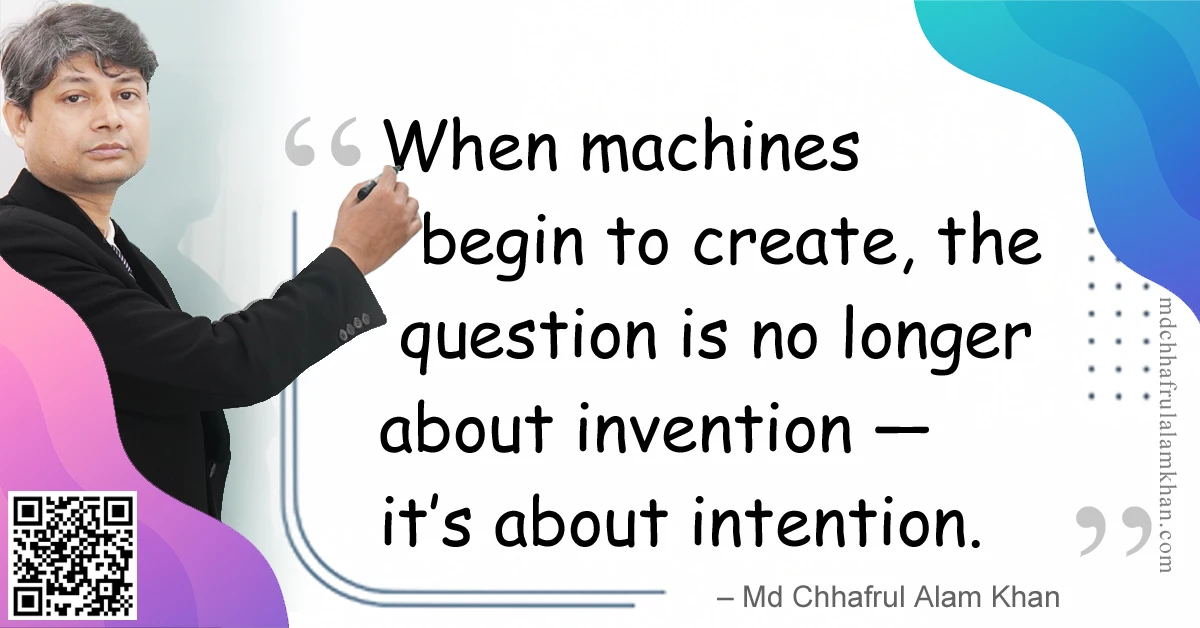
“When machines begin to create, the question is no longer about invention — it’s about intention.”
– Md Chhafrul Alam Khan
🔹 Overview
As Generative AI becomes capable of writing books, composing music, designing logos, and generating videos, an urgent legal and ethical debate has emerged: Who owns AI-generated creations?
This issue lies at the intersection of technology, law, creativity, and human identity.
Governments, artists, developers, and AI companies are still searching for global consensus on how to define authorship when a machine participates in creation.
This article explains the core copyright principles, global laws, and ethical implications related to AI-generated content — giving readers clarity on how ownership, originality, and protection work in the age of artificial creativity.
🔹 1. Understanding Copyright in the Age of AI
Copyright is a legal right that protects original works of human authorship — including literature, art, music, and software.
Traditionally, protection applies only to human creators, granting them control over reproduction, distribution, and monetization of their works.
However, AI can now autonomously produce text, images, videos, and code without human intervention. This challenges the classic definition of authorship.
“Copyright law was written for human hands, not for digital minds.” — Md Chhafrul Alam Khan (RAJ)
🔹 2. Who Can Own AI-Generated Work?
| Scenario | Ownership Likely Belongs To | Notes |
|---|---|---|
| Fully autonomous AI creation | No human ownership under current law | Most jurisdictions require human creativity |
| Human-assisted AI creation | Human user (if contribution is significant) | Example: artist directing prompts and editing outputs |
| AI-trained on copyrighted data | Original rights remain with data owners | May trigger derivative-work disputes |
| Corporate AI systems | Employer or developer (via contract/IP terms) | Depends on license and employment agreements |
🔹 3. Global Legal Perspectives
| Region | Current Position | Landmark Case or Policy |
|---|---|---|
| United States | Copyright Office states that works “produced entirely by AI” are not protected. | Zarya of the Dawn (2023) — comic’s AI-generated images denied copyright. |
| European Union | Copyright applies only to human authors; AI outputs may receive protection if “human creative choices” are substantial. | EU AI Act (2025) adds transparency duties for generative systems. |
| United Kingdom | Unique rule: “The person making the arrangements necessary for creation” owns AI output. | Section 9(3) Copyright, Designs and Patents Act 1988. |
| China | Courts increasingly grant limited protection to AI-assisted works if human input exists. | Shenzhen Court (2019) recognized AI-assisted article copyright. |
| Japan & Korea | Active in creating “data-use exemptions” for AI training while exploring output ownership. | Ongoing legislative updates. |
🔹 4. Ethical and Economic Implications
- Human Identity: Creativity has long defined humanity; AI challenges that boundary.
- Economic Impact: Artists fear devaluation; tech firms argue for open innovation.
- Transparency: Consumers must know whether content is human- or machine-made.
- Cultural Heritage: AI can replicate cultural art styles — raising questions of appropriation and respect.
Balanced copyright laws ensure that both innovation and human dignity remain protected.
🔹 5. Fair Use and Training Data
AI models often learn from vast datasets scraped from the internet, including copyrighted material.
Developers argue this is “fair use” for learning; creators claim unauthorized exploitation.
Emerging Solutions
- Opt-out Registries for artists and writers.
- Dataset Transparency Reports listing training sources.
- Compensation Systems (royalty sharing) for reused content.
A collaborative model where humans and AI share value may define the next era of copyright ethics.
🔹 6. Reader Benefits
- Legal Awareness: Understand your rights when using AI for creation.
- Creative Confidence: Learn how to legally protect AI-assisted works.
- Professional Readiness: Navigate copyright clauses in contracts or AI tools.
- Ethical Integrity: Respect original creators while innovating responsibly.
- Global Literacy: Stay informed about evolving AI laws worldwide.
🔹 7. The Future of AI Copyright
- AI Attribution Labels: Outputs will carry metadata about model, prompt, and human editor.
- Smart Licensing: Blockchain-based systems tracking creative lineage.
- Collective Compensation Models: Shared royalties for dataset contributors.
- AI Ethics and Law Integration: New hybrid discipline for global professionals.
Ultimately, the balance between human authorship and machine generation will define the creative economy of tomorrow.
“The future of copyright will not be about possession — it will be about participation.” — by Md Chhafrul Alam Khan (RAJ)
🔹 Quick Glossary
- Derivative Work: New creation based on existing copyrighted material.
- Fair Use: Limited use of copyrighted works without permission for education, commentary, etc.
- Dataset Transparency: Disclosure of data sources used for AI training.
- Attribution: Credit given to the creator of original content.
- Generative License: Agreement specifying rights for AI-generated material.
🔹 References
- U.S. Copyright Office (2023) — Policy on Works Containing AI-Generated Material
- European Commission (2025) — EU AI Act and Copyright Implications
- WIPO (World Intellectual Property Organization) — AI and IP Policy Report
- UK IPO Guidelines on Computer-Generated Works (2024)
- Stanford Cyber Policy Center — Creative Rights in Generative AI
🧭 Related Articles
- Ethics of Generative AI — Truth, Consent, and Creativity
- Generative AI — How Machines Create Text, Images, and Beyond
- Responsible AI Development — Frameworks for Ethical Innovation
- AI and Law — Global Regulations Shaping Digital Intelligence
- AI in the Creative Industry — Collaboration Between Artists and Algorithms
Boost Your Knowledge & Skills 🚀
Digital Marketing Encyclopedia: The Complete Reference to Every Concept, Channel, and Strategy in Digital Marketing
You might like↴
- Artificial Intelligence in Marketing
- Prompt Engineering: The Art and Science of Talking to AI
- Instruction-Based Prompts: Mastering Clear Communication with AI
- Role-Playing Prompts: Unlocking Creative AI Interactions
- Few-Shot Prompts: Enhancing AI Performance with Context
- How to Become a Prompt Engineer: The Ultimate Guide
- Complete List of Prompt Engineering Job Titles
- AI Content Strategist Job Description | Skills, Salary & Career Outlook
- How to Become an AI Content Strategist
- AI Model Fine-Tuning Engineer Job Description | Skills, Salary & Career Outlook
- How to Become an AI Model Fine-Tuning Engineer
- Prompt Engineering Manager Job Description | Skills, Salary & Career Outlook
- How to Become a Prompt Engineering Manager
- Director of Prompt Engineering Job Description | Skills, Salary & Career Outlook
- How to Become a Director of Prompt Engineering
- AI Research Scientist Job Description | Skills, Salary & Career Outlook
- How to Become an AI Research Scientist
- VP of AI Experience Job Description | Skills, Salary & Career Outlook
- How to Become a VP of AI Experience
- Chief AI Interaction Officer Job Description | Skills, Salary & Career Outlook
- How to Become a Chief AI Interaction Officer
- Chief AI Officer Job Description | Skills, Salary & Career Outlook
- How to Become a Chief AI Officer
- Legal Prompt Engineer Job Description | Skills, Salary & Career Outlook
- How to Become a Legal Prompt Engineer
- Healthcare AI Prompt Engineer Job Description | Skills, Salary & Career Outlook
- How to Become a Healthcare AI Prompt Engineer
- Financial AI Prompt Developer Job Description | Skills, Salary & Career Outlook
- How to Become a Financial AI Prompt Developer
- Gaming AI Narrative Engineer Job Description | Skills, Salary & Career Outlook
- How to Become a Gaming AI Narrative Engineer
- E-commerce AI Content Engineer Job Description | Skills, Salary & Career Outlook
- How to Become an E-commerce AI Content Engineer
- Types of Prompts: Unlock Your Creativity with 80 Inspiring Categories for Every Thought, Reflection, and Imagination
- Is Artificial Intelligence Advancing Too Fast for Society to Keep Up?
- AI Encyclopedia
- What Is Artificial Intelligence (AI)?
- AI vs Machine Learning vs Deep Learning
- Generative AI
- Large Language Models (LLMs)
- Ethics of Generative AI
- AI and Copyright Ownership
- Responsible AI Development Frameworks
- AI and Law — Global Regulations
- AI and Human Rights — Ensuring Dignity in the Age of Automation
- AI and Society — Human-Centered Future
- AI and Education — Transforming Learning
- AI and the Future of Work — Jobs and Skills
- Search Ecosystem Optimization (SEO) Encyclopedia
Leave a Reply