
📖 Digital Marketing Encyclopedia – Chapter 10
Content Marketing

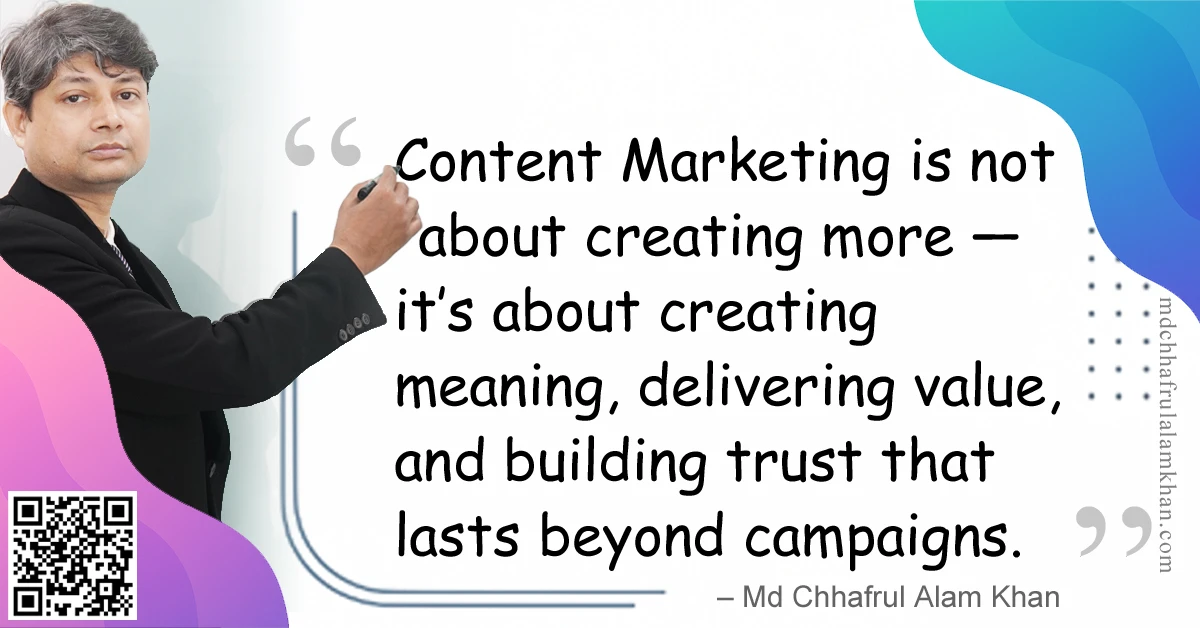
“Content Marketing is not about creating more — it’s about creating meaning, delivering value, and building trust that lasts beyond campaigns.”
– Md Chhafrul Alam Khan
Introduction
Content Marketing is the art and science of creating, publishing, and distributing valuable, relevant, and consistent content to attract and retain a clearly defined audience.
Unlike direct advertising, Content Marketing focuses on building relationships through education, storytelling, and engagement.
It is one of the most powerful strategies in Digital Marketing, driving SEO, social media, email campaigns, and even paid advertising.
🔎 What is Content Marketing?
- A strategic approach focused on long-term value instead of quick wins.
- Creates trust and authority by answering customer questions and solving their problems.
- Works across multiple formats and platforms.
🧩 Core Elements of Content Marketing
- Strategy
- Defining goals (awareness, engagement, leads).
- Identifying buyer personas.
- Mapping the content to the customer journey.
- Content Creation
- Articles, blogs, whitepapers, ebooks.
- Videos, podcasts, infographics.
- Interactive tools, calculators, quizzes.
- Content Distribution
- Owned channels (website, blog, email).
- Earned channels (SEO, PR, shares).
- Paid channels (sponsored posts, native ads).
- Optimization
- SEO for search visibility.
- A/B testing headlines and CTAs.
- Updating and repurposing content.
- Measurement
- Traffic, engagement, lead generation.
- Conversion rates.
- ROI attribution.
📊 Example: Content in the Customer Journey
| Stage | Content Format | Purpose |
|---|---|---|
| Awareness | Blog posts, infographics | Educate & attract |
| Consideration | Case studies, webinars | Build trust & authority |
| Conversion | Product demos, landing pages | Drive purchase |
| Retention | Newsletters, tips, loyalty content | Retain customers |
| Advocacy | UGC, testimonials, social sharing | Amplify reach |
🎯 Benefits of Content Marketing
- SEO Boost → Content fuels rankings.
- Brand Authority → Builds expertise and credibility.
- Engagement → Starts meaningful conversations.
- Lead Generation → Captures prospects through value.
- Cost-Effective → Long-term ROI higher than ads.
- Cross-Channel Support → Powers SEO, SEM, social, and email campaigns.
🧭 Types of Content
- Written: Blogs, articles, guides, ebooks, newsletters.
- Visual: Infographics, images, memes, carousels.
- Video: Explainers, tutorials, vlogs, live streams.
- Audio: Podcasts, audio lessons.
- Interactive: Quizzes, polls, calculators, games.
- User-Generated Content (UGC): Reviews, testimonials, social shares.
🛠️ Tools for Content Marketing
- Content Planning: Trello, Asana, Notion
- SEO Research: SEMrush, Ahrefs, SurferSEO
- Content Creation: Canva, Grammarly, Jasper, ChatGPT
- Video & Audio: Adobe Premiere Pro, Descript, Audacity
- Distribution: Buffer, Hootsuite, HubSpot
- Analytics: Google Analytics 4, BuzzSumo, Looker Studio
📊 Content Marketing vs. Traditional Advertising
| Aspect | Content Marketing | Traditional Advertising |
|---|---|---|
| Approach | Value-driven & educational | Promotional & sales-driven |
| Longevity | Evergreen & reusable | Short-term campaigns |
| Trust Factor | Builds credibility | Often viewed as interruptive |
| Cost | Lower, compounding ROI | Higher, ongoing spend |
| Audience Role | Engaged participants | Passive viewers |
❓ Frequently Asked Questions
Q1: How long does Content Marketing take to show results?
3–6 months for SEO-driven content, but some formats (like social posts) bring instant engagement.
Q2: Is Content Marketing only for big brands?
No — small businesses benefit even more by building trust in niche audiences.
Q3: How is Content Marketing connected to SEO?
SEO needs high-quality content to rank. Content without SEO often goes unseen.
Q4: Can AI create content?
Yes — AI assists with ideation, research, and drafting, but human creativity ensures originality and trust.
✨ Final Thoughts
Content Marketing is the fuel of digital growth.
- It attracts customers with value.
- It builds trust with relevance.
- It sustains growth with consistency.
“The strongest brands don’t just publish content — they build ecosystems of meaning and value that last beyond campaigns.”
– Md Chhafrul Alam Khan
Want to build a content marketing strategy that attracts, engages, and converts?
👉 Work with me to design a content ecosystem tailored for sustainable growth.
Boost Your Knowledge & Skills 🚀
Master SEO from Beginner to Expert with our Free Online Self-Learning Course on SEO Mastery.
You might like↴
- Content Creation Checklist (CCC)
- SEO Encyclopedia
- What Is SEO – Search Engine Optimization? [A Comprehensive Guide]
- How to Become an SEO Expert? A Step-by-Step Guide
- SEO Starter Guide: From Web Whispers to Search Engine Screams
- On-Page SEO Overview
- Title Tag Optimization
- Meta Description Optimization
- Meta Robots Tag Optimization
- Canonical URL Optimization
- Viewport Meta Tag Optimization
- Heading Tag H1 Optimization
- Heading Tags H2–H6 Optimization
- Heading Structure Best Practices
- Keyword Targeting in Content
- Content Structure & Readability
- Content Depth & Word Count
- Multimedia Optimization
- Content Freshness & Updates
- Internal Link Structure
- Anchor Text Optimization
- Fixing Orphan Pages
- SEO-Friendly URL Structure
- URL Parameters & Tracking Codes
- Image File Naming for SEO
- Image Compression & Formats
- Image Alt Text & Title Attributes
- Schema Markup Overview
- Common Schema Types
- Testing & Validating Schema
- Outbound Link Quality & Relevance
- Nofollow, Sponsored & UGC Attributes
- Core Web Vitals Optimization
- Mobile Friendliness
- Accessibility Standards for SEO
- Robots Meta Tag Usage
- Hreflang Implementation
- Manual On-Page SEO Audit Checklist
- On-Page SEO Tools & Software
- Competitor On-Page SEO Analysis
- Technical SEO
- Meta Charset Tag Optimization
- Pagination SEO
- Google Search Algorithm
- The future of SEO in a ChatGPT-dominated world
- SEO Mastery: Complete Course Content
- Lesson 01: What is SEO and Why Does It Matter?
- Lesson 02: Keyword Research Made Simple
- Lesson 03: On-Page SEO Basics
- Lesson 04: Technical SEO
Leave a Reply