
🌍 Cryptocurrency (Crypto): A Complete, Authoritative, and Universal Encyclopedia

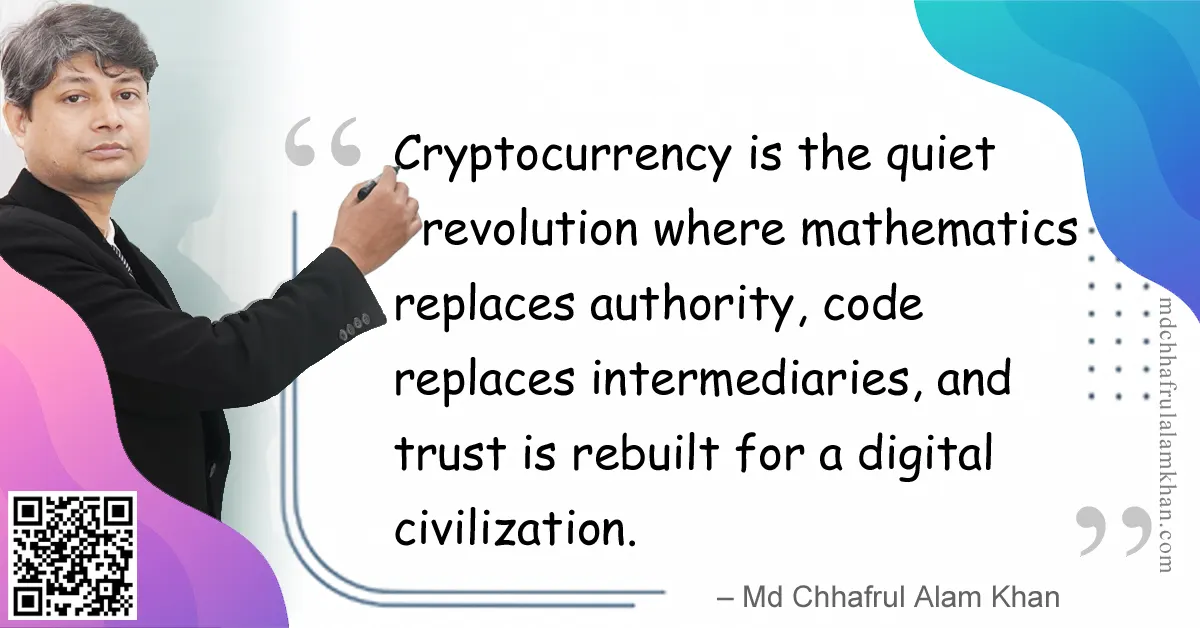
“Cryptocurrency is the quiet revolution where mathematics replaces authority, code replaces intermediaries, and trust is rebuilt for a digital civilization.”
– Md Chhafrul Alam Khan
Introduction
Cryptocurrency, commonly referred to as crypto, is a digitally native system of value secured by cryptography and coordinated through distributed networks rather than centralized institutions. It represents one of the most significant technological, economic, and social developments of the 21st century, reshaping how value is created, stored, transferred, governed, and understood.
This article is a comprehensive, standalone, encyclopedia-grade reference designed for all audiences—students, researchers, developers, investors, professionals, policymakers, entrepreneurs, and general knowledge seekers. It explains cryptocurrency from first principles to advanced applications, without speculation, promotion, or omission.
1. Historical Origins of Cryptocurrency
1.1 The Pre-Digital Money Problem
Traditional financial systems depend on centralized authorities—banks, clearing houses, and governments—to verify transactions and maintain trust. While effective, these systems introduce costs, delays, censorship risks, and global access limitations.
1.2 The Bitcoin Breakthrough
In 2008, a paper titled Bitcoin: A Peer-to-Peer Electronic Cash System introduced a solution to digital trust without intermediaries. The system was implemented in 2009 by Satoshi Nakamoto, marking the birth of cryptocurrency.
1.3 Evolution Beyond Bitcoin
Bitcoin proved decentralized money was possible. Subsequent innovations expanded functionality, leading to programmable blockchains, decentralized finance, digital assets, and autonomous governance systems.
2. Definition of Cryptocurrency
Cryptocurrency is a cryptographically secured digital asset that operates on a distributed ledger, enabling peer-to-peer transactions without reliance on centralized authorities.
Key characteristics:
- Decentralized control
- Cryptographic security
- Public verifiability
- Resistance to tampering
- Programmable functionality
3. Core Technological Foundations
3.1 Cryptography
Cryptocurrency relies on established cryptographic principles:
- Hash functions for data integrity
- Public-key cryptography for ownership
- Digital signatures for authorization
3.2 Distributed Ledgers
A distributed ledger is a synchronized database shared across independent nodes. Changes are validated collectively and recorded immutably.
3.3 Peer-to-Peer Networking
Nodes communicate directly, eliminating single points of failure and enabling global participation.
4. Consensus Mechanisms
Consensus mechanisms allow decentralized networks to agree on transaction validity.
4.1 Proof of Work (PoW)
Participants expend computational energy to secure the network.
4.2 Proof of Stake (PoS)
Validation power is assigned based on asset ownership rather than computation.
4.3 Byzantine Fault Tolerance
Advanced models allow networks to function correctly even when some participants act maliciously.
5. Major Cryptocurrency Categories
5.1 Native Digital Currencies
- Bitcoin: Digital scarcity and decentralized money
5.2 Smart-Contract Platforms
- Ethereum: Programmable blockchain enabling decentralized applications
5.3 Stablecoins
Digital assets designed to maintain stable value through fiat or asset backing.
5.4 Utility and Governance Tokens
Assets granting access rights, protocol usage, or voting power.
5.5 Privacy-Focused Cryptocurrencies
Designed to enhance transaction anonymity and confidentiality.
6. Smart Contracts and Decentralized Applications
Smart contracts are self-executing programs stored on blockchains. They enable automated agreements without intermediaries.
Decentralized applications (dApps) use smart contracts as backend logic while providing user-facing interfaces similar to traditional software.
7. Decentralized Finance (DeFi)
Decentralized finance recreates financial services using smart contracts:
- Lending and borrowing
- Decentralized exchanges
- Derivatives and synthetic assets
- Automated market-making
DeFi systems operate transparently and globally without centralized custodians.
8. Non-Fungible Tokens (NFTs)
NFTs represent unique digital assets with verifiable ownership. Use cases include:
- Digital art
- Gaming assets
- Collectibles
- Identity credentials
- Intellectual property representation
9. Web3 and Digital Identity
Web3 envisions an internet where users control assets, identity, and data through cryptographic keys rather than platform accounts.
10. Real-World Applications
Cryptocurrency is actively used for:
- Global payments and remittances
- Financial inclusion
- Supply-chain verification
- Gaming economies
- Creator monetization
- Tokenization of real-world assets
11. Wallets, Exchanges, and Security
11.1 Wallets
- Custodial wallets (managed by third parties)
- Non-custodial wallets (user-controlled)
- Hardware wallets for enhanced security
11.2 Exchanges
- Centralized exchanges facilitate fiat access
- Decentralized exchanges enable peer-to-peer trading
11.3 Security Responsibilities
Users must protect private keys, verify software authenticity, and understand transaction finality.
12. Economics and Tokenomics
Cryptocurrency economics includes:
- Supply issuance models
- Incentive structures
- Network effects
- Governance design
- Market dynamics
Sound tokenomics align long-term network health with participant incentives.
13. Regulation and Legal Frameworks
Regulatory approaches vary globally:
- Classification as securities or commodities
- Anti-money laundering standards
- Taxation policies
- Consumer protection laws
Regulation continues to evolve alongside adoption.
14. Careers and Professional Opportunities
The cryptocurrency ecosystem supports diverse roles:
- Blockchain engineers
- Security auditors
- Cryptography researchers
- Product managers
- Economists
- Legal and compliance experts
- Educators and analysts
15. Research Frontiers and Future Directions
Active research areas include:
- Layer-2 scalability
- Zero-knowledge cryptography
- Cross-chain interoperability
- Decentralized governance
- AI-integrated blockchain systems
- Quantum-resistant cryptography
16. Common Misconceptions
- Cryptocurrency is not inherently anonymous
- It is not limited to speculation
- It does not eliminate governments
- Transparency is a core design feature
17. Ethical and Social Considerations
Key discussions include:
- Energy consumption and sustainability
- Financial inclusion
- Privacy versus transparency
- Responsible innovation
18. Long-Term Perspective
Cryptocurrency represents an architectural shift in how societies coordinate value. Like the internet before it, adoption is gradual, uneven, and transformative.
Conclusion
Cryptocurrency is the convergence of cryptography, economics, computer science, and social coordination. It is neither a passing trend nor a singular technology, but a foundational layer for digital civilization.
This article stands as a complete, neutral, and enduring reference, suitable for education, research, professional practice, and historical record.
References and Foundational Sources
- Nakamoto, S. — Bitcoin: A Peer-to-Peer Electronic Cash System, 2008
- Buterin, V. — Ethereum Whitepaper, 2013
- Diffie, W., Hellman, M. — New Directions in Cryptography, IEEE, 1976
- Rivest, R., Shamir, A., Adleman, L. — Public-Key Cryptosystems, 1978
- Merkle, R. — Protocols for Public Key Cryptosystems, 1980
- Lamport, L., Shostak, R., Pease, M. — The Byzantine Generals Problem, 1982
- Castro, M., Liskov, B. — Practical Byzantine Fault Tolerance, 1999
- Narayanan, A. et al. — Bitcoin and Cryptocurrency Technologies, Princeton University Press
- Bank for International Settlements — Digital Money and Financial Stability Reports
- Financial Action Task Force — Virtual Asset Standards and Guidance
Boost Your Knowledge & Skills 🚀
Cryptocurrency Encyclopedia: A Complete, Authoritative, and Universal Encyclopedia
Digital Marketing Encyclopedia: The Complete Reference to Every Concept, Channel, and Strategy in Digital Marketing
You might like↴
- What Is a Blockchain Node
- Immutability in Blockchain
- Trustless Systems
- Peer-to-Peer Networks
- Cryptography in Cryptocurrency
- Distributed Ledger Technology
- Blockchain Explained
- Decentralization in Cryptocurrency
- Digital Currency Explained
- History of Cryptocurrency
- What Is Cryptocurrency
- Cryptocurrency Encyclopedia
- Search Ecosystem Optimization (SEO) Encyclopedia
- AI and the Future of Work — Jobs and Skills
- AI and Education — Transforming Learning
- AI and Society — Human-Centered Future
- AI and Human Rights — Ensuring Dignity in the Age of Automation
- AI and Law — Global Regulations
- Responsible AI Development Frameworks
- AI and Copyright Ownership
- Ethics of Generative AI
- Large Language Models (LLMs)
- Generative AI
- AI vs Machine Learning vs Deep Learning
- What Is Artificial Intelligence (AI)?
- AI Encyclopedia
- Is Artificial Intelligence Advancing Too Fast for Society to Keep Up?
- Types of Prompts: Unlock Your Creativity with 80 Inspiring Categories for Every Thought, Reflection, and Imagination
- How to Become an E-commerce AI Content Engineer
- E-commerce AI Content Engineer Job Description | Skills, Salary & Career Outlook
- How to Become a Gaming AI Narrative Engineer
- Gaming AI Narrative Engineer Job Description | Skills, Salary & Career Outlook
- How to Become a Financial AI Prompt Developer
- Financial AI Prompt Developer Job Description | Skills, Salary & Career Outlook
- How to Become a Healthcare AI Prompt Engineer
- Healthcare AI Prompt Engineer Job Description | Skills, Salary & Career Outlook
- How to Become a Legal Prompt Engineer
- Legal Prompt Engineer Job Description | Skills, Salary & Career Outlook
- How to Become a Chief AI Officer
- Chief AI Officer Job Description | Skills, Salary & Career Outlook
- How to Become a Chief AI Interaction Officer
- Chief AI Interaction Officer Job Description | Skills, Salary & Career Outlook
- How to Become a VP of AI Experience
- VP of AI Experience Job Description | Skills, Salary & Career Outlook
- How to Become an AI Research Scientist
- AI Research Scientist Job Description | Skills, Salary & Career Outlook
- How to Become a Director of Prompt Engineering
- Director of Prompt Engineering Job Description | Skills, Salary & Career Outlook
- How to Become a Prompt Engineering Manager
- Prompt Engineering Manager Job Description | Skills, Salary & Career Outlook
- How to Become an AI Model Fine-Tuning Engineer
- AI Model Fine-Tuning Engineer Job Description | Skills, Salary & Career Outlook
- How to Become an AI Content Strategist
- AI Content Strategist Job Description | Skills, Salary & Career Outlook
- Complete List of Prompt Engineering Job Titles
- How to Become a Prompt Engineer: The Ultimate Guide
- Few-Shot Prompts: Enhancing AI Performance with Context
- Role-Playing Prompts: Unlocking Creative AI Interactions
- Instruction-Based Prompts: Mastering Clear Communication with AI
- Prompt Engineering: The Art and Science of Talking to AI
- Artificial Intelligence in Marketing
Leave a Reply