
📖 Digital Marketing Encyclopedia – Chapter 2
Digital Marketing vs. Traditional Marketing: Understand the past, master the present, and lead the future of marketing.

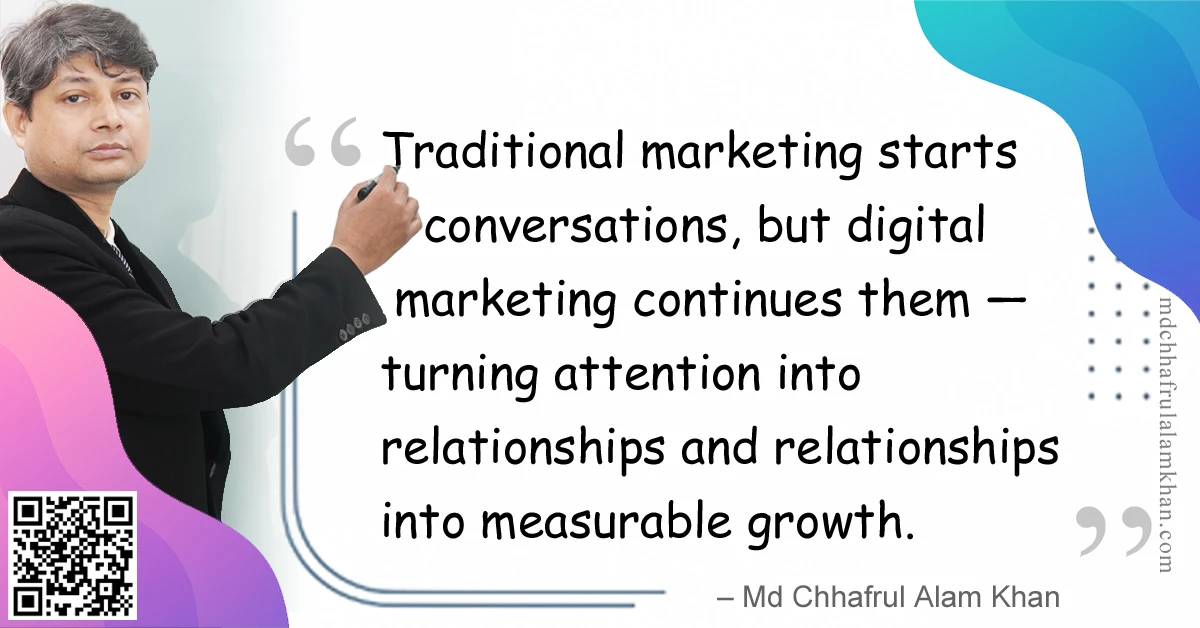
“Traditional marketing starts conversations, but digital marketing continues them — turning attention into relationships and relationships into measurable growth.”
– Md Chhafrul Alam Khan
Introduction
Marketing has always been about connecting businesses with people. The difference lies in the channels, tools, and measurement systems used to reach those people.
- Traditional Marketing relies on offline media such as print, TV, radio, billboards, and events.
- Digital Marketing uses online platforms such as search engines, social media, email, apps, and websites.
Both have strengths, but Digital Marketing has become the dominant force due to global reach, cost efficiency, and real-time measurability.
🔎 What is Traditional Marketing?
Traditional Marketing refers to the use of offline methods to promote products and services.
Examples:
- Print (newspapers, magazines, brochures)
- TV & Radio advertising
- Outdoor (billboards, posters, transit ads)
- Direct mail (postcards, flyers)
- Events, sponsorships, trade shows
Strengths:
- High impact & visibility (e.g., Super Bowl ads)
- Trust-building in certain demographics
- Broad reach for local audiences
Limitations:
- Expensive campaigns
- Hard to measure ROI
- Limited targeting & personalization
- One-way communication
💻 What is Digital Marketing?
Digital Marketing uses online platforms and digital tools to reach audiences.
Examples:
- SEO (Search Engine Optimization)
- SEM (Search Engine Marketing, PPC ads)
- Social Media Marketing (Facebook, Instagram, TikTok, LinkedIn)
- Content Marketing (blogs, videos, podcasts)
- Email Marketing & Automation
- Mobile Marketing (apps, push notifications)
Strengths:
- Global reach at lower cost
- Advanced targeting & personalization
- Real-time data & analytics
- Interactive engagement (comments, shares, conversations)
Limitations:
- Highly competitive
- Ad fatigue & content saturation
- Privacy restrictions (cookies, GDPR, CCPA)
📊 Comparison Table: Digital vs. Traditional Marketing
| Aspect | Traditional Marketing | Digital Marketing |
|---|---|---|
| Channels | TV, radio, print, billboards, events | Search engines, websites, social media, apps, email |
| Reach | Local, regional, national | Global & scalable |
| Cost | High production & media costs | Flexible budgets, cost-effective |
| Targeting | Broad audience, demographics only | Narrow targeting: interests, behavior, location |
| Measurement | Difficult, indirect | Real-time analytics & KPIs |
| Interaction | One-way communication | Two-way conversations, engagement |
| Speed | Slow, planned cycles | Instant launch & adjustments |
| ROI | Hard to track | Precisely measurable |
🎯 When to Use Traditional vs. Digital
- Traditional Marketing Works Best For:
- Local businesses targeting older demographics
- Luxury products needing high-credibility offline exposure
- Events, sponsorships, or experiences requiring physical presence
- Digital Marketing Works Best For:
- Startups & small businesses (cost-effective growth)
- Global businesses targeting diverse audiences
- Data-driven campaigns that need tracking & optimization
- Brands leveraging AI, personalization, and omnichannel reach
🧩 Integrated Marketing – The Best of Both Worlds
In reality, the strongest strategies combine both traditional and digital into a hybrid marketing approach.
- TV ads driving users to social media campaigns
- Print ads with QR codes linking to digital experiences
- Events supported by email & retargeting campaigns
“The future is not Digital vs. Traditional, but Digital + Traditional in a seamless ecosystem.”
– Md Chhafrul Alam Khan
❓ Frequently Asked Questions
Q1: Is Traditional Marketing dead?
No — it still works, especially for local and offline audiences. But it is less dominant than before.
Q2: Why has Digital Marketing grown so fast?
Because it is measurable, cost-efficient, and aligns with how people spend time (searching, scrolling, streaming, shopping online).
Q3: Can small businesses still use Traditional Marketing?
Yes, but Digital Marketing usually offers better ROI and flexibility for small budgets.
Q4: What is the future trend?
Hybrid models combining both — with Digital Marketing as the primary driver supported by Traditional for specific high-impact moments.
✨ Final Thoughts
Both Traditional and Digital Marketing serve important roles.
- Traditional builds credibility and awareness.
- Digital delivers precision, personalization, and measurable growth.
“The real power lies in integration — using Digital to extend, track, and amplify the impact of Traditional campaigns.”
– Md Chhafrul Alam Khan
Want to design a strategy that blends the power of Traditional and Digital Marketing?
👉 Work with me to build a hybrid approach for maximum impact.
Boost Your Knowledge & Skills 🚀
Master SEO from Beginner to Expert with our Free Online Self-Learning Course on SEO Mastery.
You might like↴
- Content Creation Checklist (CCC)
- SEO Encyclopedia
- What Is SEO – Search Engine Optimization? [A Comprehensive Guide]
- How to Become an SEO Expert? A Step-by-Step Guide
- SEO Starter Guide: From Web Whispers to Search Engine Screams
- On-Page SEO Overview
- Title Tag Optimization
- Meta Description Optimization
- Meta Robots Tag Optimization
- Canonical URL Optimization
- Viewport Meta Tag Optimization
- Heading Tag H1 Optimization
- Heading Tags H2–H6 Optimization
- Heading Structure Best Practices
- Keyword Targeting in Content
- Content Structure & Readability
- Content Depth & Word Count
- Multimedia Optimization
- Content Freshness & Updates
- Internal Link Structure
- Anchor Text Optimization
- Fixing Orphan Pages
- SEO-Friendly URL Structure
- URL Parameters & Tracking Codes
- Image File Naming for SEO
- Image Compression & Formats
- Image Alt Text & Title Attributes
- Schema Markup Overview
- Common Schema Types
- Testing & Validating Schema
- Outbound Link Quality & Relevance
- Nofollow, Sponsored & UGC Attributes
- Core Web Vitals Optimization
- Mobile Friendliness
- Accessibility Standards for SEO
- Robots Meta Tag Usage
- Hreflang Implementation
- Manual On-Page SEO Audit Checklist
- On-Page SEO Tools & Software
- Competitor On-Page SEO Analysis
- Technical SEO
- Meta Charset Tag Optimization
- Pagination SEO
- Google Search Algorithm
- The future of SEO in a ChatGPT-dominated world
- SEO Mastery: Complete Course Content
- Lesson 01: What is SEO and Why Does It Matter?
- Lesson 02: Keyword Research Made Simple
- Lesson 03: On-Page SEO Basics
- Lesson 04: Technical SEO