
📖 Digital Marketing Encyclopedia – Chapter 23
E-commerce Marketing Fundamentals

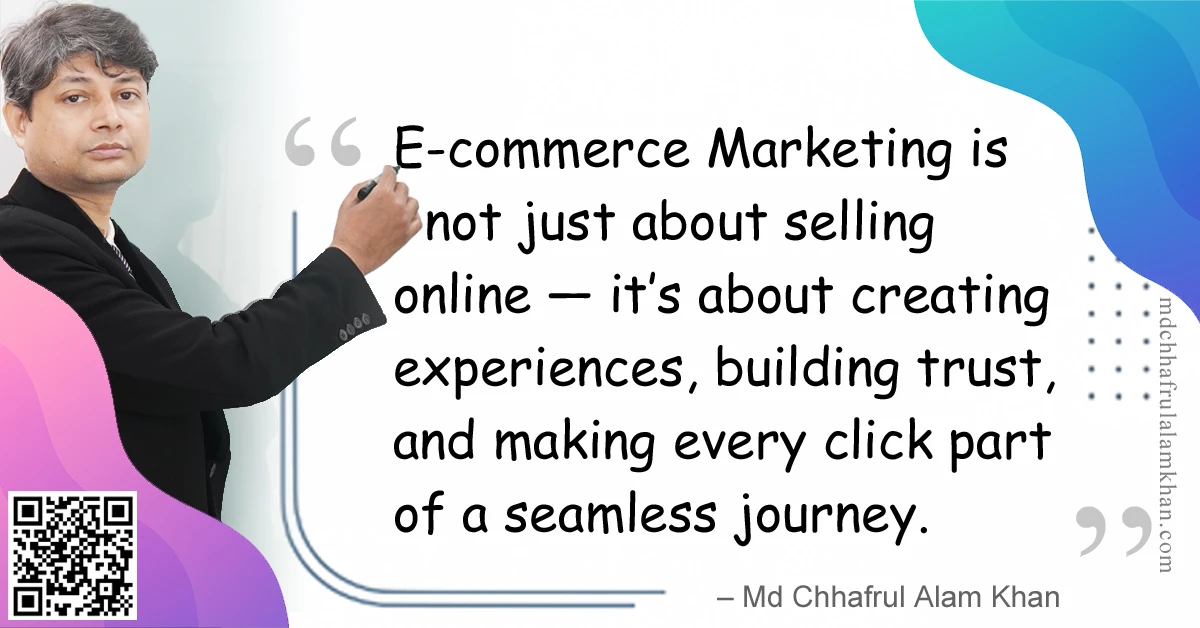
“E-commerce Marketing is not just about selling online — it’s about creating experiences, building trust, and making every click part of a seamless journey.”
– Md Chhafrul Alam Khan
Introduction
E-commerce Marketing is the practice of using digital channels, strategies, and tools to attract, engage, and convert online shoppers. It covers the end-to-end process of awareness to advocacy, ensuring customers not only buy but also return and recommend.
In today’s digital economy, e-commerce is more than just a sales channel — it’s a global ecosystem where branding, SEO, social media, email, paid ads, and customer experience converge.
🔎 What is E-commerce Marketing?
- A combination of digital marketing strategies designed to promote online stores and drive sales.
- Covers both traffic generation (SEO, PPC, social) and conversion optimization (UX, CRO, trust-building).
- Extends beyond sales into customer retention, loyalty, and advocacy.
🧩 Core Elements of E-commerce Marketing
Traffic Generation
- SEO for product and category pages.
- PPC campaigns (Google Shopping, search, display).
- Social commerce (Instagram, TikTok, Facebook Shops).
Conversion Optimization
- Clear product descriptions and reviews.
- Seamless checkout process.
- Mobile-first design and fast load speeds.
Customer Retention
- Loyalty programs and repeat purchase discounts.
- Personalized recommendations.
- Email & SMS campaigns for abandoned carts and upsells.
Trust & Credibility
- Secure payment gateways.
- Transparent shipping and returns.
- Customer reviews and social proof.
Analytics & Data
- Tracking user journeys.
- Heatmaps and funnel analysis.
- Lifetime value (LTV) and repeat purchase metrics.
📊 Example: E-commerce in the Customer Journey
| Stage | Marketing Tactic | Purpose |
|---|---|---|
| Awareness | Google Shopping Ads, SEO blogs | Attract visitors to the store |
| Consideration | Product demo videos, reviews | Build trust & reduce doubts |
| Conversion | Discounts, streamlined checkout | Drive sales |
| Retention | Loyalty rewards, email offers | Encourage repeat purchases |
| Advocacy | Referral programs, UGC campaigns | Inspire word-of-mouth promotion |
🎯 Benefits of E-commerce Marketing
- Global Reach → Sell to customers worldwide.
- Scalability → Stores run 24/7 without geographic limits.
- Personalization → Tailored experiences increase conversions.
- Cost-Effective → Lower overhead compared to physical stores.
- Data-Driven → Every interaction can be tracked and optimized.
- Omnichannel Integration → Works with SEO, social, email, and paid ads.
🧭 Types of E-commerce Marketing Strategies
- Search Engine Optimization (SEO) → Product keywords, structured data, schema markup.
- Pay-Per-Click (PPC) → Google Ads, Bing Ads, retargeting.
- Social Commerce → Shoppable posts on Instagram, TikTok, and Pinterest.
- Content Marketing → Blogs, buying guides, tutorials.
- Email & SMS Marketing → Abandoned cart recovery, upselling, reactivation.
- Affiliate & Influencer Marketing → Partner-driven sales.
- Marketplace Strategies → Selling on Amazon, eBay, Etsy alongside owned stores.
🛠️ Tools for E-commerce Marketing
- Platforms → Shopify, WooCommerce, Magento, BigCommerce
- SEO & Analytics → SEMrush, Ahrefs, Google Analytics 4
- Advertising → Google Ads, Meta Ads, TikTok Ads
- Email & Automation → Klaviyo, Mailchimp, Omnisend
- Conversion Optimization → Hotjar, Crazy Egg, Optimizely
- Reviews & Social Proof → Yotpo, Trustpilot, Judge.me
📊 E-commerce Marketing vs. Traditional Retail Marketing
| Aspect | E-commerce Marketing | Traditional Retail Marketing |
|---|---|---|
| Reach | Global, 24/7 | Local, limited by store hours |
| Cost | Lower overhead, digital ads only | Rent, staffing, physical expenses |
| Data Insights | Real-time, highly detailed | Limited, offline surveys only |
| Personalization | Highly tailored recommendations | Limited personalization |
| Convenience | Shop anytime, anywhere | Restricted to location & time |
❓ Frequently Asked Questions
Q1: What’s the best platform for e-commerce?
Shopify and WooCommerce are most popular, but choice depends on scalability, budget, and customization needs.
Q2: How do I reduce cart abandonment?
Simplify checkout, offer guest checkout, provide multiple payment options, and send reminder emails.
Q3: Is SEO important for e-commerce stores?
Yes — optimized product pages and technical SEO drive free, long-term traffic.
Q4: How can small businesses compete with giants like Amazon?
By focusing on niche products, personalization, community, and outstanding service.
✨ Final Thoughts
E-commerce Marketing is more than digital transactions — it’s about building experiences and ecosystems where customers feel valued.
“The strongest e-commerce brands don’t just sell products — they sell trust, convenience, and loyalty that last long after checkout.”
– Md Chhafrul Alam Khan
Want to grow your online store with proven e-commerce marketing strategies?
👉 Work with me to design a sales-driven, customer-first e-commerce growth plan.
Boost Your Knowledge & Skills 🚀
Master SEO from Beginner to Expert with our Free Online Self-Learning Course on SEO Mastery.
You might like↴
- Content Creation Checklist (CCC)
- SEO Encyclopedia
- What Is SEO – Search Engine Optimization? [A Comprehensive Guide]
- How to Become an SEO Expert? A Step-by-Step Guide
- SEO Starter Guide: From Web Whispers to Search Engine Screams
- On-Page SEO Overview
- Title Tag Optimization
- Meta Description Optimization
- Meta Robots Tag Optimization
- Canonical URL Optimization
- Viewport Meta Tag Optimization
- Heading Tag H1 Optimization
- Heading Tags H2–H6 Optimization
- Heading Structure Best Practices
- Keyword Targeting in Content
- Content Structure & Readability
- Content Depth & Word Count
- Multimedia Optimization
- Content Freshness & Updates
- Internal Link Structure
- Anchor Text Optimization
- Fixing Orphan Pages
- SEO-Friendly URL Structure
- URL Parameters & Tracking Codes
- Image File Naming for SEO
- Image Compression & Formats
- Image Alt Text & Title Attributes
- Schema Markup Overview
- Common Schema Types
- Testing & Validating Schema
- Outbound Link Quality & Relevance
- Nofollow, Sponsored & UGC Attributes
- Core Web Vitals Optimization
- Mobile Friendliness
- Accessibility Standards for SEO
- Robots Meta Tag Usage
- Hreflang Implementation
- Manual On-Page SEO Audit Checklist
- On-Page SEO Tools & Software
- Competitor On-Page SEO Analysis
- Technical SEO
- Meta Charset Tag Optimization
- Pagination SEO
- Google Search Algorithm
- The future of SEO in a ChatGPT-dominated world
- SEO Mastery: Complete Course Content
- Lesson 01: What is SEO and Why Does It Matter?
- Lesson 02: Keyword Research Made Simple
- Lesson 03: On-Page SEO Basics
- Lesson 04: Technical SEO
Leave a Reply