
🌍 The Artificial Intelligence Encyclopedia
⚖️ Ethics of Generative AI — Truth, Consent, and Creativity

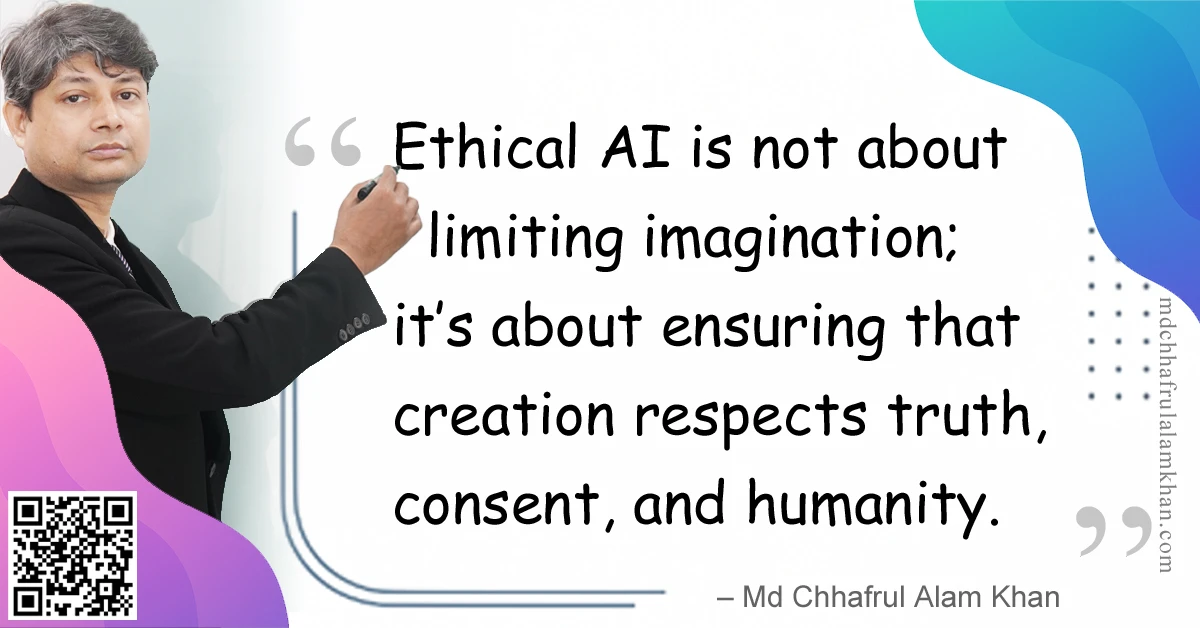
“Ethical AI is not about limiting imagination; it’s about ensuring that creation respects truth, consent, and humanity.”
– Md Chhafrul Alam Khan
🔹 Overview
Generative Artificial Intelligence (AI) gives machines creative power — the ability to write, paint, compose, or simulate human expressions.
While this creativity brings innovation, it also raises profound ethical, social, and legal challenges: Who owns AI-generated content? How do we protect truth in a world of deepfakes? What is consent in data training?
This article explores the core ethical pillars that guide responsible use of generative AI — focusing on truth, consent, and creativity — so individuals, developers, and organizations can innovate with conscience.
🔹 1. Why Ethics Matters in Generative AI
Generative models shape how people see, believe, and feel. When an image, headline, or statement is created by AI, it can influence behavior and public trust.
Without ethical boundaries:
- Misinformation spreads faster than fact-checking can respond.
- Artistic ownership is diluted as AI reproduces human styles.
- Privacy is compromised when personal data becomes training input.
Responsible AI is therefore not an optional add-on; it is the foundation of sustainable innovation.
🔹 2. The Three Pillars of Ethical Generative AI
🧠 Truth — Protecting Authenticity
- Prevent fabrication of news, research, or historical data.
- Require content provenance (metadata showing whether output is AI-generated).
- Encourage human verification loops in sensitive domains (health, finance, politics).
🤝 Consent — Respecting Data and People
- Use datasets collected with explicit permission and clear usage rights.
- Exclude copyrighted or personal materials from training when unlicensed.
- Provide users with the right to opt out of data inclusion.
🎨 Creativity — Celebrating Human Collaboration
- Acknowledge AI as a co-creator, not a replacement.
- Credit original artists and reference sources that inspire AI training.
- Encourage human review in artistic and academic outputs.
“AI should extend human creativity — never erase it.” — Md Chhafrul Alam Khan (RAJ)
🔹 3. Key Ethical Challenges
| Issue | Description | Example | Recommended Practice |
|---|---|---|---|
| Deepfakes | Manipulated media that can harm reputation | Political misinformation | Watermark & verification tools |
| Bias & Fairness | Unequal representation in training data | Gender or racial bias | Balanced datasets, bias audits |
| Copyright & Ownership | Who owns AI-generated art/code? | AI-made logo contest disputes | Clear attribution frameworks |
| Transparency | Lack of visibility in training and reasoning | “Black-box” AI outputs | Model cards & explainability reports |
| Environmental Cost | Massive energy use during training | High-compute models | Carbon offset, efficient architectures |
🔹 4. Global Ethical Guidelines and Frameworks
| Organization | Initiative | Key Principle |
|---|---|---|
| UNESCO (2021) | Recommendation on Ethics of AI | Human rights and sustainability |
| OECD (2023) | AI Principles | Transparency, robustness, accountability |
| EU AI Act (2025) | Regulatory framework | Risk-based compliance for AI systems |
| IEEE | Ethically Aligned Design | Human-centered engineering |
| Partnership on AI | Responsible Practices | Collaborative governance |
These frameworks emphasize accountability, explainability, and inclusivity — cornerstones of ethical deployment.
🔹 5. Reader Benefits
- Moral Clarity: Understand how to create and use AI responsibly.
- Legal Awareness: Learn international standards for AI regulation.
- Career Credibility: Ethical literacy enhances trust and employability.
- Creative Empowerment: Combine ethics with artistry for lasting impact.
- Societal Contribution: Help build technology that uplifts, not divides.
🔹 6. The Role of Developers and Organizations
- Conduct AI Impact Assessments before deployment.
- Establish Ethics Review Boards for product oversight.
- Document data sources, model changes, and test results transparently.
- Train teams on Responsible AI guidelines and inclusive design.
- Implement bias detection pipelines and third-party audits.
When companies align profit with purpose, AI innovation becomes sustainable.
🔹 7. Toward Ethical AI Certification
Emerging initiatives are developing AI Ethics Certifications — similar to ISO standards — that verify responsible data usage, bias mitigation, and environmental performance.
Future products may display an “AI Ethics Seal”, assuring users that the system respects truth, consent, and creativity.
🔹 8. The Future of Ethical Creativity
The next stage of Generative AI ethics will include:
- Self-auditing models that detect bias autonomously.
- Smart provenance tags embedded into digital content.
- Global Creative Commons for AI — open, fair data sharing.
- Human-AI creative councils to guide art, journalism, and education.
“The ethics of tomorrow’s AI will not be written in code — it will be written in conscience.” — Md Chhafrul Alam Khan (RAJ)
🔹 Quick Glossary
- Deepfake: AI-generated synthetic media that mimics reality.
- Bias: Systematic prejudice in model outcomes.
- Explainability: Ability to interpret and understand AI decisions.
- Model Card: Document describing model data, purpose, and limitations.
- Responsible AI: Framework ensuring fairness, safety, and accountability.
🔹 References
- UNESCO (2021) Ethics of Artificial Intelligence Recommendation
- OECD (2023) AI Principles
- European Union (2025) AI Act Overview
- IEEE (2024) Ethically Aligned Design v3
- Stanford HAI (2024) AI Governance and Human Rights Research
🧭 Related Articles
- Generative AI — How Machines Create Text, Images, and Beyond
- Prompt Engineering — The Art and Science of Talking to AI
- What Is Artificial Intelligence (AI)? — The Complete Definitive Guide
- AI and Copyright — Who Owns AI-Generated Content?
- Responsible AI Development — Frameworks for Ethical Innovation
Boost Your Knowledge & Skills 🚀
Digital Marketing Encyclopedia: The Complete Reference to Every Concept, Channel, and Strategy in Digital Marketing
You might like↴
- Artificial Intelligence in Marketing
- Prompt Engineering: The Art and Science of Talking to AI
- Instruction-Based Prompts: Mastering Clear Communication with AI
- Role-Playing Prompts: Unlocking Creative AI Interactions
- Few-Shot Prompts: Enhancing AI Performance with Context
- How to Become a Prompt Engineer: The Ultimate Guide
- Complete List of Prompt Engineering Job Titles
- AI Content Strategist Job Description | Skills, Salary & Career Outlook
- How to Become an AI Content Strategist
- AI Model Fine-Tuning Engineer Job Description | Skills, Salary & Career Outlook
- How to Become an AI Model Fine-Tuning Engineer
- Prompt Engineering Manager Job Description | Skills, Salary & Career Outlook
- How to Become a Prompt Engineering Manager
- Director of Prompt Engineering Job Description | Skills, Salary & Career Outlook
- How to Become a Director of Prompt Engineering
- AI Research Scientist Job Description | Skills, Salary & Career Outlook
- How to Become an AI Research Scientist
- VP of AI Experience Job Description | Skills, Salary & Career Outlook
- How to Become a VP of AI Experience
- Chief AI Interaction Officer Job Description | Skills, Salary & Career Outlook
- How to Become a Chief AI Interaction Officer
- Chief AI Officer Job Description | Skills, Salary & Career Outlook
- How to Become a Chief AI Officer
- Legal Prompt Engineer Job Description | Skills, Salary & Career Outlook
- How to Become a Legal Prompt Engineer
- Healthcare AI Prompt Engineer Job Description | Skills, Salary & Career Outlook
- How to Become a Healthcare AI Prompt Engineer
- Financial AI Prompt Developer Job Description | Skills, Salary & Career Outlook
- How to Become a Financial AI Prompt Developer
- Gaming AI Narrative Engineer Job Description | Skills, Salary & Career Outlook
- How to Become a Gaming AI Narrative Engineer
- E-commerce AI Content Engineer Job Description | Skills, Salary & Career Outlook
- How to Become an E-commerce AI Content Engineer
- Types of Prompts: Unlock Your Creativity with 80 Inspiring Categories for Every Thought, Reflection, and Imagination
- Is Artificial Intelligence Advancing Too Fast for Society to Keep Up?
- AI Encyclopedia
- What Is Artificial Intelligence (AI)?
- AI vs Machine Learning vs Deep Learning
- Generative AI
- Large Language Models (LLMs)
- Ethics of Generative AI
- AI and Copyright Ownership
- Responsible AI Development Frameworks
- AI and Law — Global Regulations
- AI and Human Rights — Ensuring Dignity in the Age of Automation
- AI and Society — Human-Centered Future
- AI and Education — Transforming Learning
- AI and the Future of Work — Jobs and Skills
- Search Ecosystem Optimization (SEO) Encyclopedia
Leave a Reply