
On-Page SEO Fundamentals↴
Core HTML & Metadata Optimization
>Title Tag Optimization
>Meta Description Optimization
>Meta Robots Tag Optimization
>Canonical URL Optimization
>Meta Charset Tag Optimization
>Viewport Meta Tag Optimization
Heading Structure Optimization
>Heading Tag H1 Optimization
>Heading Tags H2–H6 Optimization
>Heading Structure Best Practices
Content Optimization
>Keyword Targeting in Content
>Content Structure & Readability
>Content Depth & Word Count
>Multimedia Optimization
>Content Freshness & Updates
Internal Linking Optimization
>Internal Link Structure
>Anchor Text Optimization
>Fixing Orphan Pages
URL & Slug Optimization
Image Optimization
>Image File Naming for SEO
>Image Compression & Formats
>Image Alt Text & Title Attributes
Schema Markup & Structured Data
>Schema Markup Overview
>Common Schema Types
>Testing & Validating Schema
External & Outbound Links
>Outbound Link Quality & Relevance
>Nofollow, Sponsored & UGC Attributes
Page Experience & Engagement
>Core Web Vitals Optimization
>Mobile Friendliness
>Accessibility Standards for SEO
Crawl & Indexing Controls (On-Page)
Heading Tags H2–H6 Optimization: Structuring Content for SEO & UX

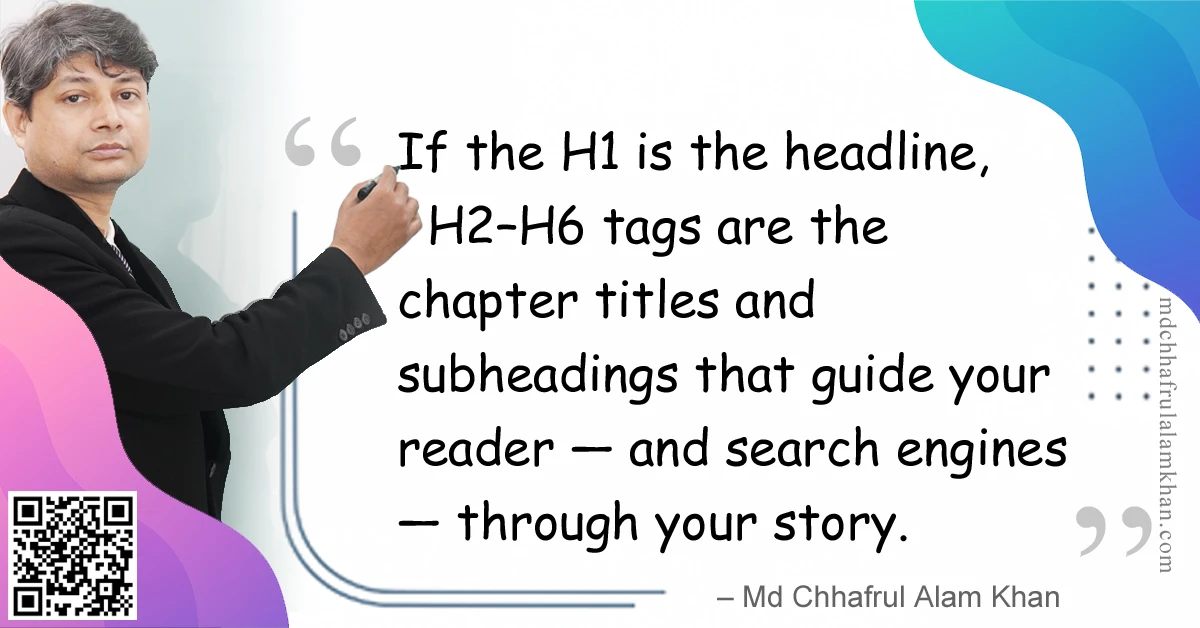
“If the H1 is the headline, H2–H6 tags are the chapter titles and subheadings that guide your reader — and search engines — through your story.”
– Md Chhafrul Alam Khan
🧭 What Are H2–H6 Tags?
In HTML, H2–H6 tags define secondary and deeper-level headings that organize content hierarchically.
- H2: Main sections under your H1
- H3: Subsections under H2
- H4–H6: Further nested subpoints for complex structures
Example:
<h1>Complete Guide to Social Media Marketing</h1>
<h2>1. Introduction</h2>
<h3>1.1 Why Social Media Matters</h3>
<h4>1.1.1 Brand Awareness</h4>
🎯 Why H2–H6 Optimization Matters
- Improved Readability
Breaks long content into digestible chunks for better user experience. - SEO Context Building
Helps search engines understand topic hierarchy and keyword relationships. - Accessibility & Screen Readers
Structured headings assist visually impaired users in navigating your content. - Featured Snippet Opportunities
Well-structured H2/H3s often get pulled into Google’s snippet boxes. - Engagement Boost
Clear subheadings encourage scrolling and reading.
📌 Best Practices for H2–H6 Tag Optimization
✅ 1. Maintain Logical Hierarchy
Never skip heading levels unnecessarily.
Correct:
<h1>Main Topic</h1>
<h2>Section</h2>
<h3>Subsection</h3>
Incorrect:
<h1>Main Topic</h1>
<h3>Subsection</h3>
✅ 2. Use Keywords Strategically
Include primary keywords in H2s and long-tail variations in H3–H6.
✅ 3. Keep Headings Descriptive
Avoid vague subheadings like “More Info” — be specific.
✅ 4. Make Them Skimmable
Write headings that allow readers to understand your article just by scanning.
✅ 5. Don’t Overuse Lower-Level Headings
H4–H6 should only be used if your content truly requires deeper structuring.
✅ 6. Style with CSS, Not Heading Abuse
Do not use heading tags purely for styling — use them for content hierarchy only.
📊 Example of Optimized Heading Structure
<h1>Ultimate Guide to Content Marketing</h1>
<h2>What is Content Marketing?</h2>
<h3>Definition and History</h3>
<h2>Content Marketing Strategies</h2>
<h3>Blogging</h3>
<h4>Choosing Topics</h4>
<h4>Writing for SEO</h4>
<h3>Video Content</h3>
<h2>Measuring Success</h2>
<h3>KPIs and Metrics</h3>
💼 Mini Case Study: Blog Engagement Growth
Problem:
A blog used multiple H1s and skipped directly to H4 for visual size control.
Solution:
Redesigned the hierarchy: one H1, H2 for main sections, H3 for subsections. Styled with CSS for visual needs.
Result:
✅ +27% average session duration
✅ Improved rankings for section-level keywords
🛠 Tools to Check Heading Structure
| Tool | Purpose |
|---|---|
| Screaming Frog SEO Spider | Detects missing/multiple headings |
| Ahrefs Site Audit | Finds keyword gaps in subheadings |
| Web Developer Toolbar | Visualizes heading outline |
| Sitebulb | Checks semantic heading structure |
⚠️ Common Mistakes to Avoid
❌ Skipping heading levels (e.g., H1 → H3 without H2)
❌ Using headings only for font size changes
❌ Keyword stuffing in subheadings
❌ Multiple H1s (reserve that for the main title)
💡 Pro Tips from My Experience
💎 Pro Tip 1: Treat H2s as mini headlines — they should be able to stand alone.
💎 Pro Tip 2: Use H3s for detailed steps, FAQs, or list sections.
💎 Pro Tip 3: Structure your H2/H3s to double as a table of contents for long-form articles.
🧠 FAQs on H2–H6 Tags
Q1: How many H2s can I have?
A: As many as needed — just maintain logical structure.
Q2: Should all H2s have keywords?
A: Not all, but most should contain relevant keyword variations.
Q3: Can I use H4–H6 often?
A: Only if your content naturally requires that depth.
Learn> >On-Page SEO >Off-Page SEO >Technical SEO >Local SEO >Next-Gen SEO
Remember:
“SEO is a journey, not a destination.”
– Md Chhafrul Alam Khan
Next Step 🚀
Master SEO from Beginner to Expert with our Free Online Self-Learning Course on SEO Mastery.
Learn> >On-Page SEO >Off-Page SEO >Technical SEO >Local SEO >Next-Gen SEO
Leave a Reply