
On-Page SEO Fundamentals↴
Core HTML & Metadata Optimization
>Title Tag Optimization
>Meta Description Optimization
>Meta Robots Tag Optimization
>Canonical URL Optimization
>Meta Charset Tag Optimization
>Viewport Meta Tag Optimization
Heading Structure Optimization
>Heading Tag H1 Optimization
>Heading Tags H2–H6 Optimization
>Heading Structure Best Practices
Content Optimization
>Keyword Targeting in Content
>Content Structure & Readability
>Content Depth & Word Count
>Multimedia Optimization
>Content Freshness & Updates
Internal Linking Optimization
>Internal Link Structure
>Anchor Text Optimization
>Fixing Orphan Pages
URL & Slug Optimization
Image Optimization
>Image File Naming for SEO
>Image Compression & Formats
>Image Alt Text & Title Attributes
Schema Markup & Structured Data
>Schema Markup Overview
>Common Schema Types
>Testing & Validating Schema
External & Outbound Links
>Outbound Link Quality & Relevance
>Nofollow, Sponsored & UGC Attributes
Page Experience & Engagement
>Core Web Vitals Optimization
>Mobile Friendliness
>Accessibility Standards for SEO
Crawl & Indexing Controls (On-Page)
Internal Link Structure: Building SEO Bridges Inside Your Website

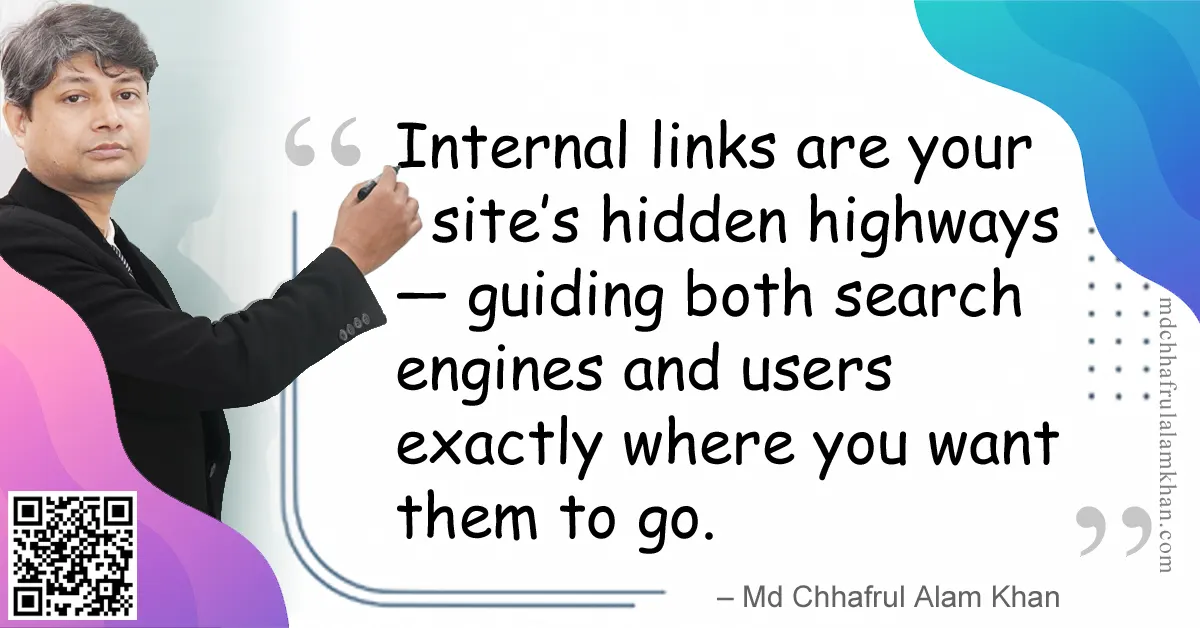
“Internal links are your site’s hidden highways — guiding both search engines and users exactly where you want them to go.”
– Md Chhafrul Alam Khan
🧭 What Is Internal Link Structure?
Your internal link structure is the way all the pages on your website are connected through hyperlinks.
It’s the blueprint that search engines use to understand your content hierarchy and the navigation map that guides visitors to discover more of your content.
Think of it as the road network of your website — if roads are broken or lead nowhere, traffic suffers.
🎯 Why Internal Link Structure Matters
- Improved Crawlability
- Helps search engines discover and index all important pages.
- SEO Authority Flow
- Distributes link equity (PageRank) across your site.
- Better User Experience (UX)
- Guides users logically to related content.
- Boost for Orphan Pages
- Pages with no internal links are harder to rank — proper linking fixes that.
- Enhanced AEO & GEO
- Well-linked content clusters are better understood by AI-powered search and generative engines.
📊 Types of Internal Links
| Link Type | Purpose | Example |
|---|---|---|
| Navigation Links | Core site structure | Menu, footer, sidebar |
| Contextual Links | In-content references | Linking related blog posts |
| Breadcrumbs | Show hierarchy | Home > Category > Post |
| Related Content Links | Encourage discovery | “You might also like…” |
| Call-to-Action Links | Conversion path | “Sign up here” |
📌 How to Build an Effective Internal Link Structure (Best Practices)
✅ 1. Follow a Logical Hierarchy
- Homepage → Category → Subcategory → Article.
✅ 2. Use Keyword-Rich Anchor Text
- Descriptive and relevant to the linked page.
✅ 3. Link to High-Priority Pages Often
- Boosts visibility and authority for your key content.
✅ 4. Avoid Over-Linking in One Section
- Keep it natural; too many links dilute value.
✅ 5. Fix Orphan Pages
- Ensure every important page has at least 2–3 internal links pointing to it.
✅ 6. Use Related Content Sections
- Keep users exploring your site longer.
🛠 Tools to Audit Internal Link Structure
| Tool | Purpose |
|---|---|
| Screaming Frog SEO Spider | Find orphan pages, broken links |
| Ahrefs Site Audit | Analyze internal link distribution |
| Google Search Console | See which pages get most internal links |
| Sitebulb | Visualize site architecture |
⚠️ Common Mistakes to Avoid
❌ Broken internal links — waste link equity and hurt UX.
❌ Using “click here” as anchor text — wastes SEO context.
❌ Too deep page depth — important pages should be reachable within 3 clicks.
❌ Overloading navigation menus — creates clutter.
💡 Pro Tips from My Experience
💎 Pro Tip 1: Cluster content by topic and link within the same cluster for topical authority.
💎 Pro Tip 2: Link from high-authority pages to newer pages to boost indexing speed.
💎 Pro Tip 3: Periodically update older articles with fresh internal links to newer relevant pages.
🧠 FAQs on Internal Link Structure
Q1: How many internal links should a page have?
A: There’s no fixed number — focus on relevance and usefulness.
Q2: Do internal links help SEO as much as backlinks?
A: Backlinks carry more external authority, but internal links are essential for distributing it.
Q3: Should I use nofollow on internal links?
A: Rarely — only for login, cart, or duplicate content pages.
Learn> >On-Page SEO >Off-Page SEO >Technical SEO >Local SEO >Next-Gen SEO
Remember:
“SEO is a journey, not a destination.”
– Md Chhafrul Alam Khan
Next Step 🚀
Master SEO from Beginner to Expert with our Free Online Self-Learning Course on SEO Mastery.
Learn> >On-Page SEO >Off-Page SEO >Technical SEO >Local SEO >Next-Gen SEO
Leave a Reply