
🌍 The Artificial Intelligence Encyclopedia
🧩 Large Language Models (LLMs) — How AI Understands and Writes Human Language

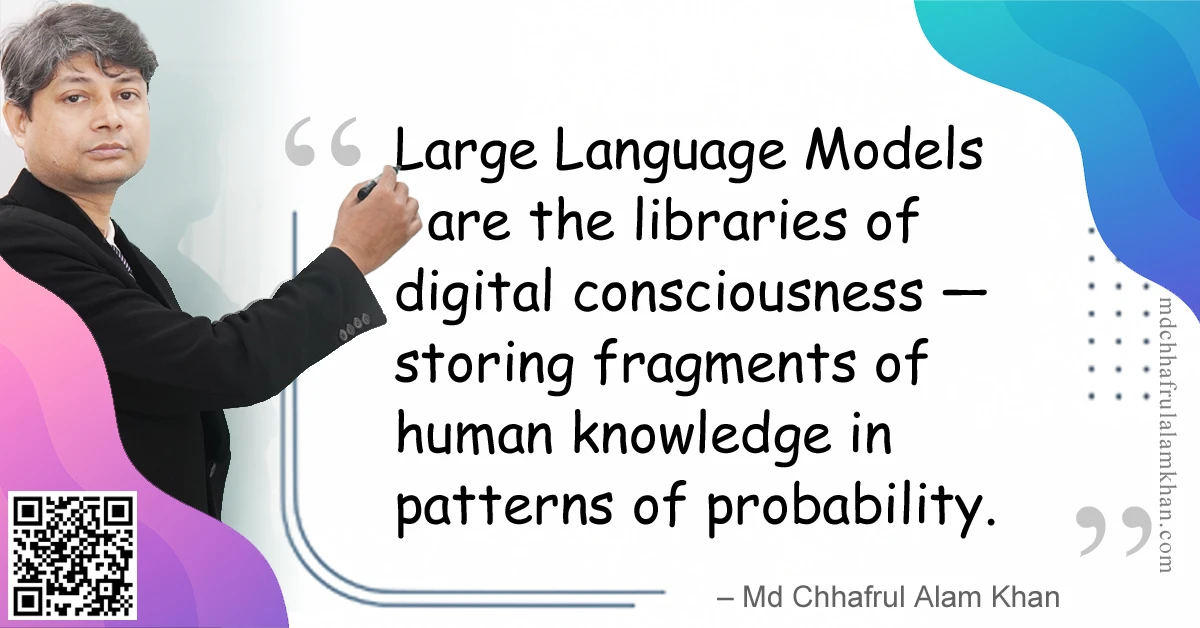
“Large Language Models are the libraries of digital consciousness — storing fragments of human knowledge in patterns of probability.”
– Md Chhafrul Alam Khan
🔹 Overview
Large Language Models (LLMs) are the core of modern Artificial Intelligence. They are the systems that understand, generate, and interact using human language — powering chatbots, assistants, search engines, and creative AI tools.
LLMs like GPT (OpenAI), Gemini (Google), Claude (Anthropic), and LLaMA (Meta) have transformed how humans communicate with technology. They learn from trillions of words, understand grammar and meaning, and can write essays, summarize research, translate languages, generate code, and reason through complex ideas.
This article explores what LLMs are, how they work, why they matter, and how they are reshaping every aspect of communication, learning, and creativity.
🔹 1. What Is a Large Language Model (LLM)?
A Large Language Model is an AI system trained on massive text datasets to learn patterns of language, semantic relationships, and contextual meaning.
Instead of memorizing, LLMs use statistical learning and neural architectures to predict the next word in a sequence, enabling them to form coherent, context-aware, and meaningful responses.
Simply put: LLMs read the world to learn how to speak it back intelligently.
🔹 2. The Core Mechanism — The Transformer Architecture
The foundation of LLMs is the Transformer, introduced by Google in 2017.
Transformers use a mechanism called Self-Attention, which allows the model to weigh the importance of each word in a sentence relative to others.
Key Components:
| Component | Function |
|---|---|
| Embedding Layer | Converts words into numerical vectors (tokens). |
| Self-Attention Mechanism | Identifies relationships between words in a sequence. |
| Feedforward Layers | Processes and refines context understanding. |
| Decoder Blocks | Generates meaningful outputs word-by-word. |
This architecture enables parallel training and long-context understanding, making Transformers vastly more powerful than previous models like RNNs and LSTMs.
🔹 3. How LLMs Learn
- Data Collection:
Models are trained on a diverse range of sources — books, articles, websites, academic papers, code, and social media. - Tokenization:
The text is broken into small pieces (tokens) that represent words or parts of words. - Training Objective:
The model learns to predict the next token based on all previous ones. - Fine-tuning:
After pretraining, it’s refined using specific datasets or Reinforcement Learning from Human Feedback (RLHF). - Inference:
Once trained, the model generates text, answers questions, or executes tasks using learned probabilities.
🔹 4. Major LLMs in the World
| Model | Developer | Distinct Feature |
|---|---|---|
| GPT-4 & GPT-5 | OpenAI | Multimodal, reasoning and creativity |
| Gemini 1.5 / 2 | Google DeepMind | Unified multimodal model (text, image, audio) |
| Claude 3 / Opus | Anthropic | Safety and context-based reasoning |
| LLaMA 3 | Meta AI | Open-source and customizable |
| Mistral / Mixtral | Mistral AI | Lightweight, efficient open models |
| Command-R / Cohere | Cohere | Retrieval and enterprise use |
| Yi, DeepSeek, Qwen | Asian AI Labs | Language and culture-specific advancements |
🔹 5. Capabilities of Large Language Models
- Text Understanding and Generation — writing essays, blogs, stories, and summaries.
- Code Generation and Debugging — building software with natural language commands.
- Translation and Multilingual Communication — bridging linguistic barriers.
- Reasoning and Decision Support — helping users think through complex issues.
- Knowledge Synthesis — combining information from multiple sources to form insights.
- Conversational Interaction — human-like chat experiences.
- Multimodal Integration — some LLMs process text, images, video, and audio together.
🔹 6. Reader Benefits
- Understanding Technology: Grasp the mechanism behind ChatGPT and similar AI tools.
- Professional Edge: Use LLMs to accelerate work, writing, or analysis.
- Innovation Readiness: Apply LLMs in business, design, or development.
- Ethical Awareness: Recognize the limitations and biases of generated content.
- Lifelong Learning: Discover how AI communicates — and how to communicate with AI better.
🔹 7. Limitations and Challenges
| Challenge | Description |
|---|---|
| Hallucination | LLMs can generate plausible but incorrect information. |
| Bias | Reflections of bias present in training data. |
| Energy Consumption | Training large models requires significant computational resources. |
| Context Limits | Limited “memory” for long conversations (context window). |
| Factuality and Verification | Requires human review for critical use cases. |
Ethical use of LLMs means combining AI generation with human judgment.
🔹 8. The Future of LLMs
- Multimodal Integration: Text, audio, video, and 3D models combined in one system.
- Personalized AI Models: User-trained assistants that adapt to your tone and needs.
- Agentic Intelligence: LLMs that autonomously plan and execute tasks.
- Hybrid Reasoning: Combining symbolic logic with neural networks.
- Quantum-Accelerated Learning: Faster, more efficient model training through quantum computing.
The future LLM won’t just understand words — it will understand intent, emotion, and context.
🔹 Quick Glossary
- LLM: Large Language Model — a deep learning system trained on massive text data.
- Token: Smallest text unit processed by the model.
- Transformer: Architecture enabling contextual understanding.
- RLHF: Reinforcement Learning from Human Feedback — fine-tuning with human evaluation.
- Context Window: The amount of text an LLM can process at once.
🔹 References
- Vaswani et al. (2017) — Attention Is All You Need
- OpenAI Technical Reports (GPT-3, GPT-4, GPT-5)
- Anthropic Research — Constitutional AI Papers
- Google DeepMind Gemini Whitepapers
- Stanford Center for Research on Foundation Models (CRFM)
🧭 Related Articles
- What Is Artificial Intelligence (AI)? — The Complete Definitive Guide
- AI vs Machine Learning vs Deep Learning — The Plain-English Difference
- Generative AI — How Machines Create Text, Images, and Beyond
- Prompt Engineering — The Art and Science of Talking to AI
- Ethics of Generative AI — Truth, Consent, and Creativity
Boost Your Knowledge & Skills 🚀
Digital Marketing Encyclopedia: The Complete Reference to Every Concept, Channel, and Strategy in Digital Marketing
You might like↴
- Artificial Intelligence in Marketing
- Prompt Engineering: The Art and Science of Talking to AI
- Instruction-Based Prompts: Mastering Clear Communication with AI
- Role-Playing Prompts: Unlocking Creative AI Interactions
- Few-Shot Prompts: Enhancing AI Performance with Context
- How to Become a Prompt Engineer: The Ultimate Guide
- Complete List of Prompt Engineering Job Titles
- AI Content Strategist Job Description | Skills, Salary & Career Outlook
- How to Become an AI Content Strategist
- AI Model Fine-Tuning Engineer Job Description | Skills, Salary & Career Outlook
- How to Become an AI Model Fine-Tuning Engineer
- Prompt Engineering Manager Job Description | Skills, Salary & Career Outlook
- How to Become a Prompt Engineering Manager
- Director of Prompt Engineering Job Description | Skills, Salary & Career Outlook
- How to Become a Director of Prompt Engineering
- AI Research Scientist Job Description | Skills, Salary & Career Outlook
- How to Become an AI Research Scientist
- VP of AI Experience Job Description | Skills, Salary & Career Outlook
- How to Become a VP of AI Experience
- Chief AI Interaction Officer Job Description | Skills, Salary & Career Outlook
- How to Become a Chief AI Interaction Officer
- Chief AI Officer Job Description | Skills, Salary & Career Outlook
- How to Become a Chief AI Officer
- Legal Prompt Engineer Job Description | Skills, Salary & Career Outlook
- How to Become a Legal Prompt Engineer
- Healthcare AI Prompt Engineer Job Description | Skills, Salary & Career Outlook
- How to Become a Healthcare AI Prompt Engineer
- Financial AI Prompt Developer Job Description | Skills, Salary & Career Outlook
- How to Become a Financial AI Prompt Developer
- Gaming AI Narrative Engineer Job Description | Skills, Salary & Career Outlook
- How to Become a Gaming AI Narrative Engineer
- E-commerce AI Content Engineer Job Description | Skills, Salary & Career Outlook
- How to Become an E-commerce AI Content Engineer
- Types of Prompts: Unlock Your Creativity with 80 Inspiring Categories for Every Thought, Reflection, and Imagination
- Is Artificial Intelligence Advancing Too Fast for Society to Keep Up?
- AI Encyclopedia
- What Is Artificial Intelligence (AI)?
- AI vs Machine Learning vs Deep Learning
- Generative AI
- Large Language Models (LLMs)
- Ethics of Generative AI
- AI and Copyright Ownership
- Responsible AI Development Frameworks
- AI and Law — Global Regulations
- AI and Human Rights — Ensuring Dignity in the Age of Automation
- AI and Society — Human-Centered Future
- AI and Education — Transforming Learning
- AI and the Future of Work — Jobs and Skills
- Search Ecosystem Optimization (SEO) Encyclopedia
Leave a Reply