
📖 Digital Marketing Encyclopedia – Chapter 33
Personalization & Predictive Marketing

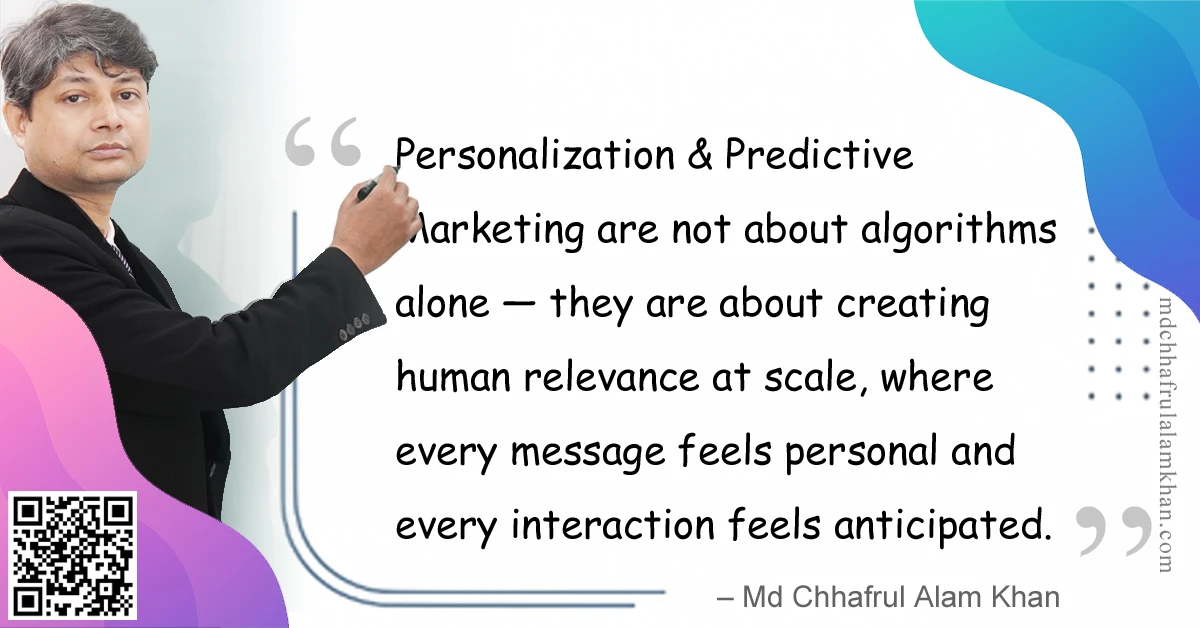
“Personalization & Predictive Marketing are not about algorithms alone — they are about creating human relevance at scale, where every message feels personal and every interaction feels anticipated.”
– Md Chhafrul Alam Khan
Introduction
Personalization & Predictive Marketing are data-driven approaches that transform how brands communicate with their audiences.
- Personalization ensures that customers receive tailored messages, products, and experiences based on their behavior, preferences, and history.
- Predictive Marketing leverages AI, machine learning, and analytics to forecast customer actions and proactively deliver the right message at the right time.
Together, they make marketing more relevant, efficient, and impactful, moving from generic campaigns to individualized journeys.
🔎 What is Personalization & Predictive Marketing?
- Personalization → Adjusting marketing experiences in real-time to match the customer’s profile.
- Predictive Marketing → Using data, AI, and statistical models to predict customer behavior (churn, purchase, engagement).
- These approaches combine to create customer-centric marketing with higher conversion rates and loyalty.
🧩 Core Elements of Personalization & Predictive Marketing
Data Collection & Integration
- Customer profiles from CRM, web analytics, and purchase history.
- Behavioral data (clicks, searches, cart activity).
- Social and demographic data.
Segmentation & Targeting
- Micro-segmentation based on interest, intent, and lifecycle stage.
- Contextual personalization (location, device, time).
Predictive Models
- Churn Prediction → Identify customers likely to leave.
- Purchase Probability → Predict likelihood of buying.
- Next-Best Action (NBA) → Suggest actions most likely to engage.
- Dynamic Pricing → Adjust pricing based on demand & user profile.
Delivery Channels
- Personalized email campaigns.
- AI-powered product recommendations.
- Chatbots & voice assistants with contextual replies.
- Personalized website experiences.
Measurement & Feedback
- Conversion lift due to personalization.
- Customer Lifetime Value (CLV).
- Engagement scores across campaigns.
📊 Example: Personalization in the Customer Journey
| Stage | Tactic | Purpose |
|---|---|---|
| Awareness | Personalized ad targeting | Capture attention with relevance |
| Consideration | Predictive product recommendations | Guide decision-making |
| Conversion | Dynamic pricing & tailored offers | Increase purchase likelihood |
| Retention | AI-driven loyalty campaigns | Encourage repeat buying |
| Advocacy | Personalized referral rewards | Turn customers into promoters |
🎯 Benefits of Personalization & Predictive Marketing
- Higher Engagement → Relevant messages increase response rates.
- Increased Conversions → Tailored offers boost purchases.
- Improved Loyalty → Customers feel valued and understood.
- Efficiency → Smarter targeting reduces wasted ad spend.
- Customer Insight → Predictions uncover hidden patterns.
- Competitive Edge → Anticipating needs builds trust.
🧭 Types of Personalization & Predictive Strategies
- Content Personalization → Blogs, emails, and landing pages tailored per user.
- Product Recommendations → “Customers also bought” or “For you” suggestions.
- Behavioral Triggers → Abandoned cart reminders, re-engagement campaigns.
- Predictive Segmentation → Grouping customers by likelihood of churn or purchase.
- AI Chatbots & Assistants → Deliver personalized support at scale.
🛠️ Tools for Personalization & Predictive Marketing
- Personalization Engines → Dynamic Yield, Optimizely, Adobe Target
- Predictive Analytics → Salesforce Einstein, IBM Watson, Microsoft Azure AI
- Email & Automation → Klaviyo, ActiveCampaign, HubSpot
- E-commerce Personalization → Nosto, Algolia, Bloomreach
- Data Platforms → Segment, Tealium, BlueConic
📊 Personalization vs. Predictive Marketing
| Aspect | Personalization | Predictive Marketing |
|---|---|---|
| Focus | Tailoring experiences in real-time | Forecasting future behavior |
| Data Use | Current & past data | Past + predictive AI modeling |
| Goal | Improve relevance | Anticipate needs |
| Technology | Automation & segmentation tools | AI & machine learning |
| Value | Short-term engagement | Long-term customer growth |
❓ Frequently Asked Questions
Q1: Do personalization and predictive marketing require AI?
Personalization can start simple; predictive marketing typically relies on AI.
Q2: Can small businesses use these strategies?
Yes — even small stores can use email personalization and basic predictive analytics.
Q3: Is predictive marketing always accurate?
No — predictions improve with more data and advanced models.
Q4: Does personalization impact SEO?
Indirectly — improved engagement signals (time on site, CTR) can boost SEO rankings.
✨ Final Thoughts
Personalization & Predictive Marketing transform marketing from reactive to proactive.
They create journeys where customers feel recognized, valued, and anticipated.
“The strongest brands don’t just talk to customers — they listen, predict, and personalize at scale.”
– Md Chhafrul Alam Khan
Want to build personalized and predictive campaigns that drive engagement and loyalty?
👉 Work with me to design AI-powered marketing strategies that connect deeply with your audience.
Boost Your Knowledge & Skills 🚀
Master SEO from Beginner to Expert with our Free Online Self-Learning Course on SEO Mastery.
You might like↴
- Content Creation Checklist (CCC)
- SEO Encyclopedia
- What Is SEO – Search Engine Optimization? [A Comprehensive Guide]
- How to Become an SEO Expert? A Step-by-Step Guide
- SEO Starter Guide: From Web Whispers to Search Engine Screams
- On-Page SEO Overview
- Title Tag Optimization
- Meta Description Optimization
- Meta Robots Tag Optimization
- Canonical URL Optimization
- Viewport Meta Tag Optimization
- Heading Tag H1 Optimization
- Heading Tags H2–H6 Optimization
- Heading Structure Best Practices
- Keyword Targeting in Content
- Content Structure & Readability
- Content Depth & Word Count
- Multimedia Optimization
- Content Freshness & Updates
- Internal Link Structure
- Anchor Text Optimization
- Fixing Orphan Pages
- SEO-Friendly URL Structure
- URL Parameters & Tracking Codes
- Image File Naming for SEO
- Image Compression & Formats
- Image Alt Text & Title Attributes
- Schema Markup Overview
- Common Schema Types
- Testing & Validating Schema
- Outbound Link Quality & Relevance
- Nofollow, Sponsored & UGC Attributes
- Core Web Vitals Optimization
- Mobile Friendliness
- Accessibility Standards for SEO
- Robots Meta Tag Usage
- Hreflang Implementation
- Manual On-Page SEO Audit Checklist
- On-Page SEO Tools & Software
- Competitor On-Page SEO Analysis
- Technical SEO
- Meta Charset Tag Optimization
- Pagination SEO
- Google Search Algorithm
- The future of SEO in a ChatGPT-dominated world
- SEO Mastery: Complete Course Content
- Lesson 01: What is SEO and Why Does It Matter?
- Lesson 02: Keyword Research Made Simple
- Lesson 03: On-Page SEO Basics
- Lesson 04: Technical SEO