
📖 Digital Marketing Encyclopedia – Chapter 51
Privacy & Compliance (GDPR, CCPA, Cookie-less Future)

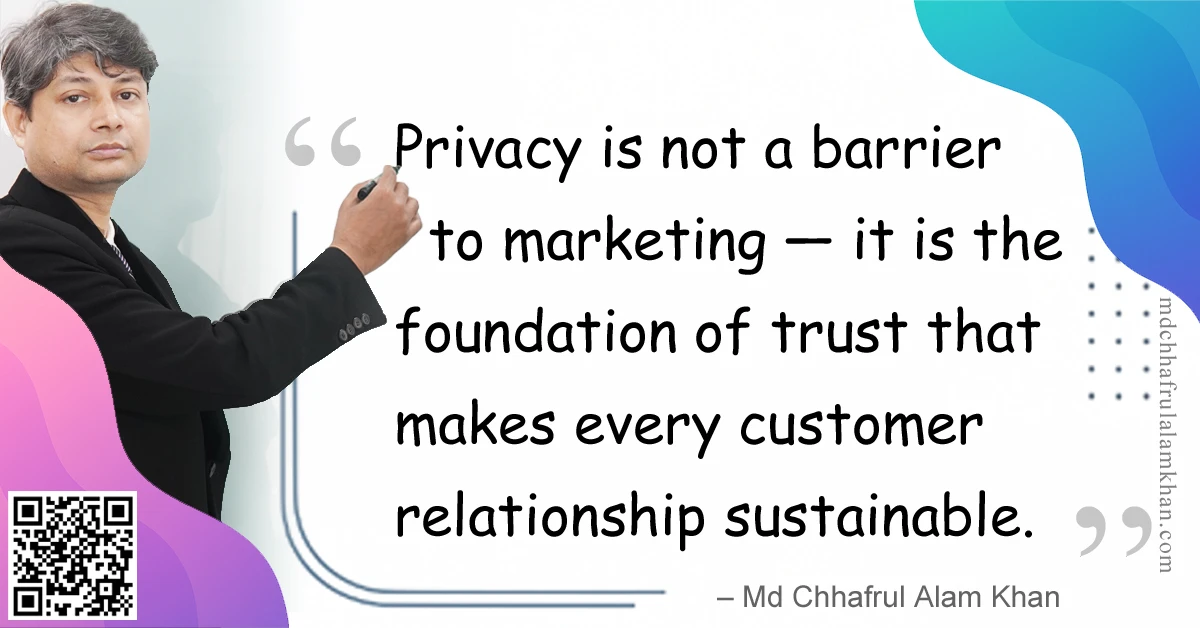
“Privacy is not a barrier to marketing — it is the foundation of trust that makes every customer relationship sustainable.”
– Md Chhafrul Alam Khan
Introduction
In the digital era, data powers personalization, targeting, and insights. But with great power comes great responsibility. Privacy & Compliance in marketing ensures that brands use customer data ethically, transparently, and legally.
With regulations like GDPR (Europe) and CCPA (California), and the coming cookie-less future, marketers must shift from invasive tracking to trust-based strategies that prioritize customer rights and consent.
🔎 What is Privacy & Compliance in Marketing?
- GDPR (General Data Protection Regulation) → EU law regulating personal data usage and requiring explicit consent.
- CCPA (California Consumer Privacy Act) → Gives California residents rights to control how businesses use their data.
- Cookie-less Future → The phase-out of third-party cookies in browsers, pushing marketers toward first-party data strategies.
Together, these frameworks shape how brands collect, store, and use data responsibly.
🧩 Core Elements of Privacy & Compliance
Transparency & Consent
- Clear opt-in policies.
- Easy-to-understand privacy notices.
- Consent banners for cookies & tracking.
Data Minimization
- Collect only necessary data.
- Store securely and delete when no longer needed.
First-Party Data Focus
- Collect data directly via websites, apps, and loyalty programs.
- Build stronger customer relationships without third-party trackers.
User Rights Management
- Allow users to access, update, or delete their data.
- Honor “Do Not Sell My Data” requests (CCPA).
Secure Data Practices
- Encrypt sensitive data.
- Regular audits and compliance checks.
📊 Example: Privacy & Compliance in the Customer Journey
| Stage | Privacy Strategy | Purpose |
|---|---|---|
| Awareness | Transparent privacy policies | Build initial trust |
| Consideration | Consent banners with choices | Empower users |
| Conversion | Secure checkout with opt-in | Increase confidence |
| Retention | Loyalty programs with first-party data | Maintain engagement safely |
| Advocacy | Transparency reports & compliance | Strengthen trust-based advocacy |
🎯 Benefits of Privacy & Compliance
- Trust & Loyalty → Customers value transparent brands.
- Competitive Edge → Privacy-respecting brands attract more users.
- Future-Proofing → Ready for cookie-less future & new laws.
- Risk Reduction → Avoid fines, penalties, and PR crises.
- Better Data Quality → First-party data is more accurate.
- Customer Empowerment → Users feel respected and valued.
🧭 Types of Privacy & Compliance Strategies
- First-Party Data Marketing → Surveys, loyalty programs, owned media.
- Contextual Advertising → Ads based on page content, not tracking.
- Privacy-Centric Analytics → GA4, Plausible, Matomo.
- Zero-Party Data Collection → Customers voluntarily share preferences.
- Privacy UX Design → Simple, user-friendly consent flows.
🛠️ Tools for Privacy & Compliance
- Consent Management → OneTrust, Cookiebot, TrustArc.
- Privacy-Friendly Analytics → Plausible, Matomo, Fathom Analytics.
- Data Security → AWS Shield, Cloudflare, GDPR-compliant storage.
- User Rights Management → Ethyca, Osano.
- Marketing Tools with Compliance → HubSpot, Klaviyo, Salesforce (GDPR-ready).
📊 Privacy vs. Personalization Balance
| Aspect | Privacy-Focused Marketing | Traditional Tracking Marketing |
|---|---|---|
| Data Collection | First-party, opt-in | Third-party, cookies |
| Trust Factor | High (transparent) | Low (hidden tracking) |
| Regulation Risk | Low | High |
| Personalization | Ethical, user-driven | Often intrusive |
| Future-Proofing | Strong | Weak (cookies disappearing) |
❓ Frequently Asked Questions
Q1: Will cookie-less marketing kill personalization?
No — personalization will shift to first-party and zero-party data strategies.
Q2: What happens if my business ignores GDPR or CCPA?
Fines can be enormous (GDPR fines can reach 4% of global annual revenue).
Q3: Is GA4 compliant with privacy laws?
Yes — GA4 offers privacy-first tracking but must be configured correctly.
Q4: Do customers really care about privacy?
Yes — studies show 70% of consumers prefer brands that protect their data.
✨ Final Thoughts
Privacy & Compliance are not roadblocks — they are the keys to trust-based marketing.
Brands that embrace privacy as a value, not just a regulation, will thrive in the future.
“The strongest marketers don’t just collect data — they earn it through trust, transparency, and respect.”
– Md Chhafrul Alam Khan
Want to future-proof your marketing in the privacy-first era?
👉 Work with me to design GDPR, CCPA, and cookie-less strategies that protect trust and drive growth.
Boost Your Knowledge & Skills 🚀
Master SEO from Beginner to Expert with our Free Online Self-Learning Course on SEO Mastery.
You might like↴
- Content Creation Checklist (CCC)
- SEO Encyclopedia
- What Is SEO – Search Engine Optimization? [A Comprehensive Guide]
- How to Become an SEO Expert? A Step-by-Step Guide
- SEO Starter Guide: From Web Whispers to Search Engine Screams
- On-Page SEO Overview
- Title Tag Optimization
- Meta Description Optimization
- Meta Robots Tag Optimization
- Canonical URL Optimization
- Viewport Meta Tag Optimization
- Heading Tag H1 Optimization
- Heading Tags H2–H6 Optimization
- Heading Structure Best Practices
- Keyword Targeting in Content
- Content Structure & Readability
- Content Depth & Word Count
- Multimedia Optimization
- Content Freshness & Updates
- Internal Link Structure
- Anchor Text Optimization
- Fixing Orphan Pages
- SEO-Friendly URL Structure
- URL Parameters & Tracking Codes
- Image File Naming for SEO
- Image Compression & Formats
- Image Alt Text & Title Attributes
- Schema Markup Overview
- Common Schema Types
- Testing & Validating Schema
- Outbound Link Quality & Relevance
- Nofollow, Sponsored & UGC Attributes
- Core Web Vitals Optimization
- Mobile Friendliness
- Accessibility Standards for SEO
- Robots Meta Tag Usage
- Hreflang Implementation
- Manual On-Page SEO Audit Checklist
- On-Page SEO Tools & Software
- Competitor On-Page SEO Analysis
- Technical SEO
- Meta Charset Tag Optimization
- Pagination SEO
- Google Search Algorithm
- The future of SEO in a ChatGPT-dominated world
- SEO Mastery: Complete Course Content
- Lesson 01: What is SEO and Why Does It Matter?
- Lesson 02: Keyword Research Made Simple
- Lesson 03: On-Page SEO Basics
- Lesson 04: Technical SEO