
📖 Digital Marketing Encyclopedia – Chapter 11
Social Media Marketing (SMM)

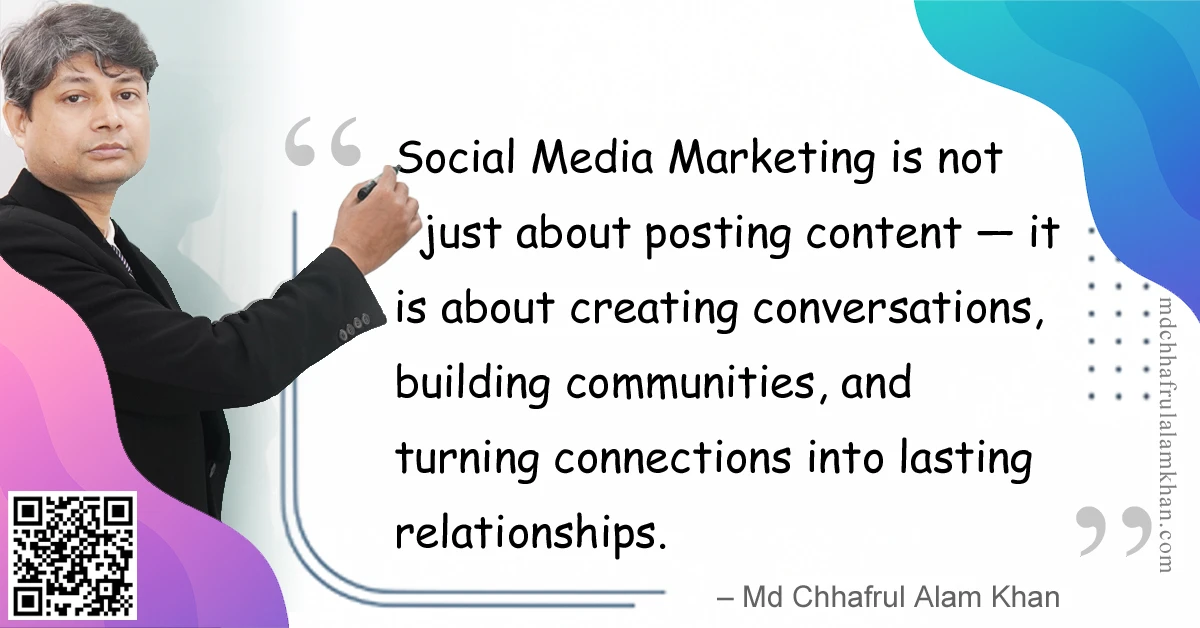
“Social Media Marketing is not just about posting content — it is about creating conversations, building communities, and turning connections into lasting relationships.”
– Md Chhafrul Alam Khan
Introduction
Social Media Marketing (SMM) is the strategic use of social platforms to promote brands, products, and services while engaging audiences in meaningful two-way interactions.
Unlike traditional one-directional communication, SMM thrives on community, user-generated content, real-time engagement, and data-driven targeting. It is one of the fastest-growing pillars of Digital Marketing, fueling awareness, engagement, reputation, and conversions.
🔎 What is Social Media Marketing?
- A digital strategy that leverages social platforms like Facebook, Instagram, LinkedIn, TikTok, Twitter/X, YouTube, and Pinterest.
- Builds brand awareness, customer loyalty, and measurable business growth.
- Integrates both organic (content, engagement, virality) and paid (ads, sponsorships, collaborations) approaches.
🧩 Core Elements of Social Media Marketing
Strategy
- Define goals (awareness, traffic, engagement, conversions).
- Identify target audience and buyer personas.
- Choose platforms aligned with audience behavior.
Content Creation
- Short-form: posts, stories, reels, memes.
- Long-form: videos, blogs, podcasts, live streams.
- Visual storytelling: carousels, infographics, branded templates.
Community Engagement
- Responding to comments, DMs, mentions.
- Creating polls, Q&As, contests.
- Encouraging user-generated content.
Advertising
- Paid campaigns with precise targeting.
- Retargeting ads for conversion optimization.
- Lookalike audience creation.
Analytics & Optimization
- Tracking KPIs (reach, engagement, CTR, conversions).
- A/B testing ad creatives and captions.
- Refining posting schedules with data insights.
📊 Example: SMM in the Customer Journey
| Stage | Social Media Format | Purpose |
|---|---|---|
| Awareness | Viral videos, reels, memes | Capture attention & go viral |
| Consideration | Tutorials, case studies, guides | Build trust & authority |
| Conversion | Paid ads, shoppable posts | Drive clicks & sales |
| Retention | Groups, communities, newsletters | Foster loyalty & repeat purchase |
| Advocacy | UGC, testimonials, hashtags | Amplify reach through customers |
🎯 Benefits of Social Media Marketing
- Global Reach → Access billions of users instantly.
- Engagement → Create conversations, not just impressions.
- Trust Building → Direct interaction enhances credibility.
- Cost-Effective → Organic visibility + paid ads = balance.
- Real-Time Feedback → Immediate audience response.
- Brand Personality → Humanizes brands through tone and storytelling.
🧭 Types of Social Media Marketing
- Organic SMM → Posting, engagement, community-building.
- Paid SMM → Ads, influencer partnerships, sponsored content.
- Influencer Marketing → Leveraging voices of authority.
- Social Commerce → Shoppable posts, in-app purchases.
- Employee Advocacy → Staff amplifying brand messaging.
- Crisis Management → Protecting reputation during issues.
🛠️ Tools for Social Media Marketing
- Scheduling & Management → Buffer, Hootsuite, Sprout Social
- Content Creation → Canva, Adobe Express, CapCut
- Analytics → Meta Business Suite, Google Analytics 4, Sprinklr
- Listening & Monitoring → Brandwatch, Mention, Talkwalker
- Advertising → Facebook Ads Manager, LinkedIn Campaign Manager, TikTok Ads
📊 SMM vs. Traditional Marketing
| Aspect | Social Media Marketing | Traditional Marketing |
|---|---|---|
| Communication | Two-way, interactive | One-way, broadcast |
| Cost | Low entry, scalable ads | High fixed costs |
| Targeting | Hyper-personalized, data-driven | Broad, less specific |
| Speed | Real-time, instant feedback | Delayed, slower response |
| Content Format | Dynamic, multimedia | Static, print/radio/TV |
❓ Frequently Asked Questions
Q1: Is Social Media Marketing only for big brands?
No — small businesses can build strong communities and niche authority with creative, consistent content.
Q2: How do I measure success in SMM?
Track KPIs like reach, impressions, engagement rate, CTR, leads, and conversions.
Q3: Which platform is best for SMM?
It depends on your audience. B2B thrives on LinkedIn, while B2C often succeeds on Instagram, TikTok, and Facebook.
Q4: How often should I post?
Quality > Quantity. Posting 3–5 times weekly with strong engagement is more effective than daily low-value posts.
✨ Final Thoughts
Social Media Marketing is the heartbeat of digital communication.
It builds trust through authenticity, loyalty through engagement, and growth through storytelling.
“The strongest brands don’t just sell on social media — they create conversations, inspire movements, and turn customers into advocates.”
– Md Chhafrul Alam Khan
Want to unlock the power of social media to grow your brand, community, and sales?
👉 Work with me to craft a Social Media Marketing strategy that inspires, engages, and converts.
Boost Your Knowledge & Skills 🚀
Master SEO from Beginner to Expert with our Free Online Self-Learning Course on SEO Mastery.
You might like↴
- Content Creation Checklist (CCC)
- SEO Encyclopedia
- What Is SEO – Search Engine Optimization? [A Comprehensive Guide]
- How to Become an SEO Expert? A Step-by-Step Guide
- SEO Starter Guide: From Web Whispers to Search Engine Screams
- On-Page SEO Overview
- Title Tag Optimization
- Meta Description Optimization
- Meta Robots Tag Optimization
- Canonical URL Optimization
- Viewport Meta Tag Optimization
- Heading Tag H1 Optimization
- Heading Tags H2–H6 Optimization
- Heading Structure Best Practices
- Keyword Targeting in Content
- Content Structure & Readability
- Content Depth & Word Count
- Multimedia Optimization
- Content Freshness & Updates
- Internal Link Structure
- Anchor Text Optimization
- Fixing Orphan Pages
- SEO-Friendly URL Structure
- URL Parameters & Tracking Codes
- Image File Naming for SEO
- Image Compression & Formats
- Image Alt Text & Title Attributes
- Schema Markup Overview
- Common Schema Types
- Testing & Validating Schema
- Outbound Link Quality & Relevance
- Nofollow, Sponsored & UGC Attributes
- Core Web Vitals Optimization
- Mobile Friendliness
- Accessibility Standards for SEO
- Robots Meta Tag Usage
- Hreflang Implementation
- Manual On-Page SEO Audit Checklist
- On-Page SEO Tools & Software
- Competitor On-Page SEO Analysis
- Technical SEO
- Meta Charset Tag Optimization
- Pagination SEO
- Google Search Algorithm
- The future of SEO in a ChatGPT-dominated world
- SEO Mastery: Complete Course Content
- Lesson 01: What is SEO and Why Does It Matter?
- Lesson 02: Keyword Research Made Simple
- Lesson 03: On-Page SEO Basics
- Lesson 04: Technical SEO
Leave a Reply