
🌍 The Artificial Intelligence Encyclopedia
🧠 What Is Artificial Intelligence (AI)? — The Complete Definitive Guide

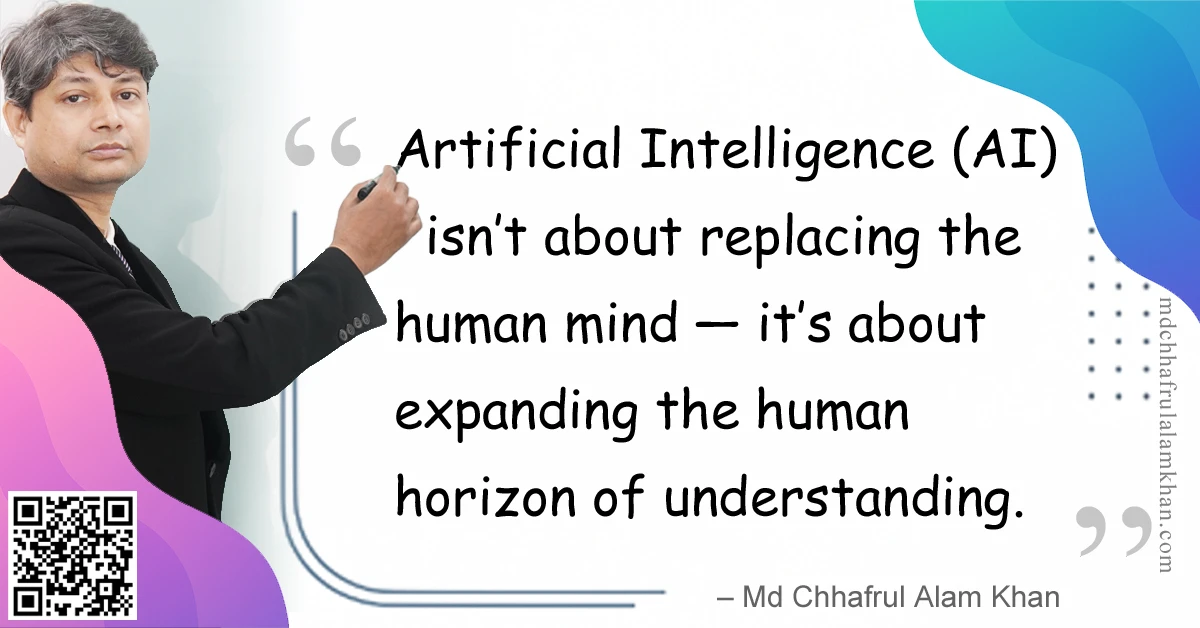
“Artificial Intelligence (AI) isn’t about replacing the human mind — it’s about expanding the human horizon of understanding.”
– Md Chhafrul Alam Khan
🔹 Overview
Artificial Intelligence (AI) is the scientific and engineering discipline that enables machines to perform tasks that normally require human intelligence. These tasks include understanding language, recognizing images, solving problems, reasoning, and even creating new ideas.
In essence, AI is the pursuit of replicating — and enhancing — human cognitive abilities through algorithms, data, and computational power.
This encyclopedia article serves as the global foundation for understanding AI in its entirety: its meaning, mechanisms, history, branches, applications, ethics, and its impact on humanity. It is designed to benefit learners, professionals, researchers, policymakers, and all readers worldwide.
🔹 1. Definition of Artificial Intelligence
Classical Definition
AI is the field of computer science dedicated to building systems that think, learn, and act intelligently.
This definition was first articulated by John McCarthy in 1956 at the Dartmouth Conference — the birthplace of the term Artificial Intelligence.
Modern Definition
AI is the science of creating algorithms and models that can learn from data, make predictions, generate insights, and adapt autonomously with minimal human intervention.
In today’s world, AI includes both symbolic systems (based on logic and rules) and learning systems (based on data and neural networks).
🔹 2. The Core Idea: Intelligence Through Computation
At the heart of AI lies one principle:
“If human reasoning can be described, it can be simulated.”
AI systems process data to:
- Perceive information (see, hear, read)
- Interpret patterns and relationships
- Decide or recommend actions
- Learn from outcomes and feedback
This creates a loop of artificial cognition — where machines evolve their understanding just as humans do through experience.
🔹 3. Types of Artificial Intelligence
| Type | Description | Example |
|---|---|---|
| Narrow AI (Weak AI) | Performs specific tasks extremely well | Siri, ChatGPT, recommendation systems |
| General AI (Strong AI) | Can understand and learn any intellectual task | Still theoretical (AGI research) |
| Super AI (ASI) | Surpasses human intelligence in every domain | Hypothetical future stage |
🔹 4. Core Subfields of AI
- Machine Learning (ML) – Systems that learn from data.
- Deep Learning (DL) – Multi-layered neural networks inspired by the brain.
- Natural Language Processing (NLP) – Understanding and generating human language.
- Computer Vision (CV) – Interpreting visual data.
- Robotics – Integrating AI with mechanical movement.
- Expert Systems – Decision-making based on predefined knowledge rules.
- Generative AI – Creating new content (text, images, video, code).
- Agentic AI – Self-directed, goal-seeking intelligent agents.
🔹 5. The Evolution of AI (Brief Timeline)
| Era | Breakthrough | Contribution |
|---|---|---|
| 1950s–1970s | Symbolic AI | Early reasoning and problem-solving systems |
| 1980s | Expert Systems | Domain-specific intelligence |
| 1990s | Machine Learning | Data-driven algorithms |
| 2000s | Big Data + Deep Learning | Large-scale pattern recognition |
| 2010s–2020s | Generative & Agentic AI | Machines that create and act autonomously |
🔹 6. How AI Works — The Simplified Process
- Data Collection — Gather raw data (text, images, audio, etc.).
- Preprocessing — Clean, label, and structure data.
- Model Selection — Choose appropriate algorithms (decision trees, neural networks, etc.).
- Training — Feed data to models to learn from patterns.
- Evaluation — Measure performance, accuracy, and bias.
- Deployment — Integrate the trained model into applications.
- Monitoring — Continuously improve through feedback and updates.
🔹 7. Real-World Applications
| Field | Example | Benefit |
|---|---|---|
| Healthcare | AI diagnostics, drug discovery | Early detection, improved accuracy |
| Finance | Fraud detection, trading bots | Risk reduction, automation |
| Marketing | Customer segmentation, personalization | Higher ROI, better engagement |
| Education | AI tutors, content generation | Personalized learning |
| Transportation | Self-driving cars, traffic prediction | Safety, efficiency |
| Environment | Climate modeling, energy optimization | Sustainability, conservation |
🔹 8. Reader Benefits: Why Understanding AI Matters
- Career Growth: Mastering AI ensures relevance in the future economy.
- Informed Decision-Making: Understanding AI helps individuals use technology wisely.
- Ethical Awareness: Encourages responsible innovation and prevention of bias or misuse.
- Productivity Boost: AI knowledge allows automation and efficiency in personal and professional life.
- Innovation Potential: Inspires creation of new tools, businesses, and solutions.
AI knowledge empowers every human being to participate in shaping the digital future rather than being shaped by it.
🔹 9. Ethical Considerations
- Bias and Fairness – AI must represent all communities equally.
- Privacy – Respect and protect user data.
- Transparency – Make AI decisions explainable.
- Accountability – Define responsibility for AI outcomes.
- Environmental Cost – Minimize energy consumption in model training.
🔹 10. The Future of AI
The next frontier of AI includes General Intelligence (AGI), Quantum AI, Bio-AI, and Emotionally Intelligent Systems.
AI will not replace humanity; rather, it will amplify it — empowering us to achieve more in science, education, creativity, and global collaboration.
🔹 Quick Glossary
- Algorithm: A set of rules for solving a problem.
- Dataset: A collection of structured or unstructured data.
- Neural Network: A system of nodes mimicking brain neurons.
- Training: Process of learning from data.
- Inference: Making predictions based on a trained model.
- Generative AI: AI that creates original output (e.g., text, art).
🔹 References
- Russell, S. & Norvig, P. — Artificial Intelligence: A Modern Approach
- Goodfellow, I., Bengio, Y., & Courville, A. — Deep Learning
- Stanford AI Index (2024 Edition)
- UNESCO — Ethical Principles of AI (2021)
- OECD — AI Governance Frameworks (2023)
🧭 Related Articles
- AI vs Machine Learning vs Deep Learning — The Plain-English Difference
- Generative AI — How Machines Create Text, Images, and Beyond
- History of Artificial Intelligence — From Turing to Transformers
- The Ethics of Artificial Intelligence — Balancing Innovation with Responsibility
- AI Applications in Daily Life — From Smartphones to Smart Cities
Boost Your Knowledge & Skills 🚀
Digital Marketing Encyclopedia: The Complete Reference to Every Concept, Channel, and Strategy in Digital Marketing
You might like↴
- Artificial Intelligence in Marketing
- Prompt Engineering: The Art and Science of Talking to AI
- Instruction-Based Prompts: Mastering Clear Communication with AI
- Role-Playing Prompts: Unlocking Creative AI Interactions
- Few-Shot Prompts: Enhancing AI Performance with Context
- How to Become a Prompt Engineer: The Ultimate Guide
- Complete List of Prompt Engineering Job Titles
- AI Content Strategist Job Description | Skills, Salary & Career Outlook
- How to Become an AI Content Strategist
- AI Model Fine-Tuning Engineer Job Description | Skills, Salary & Career Outlook
- How to Become an AI Model Fine-Tuning Engineer
- Prompt Engineering Manager Job Description | Skills, Salary & Career Outlook
- How to Become a Prompt Engineering Manager
- Director of Prompt Engineering Job Description | Skills, Salary & Career Outlook
- How to Become a Director of Prompt Engineering
- AI Research Scientist Job Description | Skills, Salary & Career Outlook
- How to Become an AI Research Scientist
- VP of AI Experience Job Description | Skills, Salary & Career Outlook
- How to Become a VP of AI Experience
- Chief AI Interaction Officer Job Description | Skills, Salary & Career Outlook
- How to Become a Chief AI Interaction Officer
- Chief AI Officer Job Description | Skills, Salary & Career Outlook
- How to Become a Chief AI Officer
- Legal Prompt Engineer Job Description | Skills, Salary & Career Outlook
- How to Become a Legal Prompt Engineer
- Healthcare AI Prompt Engineer Job Description | Skills, Salary & Career Outlook
- How to Become a Healthcare AI Prompt Engineer
- Financial AI Prompt Developer Job Description | Skills, Salary & Career Outlook
- How to Become a Financial AI Prompt Developer
- Gaming AI Narrative Engineer Job Description | Skills, Salary & Career Outlook
- How to Become a Gaming AI Narrative Engineer
- E-commerce AI Content Engineer Job Description | Skills, Salary & Career Outlook
- How to Become an E-commerce AI Content Engineer
- Types of Prompts: Unlock Your Creativity with 80 Inspiring Categories for Every Thought, Reflection, and Imagination
- Is Artificial Intelligence Advancing Too Fast for Society to Keep Up?
- AI Encyclopedia
- What Is Artificial Intelligence (AI)?
- AI vs Machine Learning vs Deep Learning
- Generative AI
- Large Language Models (LLMs)
- Ethics of Generative AI
- AI and Copyright Ownership
- Responsible AI Development Frameworks
- AI and Law — Global Regulations
- AI and Human Rights — Ensuring Dignity in the Age of Automation
- AI and Society — Human-Centered Future
- AI and Education — Transforming Learning
- AI and the Future of Work — Jobs and Skills
- Search Ecosystem Optimization (SEO) Encyclopedia
Leave a Reply