
📖 Digital Marketing Encyclopedia – Chapter 50
Generative Engines & Hyper-Personalization

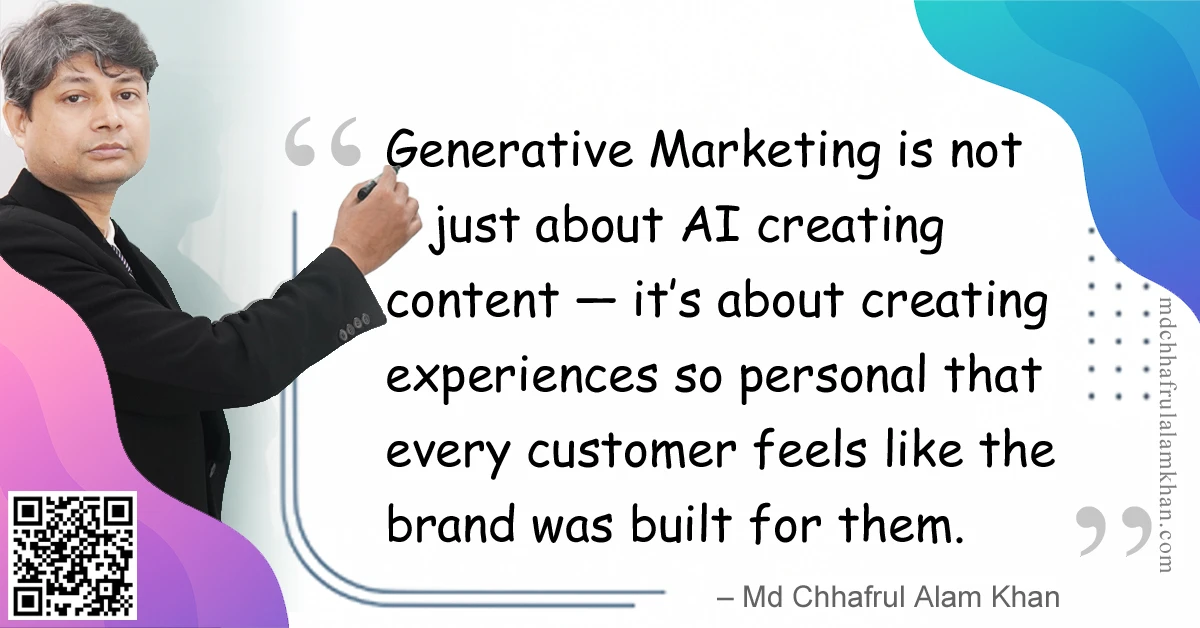
“Generative Marketing is not just about AI creating content — it’s about creating experiences so personal that every customer feels like the brand was built for them.”
– Md Chhafrul Alam Khan
Introduction
The rise of Generative AI has given birth to Generative Engines — platforms capable of producing personalized content, recommendations, and interactions at scale.
Combined with Hyper-Personalization, marketers can now deliver real-time, AI-powered experiences tailored to each customer’s context, intent, and preferences.
This chapter explores how generative technology is transforming marketing from one-to-many campaigns into one-to-one conversations at scale.
🔎 What are Generative Engines & Hyper-Personalization?
- Generative Engines → AI-powered platforms (ChatGPT, Claude, Gemini, MidJourney, etc.) that generate text, images, audio, and experiences.
- Hyper-Personalization → Using real-time data, AI, and predictive analytics to craft individualized customer journeys.
- Together, they create dynamic, adaptive, and deeply human-like marketing interactions.
🧩 Core Elements of Generative Engines & Hyper-Personalization
Data Integration
- Collect real-time customer data (behavioral, transactional, contextual).
- Build unified customer profiles.
AI-Powered Generation
- Personalized emails, chatbots, and content.
- Product recommendations in real-time.
- Dynamic ad creatives.
Predictive Personalization
- AI anticipates needs before customers express them.
- Example: Netflix recommending content, Amazon suggesting products.
Conversational Marketing
- Chatbots powered by LLMs for natural dialogue.
- Voice-enabled assistants for shopping and support.
Ethical Use
- Transparency in AI use.
- Avoiding over-intrusiveness in personalization.
- Ensuring compliance with GDPR and privacy laws.
📊 Example: Hyper-Personalization in the Customer Journey
| Stage | Strategy | Purpose |
|---|---|---|
| Awareness | Personalized ads via AI engines | Capture attention with relevance |
| Consideration | AI-driven recommendations | Build trust with tailored options |
| Conversion | Customized landing pages | Maximize conversion likelihood |
| Retention | Predictive offers & re-engagement | Strengthen loyalty |
| Advocacy | Personalized referral incentives | Encourage advocacy & sharing |
🎯 Benefits of Generative Engines & Hyper-Personalization
- Deeper Engagement → Customers interact with brand “personally.”
- Higher Conversions → Relevant experiences reduce friction.
- Scalability → One-to-one personalization at massive scale.
- Predictive Advantage → AI anticipates behavior before action.
- Content Efficiency → Automated generation of blogs, ads, and visuals.
- Customer Loyalty → Personalized journeys strengthen trust.
🧭 Types of Generative & Hyper-Personalized Strategies
- AI-Powered Chatbots & Assistants.
- Dynamic Email Campaigns → Personalized subject lines and offers.
- Real-Time Website Personalization.
- Generative Ad Creatives → Custom ad variations at scale.
- Voice & Conversational Commerce.
- Predictive Cross-Selling & Upselling.
🛠️ Tools for Generative Engines & Hyper-Personalization
- Generative AI → ChatGPT, Jasper, MidJourney, Synthesia.
- Personalization Engines → Dynamic Yield, Optimizely, Insider.
- Customer Data Platforms (CDPs) → Segment, BlueConic, Tealium.
- Predictive Analytics → Google AI, Salesforce Einstein.
- Marketing Automation → HubSpot, Marketo, Klaviyo.
📊 Generative Marketing vs. Traditional Personalization
| Aspect | Generative Engines & Hyper-Personalization | Traditional Personalization |
|---|---|---|
| Scale | One-to-one at massive scale | Limited segmentation |
| Data Use | Real-time, behavioral, predictive | Static, demographic-based |
| Content | AI-generated, adaptive | Pre-written, static |
| Experience | Conversational, dynamic | One-way, fixed |
| Future-Readiness | AI-driven, evolving | Outdated, manual |
❓ Frequently Asked Questions
Q1: Can small businesses use generative engines?
Yes — tools like ChatGPT and Jasper make AI marketing accessible.
Q2: Is hyper-personalization intrusive?
It can be — transparency and ethical use are key.
Q3: Do customers really prefer AI-driven personalization?
Yes — when it’s relevant, respectful, and saves time.
Q4: Will AI replace human marketers?
No — it will augment human creativity, not replace it.
✨ Final Thoughts
Generative Engines & Hyper-Personalization are the next frontier of digital marketing.
They enable deeply human, one-to-one experiences at infinite scale.
“The strongest brands don’t just use AI to generate content — they use AI to generate trust, relevance, and meaningful relationships.”
– Md Chhafrul Alam Khan
Want to leverage generative AI for hyper-personalized customer journeys?
👉 Work with me to design AI-powered strategies that engage and convert at scale.
Boost Your Knowledge & Skills 🚀
Master SEO from Beginner to Expert with our Free Online Self-Learning Course on SEO Mastery.
You might like↴
- Content Creation Checklist (CCC)
- SEO Encyclopedia
- What Is SEO – Search Engine Optimization? [A Comprehensive Guide]
- How to Become an SEO Expert? A Step-by-Step Guide
- SEO Starter Guide: From Web Whispers to Search Engine Screams
- On-Page SEO Overview
- Title Tag Optimization
- Meta Description Optimization
- Meta Robots Tag Optimization
- Canonical URL Optimization
- Viewport Meta Tag Optimization
- Heading Tag H1 Optimization
- Heading Tags H2–H6 Optimization
- Heading Structure Best Practices
- Keyword Targeting in Content
- Content Structure & Readability
- Content Depth & Word Count
- Multimedia Optimization
- Content Freshness & Updates
- Internal Link Structure
- Anchor Text Optimization
- Fixing Orphan Pages
- SEO-Friendly URL Structure
- URL Parameters & Tracking Codes
- Image File Naming for SEO
- Image Compression & Formats
- Image Alt Text & Title Attributes
- Schema Markup Overview
- Common Schema Types
- Testing & Validating Schema
- Outbound Link Quality & Relevance
- Nofollow, Sponsored & UGC Attributes
- Core Web Vitals Optimization
- Mobile Friendliness
- Accessibility Standards for SEO
- Robots Meta Tag Usage
- Hreflang Implementation
- Manual On-Page SEO Audit Checklist
- On-Page SEO Tools & Software
- Competitor On-Page SEO Analysis
- Technical SEO
- Meta Charset Tag Optimization
- Pagination SEO
- Google Search Algorithm
- The future of SEO in a ChatGPT-dominated world
- SEO Mastery: Complete Course Content
- Lesson 01: What is SEO and Why Does It Matter?
- Lesson 02: Keyword Research Made Simple
- Lesson 03: On-Page SEO Basics
- Lesson 04: Technical SEO