
📖 Digital Marketing Encyclopedia – Chapter 8
🌐 SEO Encyclopedia: The Complete Evergreen Guide to Search Optimization

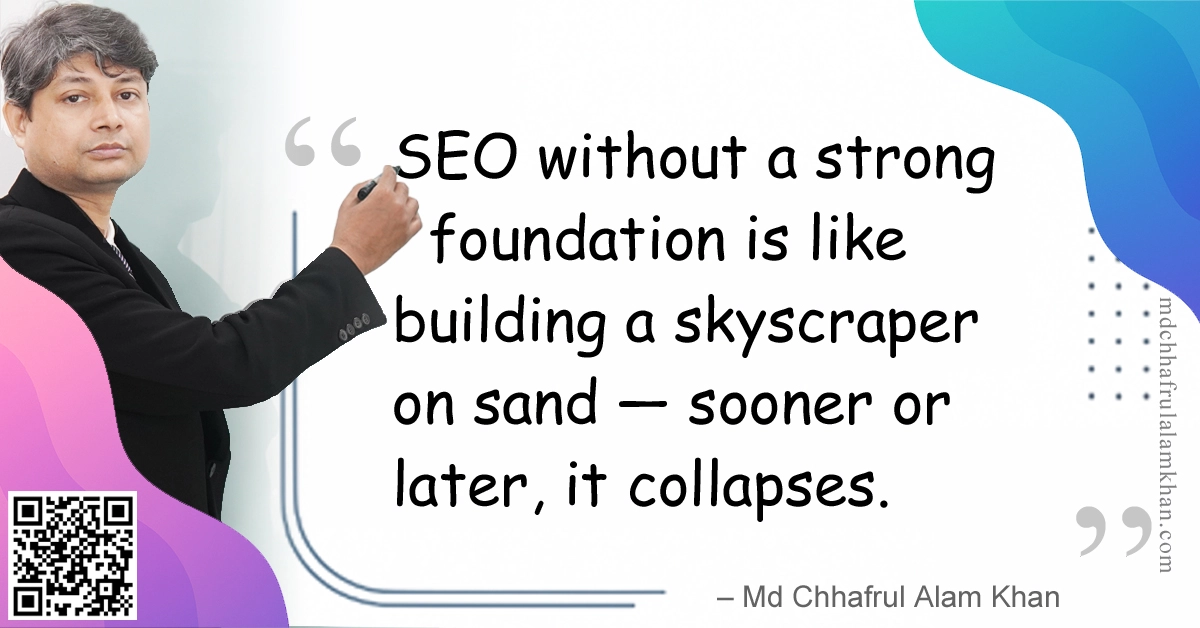
“SEO without a strong foundation is like building a skyscraper on sand — sooner or later, it collapses.”
– Md Chhafrul Alam Khan
Search Engine Optimization (SEO) is the backbone of Digital Marketing.
It ensures that your website and content are visible, relevant, and competitive in search engines like Google, Bing, and Yahoo. Unlike paid ads, SEO builds a long-term presence that generates free, organic traffic 24/7.
This encyclopedia entry is both a guide for beginners and a complete reference for professionals, covering every pillar, strategy, specialization, and tool of SEO.
📖 Table of Contents
- What is SEO?
- Why SEO Matters
- SEO Types List: Classic & Next-Gen
- Core SEO Types
- Search Intent & Content-Focused SEO
- Search Engine & Platform-Specific SEO
- Search Engine Algorithmic & Emerging SEO
- Industry & Goal-Specific SEO
- Risk, Compliance & Performance-Based SEO
- Analytical & Research-Driven SEO
- Holistic & Ecosystem SEO
- Benefits of SEO
- SEO Techniques & Best Practices
- SEO Tools & Platforms
- FAQs
- Final Thoughts
🔎 1. What is SEO?
Search Engine Optimization (SEO) is the process of optimizing websites and content to:
- Improve rankings in search results.
- Increase organic traffic.
- Build trust and authority.
SEO blends:
- Technical excellence (fast, secure, mobile-friendly websites).
- Content value (useful, relevant, optimized content).
- Authority signals (links, mentions, reviews).
“Search Engine Optimization (SEO) is the universal discipline of digital visibility. It goes beyond Google rankings — today SEO means being discoverable everywhere: in search engines, AI assistants, social platforms, video platforms, app stores, and maps.”
– Md Chhafrul Alam Khan
🎯 2. Why SEO Matters
- Visibility: Appear where people search.
- Trust: Higher rankings = more credibility.
- Cost-Effective: Traffic without paying for ads.
- User Experience: Better speed, design, and accessibility.
- Sustainability: Long-term growth compared to short-term paid ads.
🧩 3. SEO Types List: Classic & Next-Gen
Search Engine Optimization (SEO) has grown from simple keyword placement into a multi-layered ecosystem that powers the entire digital marketing world.
Here, I’ll cover all SEO types — from the classic foundations to the next-generation optimizations for AI and LLMs — making this the most complete encyclopedia of SEO types ever published.
3.1. Core SEO Types
On-Page SEO
Optimizing everything within the website: content, keywords, headings, meta tags, images, and internal linking.
Technical SEO
Enhancing the technical foundation: crawling, indexing, speed, security, Core Web Vitals, and site architecture.
Off-Page SEO
Building authority outside the website: backlinks, PR, brand mentions, influencer outreach.
3.2. Search Intent & Content-Focused SEO
Content SEO
Creating high-quality, user-intent-driven content that satisfies both readers and search engines.
Semantic SEO
Going beyond keywords to build topical authority using entities, synonyms, and semantic context.
Voice SEO (VSO)
Optimizing for conversational queries via voice assistants like Siri, Alexa, and Google Assistant.
Video SEO (VSEO)
Improving video discoverability on YouTube, TikTok, and search engines with optimized titles, metadata, and engagement signals.
Image SEO (ISO)
Enhancing image search visibility with alt text, sitemaps, schema, and fast-loading formats (WebP).
Podcast SEO (PSO)
Making podcasts searchable and discoverable through transcripts, metadata, and optimized descriptions.
3.3. Search Engine & Platform-Specific SEO
E-commerce SEO
Optimizing online stores (Shopify, WooCommerce, Magento) with structured product pages, reviews, and schema markup.
Local SEO
Boosting local presence with Google Business Profile, NAP consistency, reviews, and map pack rankings.
International SEO
Targeting multiple countries and languages with hreflang, geo-targeting, and cultural keyword research.
Mobile SEO
Delivering mobile-first experiences with responsive design, AMP, and mobile UX optimization.
App Store Optimization (ASO)
Improving mobile app visibility in Google Play and Apple App Store using titles, keywords, and reviews.
Amazon SEO
Optimizing product listings for Amazon’s A9 algorithm to increase conversions and visibility.
YouTube SEO
Ranking videos on YouTube search and recommendations through metadata, watch time, and thumbnails.
Social Media Optimization (SMO)
Enhancing social content and profiles for better reach, engagement, and brand visibility.
3.4. Search Engine Algorithmic & Emerging SEO
AI SEO / AIO (Artificial Intelligence Optimization)
Adapting content for AI-driven discovery and recommendation systems like Google SGE and ChatGPT.
AEO (Answer Engine Optimization)
Structuring content in Q&A and snippet-friendly formats to win direct answers in AI and search engines.
GEO (Generative Engine Optimization)
Creating content designed for generative AI outputs in platforms like Google SGE, Perplexity, and Claude.
LEO (LLM Engine Optimization)
Optimizing visibility inside Large Language Models (LLMs) by ensuring entity recognition, citations, and factual credibility.
Entity SEO / Knowledge Graph SEO
Building structured, entity-based content to appear in Google’s Knowledge Graph and AI knowledge bases.
Programmatic SEO
Automating SEO at scale with dynamic templates and data-driven landing pages.
Predictive SEO
Using AI, analytics, and trend forecasting to optimize for future queries before they rise.
SaaS SEO
Tailored SEO strategies for SaaS businesses, focusing on acquisition, onboarding, and churn reduction.
3.5. Industry & Goal-Specific SEO
Enterprise SEO
Scaling SEO across massive websites and international teams.
Startup SEO
Fast-growth strategies for early-stage businesses on limited budgets.
B2B SEO
Targeting professional buyers with high-value content and long sales cycles.
B2C SEO
Consumer-focused SEO that taps into high-volume and emotion-driven searches.
Nonprofit SEO
Improving visibility for NGOs and charitable organizations.
News & Media SEO
Optimizing content for real-time indexing in Google News, Discover, and trending results.
3.6. Risk, Compliance & Performance-Based SEO
White Hat SEO
Ethical SEO strategies that follow search engine guidelines.
Black Hat SEO
Manipulative practices like cloaking, keyword stuffing, and link schemes (not recommended).
Grey Hat SEO
Mix of both ethical and risky tactics — walking the fine line between safe and manipulative.
Negative SEO Defense
Protecting your site against harmful backlinks and malicious SEO attacks.
Sustainable / Evergreen SEO
Creating long-lasting SEO strategies with minimal risk of penalties.
Conversion SEO (CRO + SEO)
Aligning SEO efforts with conversion optimization to maximize business ROI.
Customer Experience Optimization (CXO)
Improving every step of the user journey to align SEO with customer satisfaction.
3.7. Analytical & Research-Driven SEO
Keyword SEO
Advanced keyword research, clustering, and intent analysis.
Competitor SEO / Gap Analysis
Reverse-engineering competitors to identify opportunities and outperform them.
Data-Driven SEO
Using analytics, log files, and A/B testing to guide strategies.
Knowledge Graph Optimization (KMO)
Structuring brand and entity data for semantic and AI-driven discovery.
3.8. Holistic & Ecosystem SEO
Marketing Ecosystem Optimization (MEO)
Integrating SEO with CRO, SMO, ASO, and paid marketing into a unified growth strategy.
Brand Reputation Optimization (BRO)
Managing reviews, PR, and trust signals to enhance brand authority.
Omnichannel Optimization (OO)
Ensuring a consistent brand experience across web, mobile, apps, social, and offline channels.
💡 4. Benefits of SEO
- Traffic Growth: More organic visitors.
- Higher ROI: Cost-effective over time.
- Brand Authority: Being visible in top results builds trust.
- Better UX: Speed, navigation, and mobile optimization.
- Competitive Advantage: Outperform rivals by ranking higher.
📊 5. SEO Techniques & Best Practices
- Use keywords naturally (avoid stuffing).
- Optimize titles, headings, meta tags.
- Build quality backlinks, not spam.
- Improve page speed & mobile design.
- Add schema markup for rich snippets.
- Publish evergreen, valuable content.
- Update old content regularly.
- Ensure clear site structure & navigation.
🛠️ 6. SEO Tools & Platforms
- Keyword Research: Google Keyword Planner, SEMrush, Ahrefs
- On-Page: Yoast SEO, Rank Math, SurferSEO
- Technical Audits: Screaming Frog, Sitebulb
- Backlinks: Ahrefs, Majestic, Moz
- Local SEO: BrightLocal, Whitespark
- Analytics: Google Analytics 4, Search Console, Looker Studio
❓ 7. Frequently Asked Questions
Q1: How long does SEO take to work?
Usually 3–6 months, depending on industry and competition.
Q2: Is SEO better than ads?
Both are needed. SEO = long-term sustainability, Ads = instant results.
Q3: Do small businesses need SEO?
Yes — local SEO especially helps small businesses compete.
Q4: What is the future of SEO?
AI-driven, entity-based, voice search, video dominance, and generative search engines.
Q5. What are the core types of SEO?
The three universally recognized core types are On-Page SEO, Technical SEO, and Off-Page SEO, with Local SEO as a specialized extension.
Q6. What is Next-Gen SEO?
Next-Gen SEO includes AI SEO (AIO), Answer Engine Optimization (AEO), Generative Engine Optimization (GEO), and LLM Engine Optimization (LEO), which focus on AI-driven discovery.
Q7. Is Local SEO different from International SEO?
Yes. Local SEO targets city/region-based searches, while International SEO manages multiple countries and languages.
Q8. What is LEO in SEO?
LEO stands for LLM Engine Optimization, focusing on optimizing visibility inside Large Language Models like ChatGPT, Gemini, Claude, and Perplexity.
✨ 8. Final Thoughts
SEO is the cornerstone of Digital Marketing.
- It makes businesses findable everywhere people search.
- It builds trust and long-term growth.
- It evolves continuously — from keywords to AI-driven generative optimization.
“The brands that succeed are those that treat SEO as a long-term investment in visibility, trust, and customer value.”
– Md Chhafrul Alam Khan
“Information is the primary key behind every success. SEO is the art of unlocking that information for the world.”
– Md Chhafrul Alam Khan
Want to build a strong SEO foundation and future-proof your digital presence?
👉 Work with me to design and optimize strategies that make your business visible everywhere humans search and everywhere AI generates.
“SEO is a journey, not a destination.”
– Md Chhafrul Alam Khan
Next Step 🚀
Master SEO from Beginner to Expert with our Free Online Self-Learning Course on SEO Mastery.
You might like↴
- Content Creation Checklist (CCC)
- SEO Encyclopedia
- What Is SEO – Search Engine Optimization? [A Comprehensive Guide]
- How to Become an SEO Expert? A Step-by-Step Guide
- SEO Starter Guide: From Web Whispers to Search Engine Screams
- On-Page SEO Overview
- Title Tag Optimization
- Meta Description Optimization
- Meta Robots Tag Optimization
- Canonical URL Optimization
- Viewport Meta Tag Optimization
- Heading Tag H1 Optimization
- Heading Tags H2–H6 Optimization
- Heading Structure Best Practices
- Keyword Targeting in Content
- Content Structure & Readability
- Content Depth & Word Count
- Multimedia Optimization
- Content Freshness & Updates
- Internal Link Structure
- Anchor Text Optimization
- Fixing Orphan Pages
- SEO-Friendly URL Structure
- URL Parameters & Tracking Codes
- Image File Naming for SEO
- Image Compression & Formats
- Image Alt Text & Title Attributes
- Schema Markup Overview
- Common Schema Types
- Testing & Validating Schema
- Outbound Link Quality & Relevance
- Nofollow, Sponsored & UGC Attributes
- Core Web Vitals Optimization
- Mobile Friendliness
- Accessibility Standards for SEO
- Robots Meta Tag Usage
- Hreflang Implementation
- Manual On-Page SEO Audit Checklist
- On-Page SEO Tools & Software
- Competitor On-Page SEO Analysis
- Technical SEO
- Meta Charset Tag Optimization
- Pagination SEO
- Google Search Algorithm
- The future of SEO in a ChatGPT-dominated world
- SEO Mastery: Complete Course Content
- Lesson 01: What is SEO and Why Does It Matter?
- Lesson 02: Keyword Research Made Simple
- Lesson 03: On-Page SEO Basics
- Lesson 04: Technical SEO
Leave a Reply