
📖 Digital Marketing Encyclopedia – Chapter 52
The Omnipresence Model – Everywhere Humans Search & AI Generates

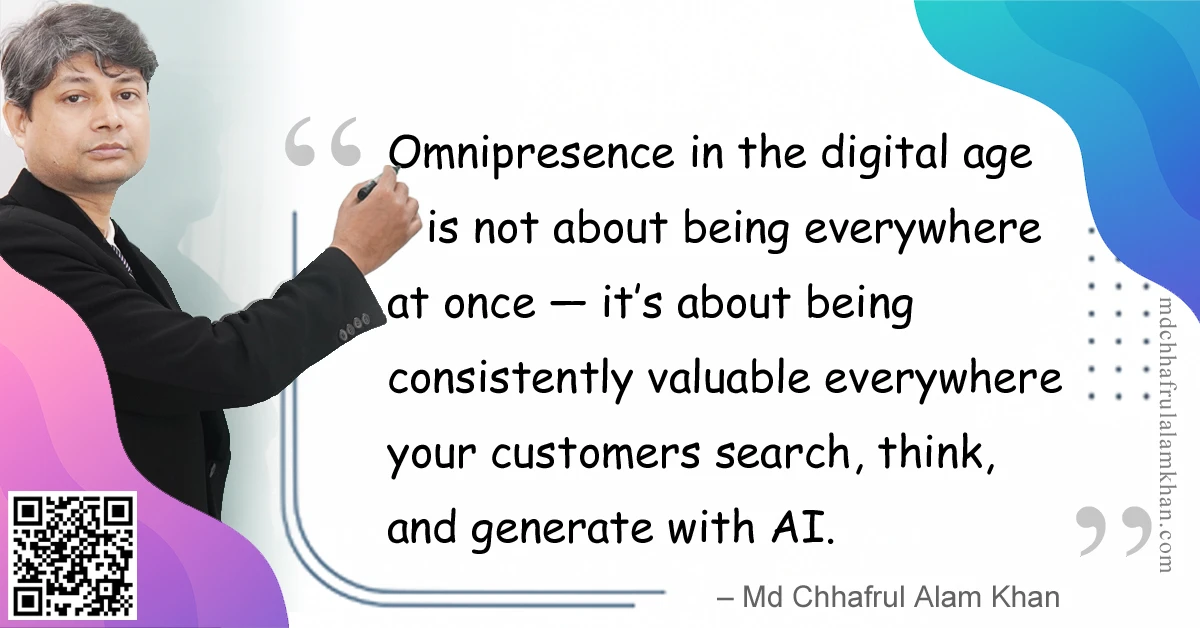
“Omnipresence in the digital age is not about being everywhere at once — it’s about being consistently valuable everywhere your customers search, think, and generate with AI.”
– Md Chhafrul Alam Khan
Introduction
The future of digital marketing is omnipresence — ensuring a brand’s visibility, relevance, and trust across every platform, device, and AI-driven engine.
As humans search through Google, YouTube, TikTok, and Maps, and as AI generates answers in ChatGPT, Gemini, Claude, and Perplexity, the brands that thrive are those that build a unified presence across all search and generative ecosystems.
The Omnipresence Model transforms marketing from a channel-based strategy into an everywhere, always-available, all-signal presence.
🔎 What is the Omnipresence Model?
- A digital marketing framework where brands maintain visibility and authority across all digital signals (search, social, voice, video, AI).
- Ensures that when customers search or ask AI engines, the brand appears as a trusted, recommended authority.
- Driven by multi-channel optimization, entity-based marketing, and AI alignment.
🧩 Core Elements of the Omnipresence Model
All-Signal SEO/Optimization
- Optimize for SEO, AIO (AI Optimization), VSO (Voice Search), VSEO (Video Search), ASO (App Store), and ESO (Entity SEO).
Content Ecosystem
- Build pillar content connected across blogs, videos, podcasts, and social posts.
- Repurpose content into AI-readable formats.
AI-Ready Branding
- Structured data + schema for AI training.
- Verified Knowledge Graph presence.
- Consistent NAP (Name, Address, Phone) across the web.
Cross-Platform Consistency
- Brand message, visuals, and tone aligned across all channels.
- Unified campaigns running in search, social, and AI ecosystems.
Data & Feedback Loops
- Analyze performance across search engines, AI assistants, and platforms.
- Adapt content for emerging generative platforms.
📊 Example: Omnipresence in the Customer Journey
| Stage | Omnipresence Strategy | Purpose |
|---|---|---|
| Awareness | SEO + AI snippet optimization | Ensure discovery in search & AI |
| Consideration | Cross-channel reviews & UGC | Build trust across platforms |
| Conversion | Consistent CTAs across web & AI | Drive seamless action |
| Retention | Loyalty programs across apps & AI | Keep customers engaged |
| Advocacy | Omnipresent storytelling | Amplify advocacy across networks |
🎯 Benefits of the Omnipresence Model
- Maximum Visibility → Appear in search, social, and AI simultaneously.
- AI Trust Signals → Align with generative engines as a source of truth.
- Seamless User Experience → Customers find you everywhere consistently.
- Competitive Edge → Most brands focus on one or two channels, not all.
- Future-Proofing → Adaptable to new platforms and AI shifts.
- Authority Building → Consistent omnipresence creates thought leadership.
🧭 Types of Omnipresence Strategies
- Search Omnipresence → SEO, paid ads, knowledge panels.
- AI Omnipresence → Optimize for ChatGPT, Gemini, Perplexity, Claude.
- Content Omnipresence → Blogs, podcasts, videos, infographics interconnected.
- Brand Omnipresence → Unified visuals and messaging across platforms.
- Community Omnipresence → Active presence in forums, groups, and communities.
🛠️ Tools for the Omnipresence Model
- SEO & Entity Tools → SEMrush, Ahrefs, InLinks, WordLift.
- AI Optimization Tools → Jasper, SurferSEO, AIO dashboards.
- Content Distribution → Buffer, Hootsuite, Repurpose.io.
- Analytics & Insights → GA4, Search Console, Brand24, BuzzSumo.
- Knowledge Graph Tools → Kalicube Pro, Schema.org, Wikidata.
📊 Omnipresence vs. Multichannel Marketing
| Aspect | Omnipresence Model | Multichannel Marketing |
|---|---|---|
| Focus | All signals (search + AI) | Individual channels |
| Visibility | Everywhere customers look | Limited to chosen platforms |
| Consistency | Unified messaging | Variable messaging |
| Future-Readiness | AI-driven, adaptive | Risk of obsolescence |
| Authority | Recognized entity across systems | Fragmented presence |
❓ Frequently Asked Questions
Q1: Isn’t omnipresence too resource-heavy?
Yes, but tools + repurposing make it scalable. Focus first on core platforms + AI readiness.
Q2: How do I know if my brand is AI-visible?
Test queries in AI engines (ChatGPT, Gemini, Claude) and monitor mentions.
Q3: Does omnipresence mean being on every platform?
Not necessarily — it means being consistently visible where your audience is.
Q4: Is the Omnipresence Model only for big brands?
No — even small businesses can apply omnipresence with strategic focus and AI-aligned content.
✨ Final Thoughts
The Omnipresence Model is the ultimate state of digital visibility.
It ensures your brand is found, trusted, and recommended — everywhere humans search and everywhere AI generates.
“The strongest brands don’t chase platforms — they build ecosystems of omnipresence that adapt to every new wave of search and AI innovation.”
– Md Chhafrul Alam Khan
Want to achieve true digital omnipresence?
👉 Work with me to design an omnipresence strategy that makes your brand visible everywhere humans search and AI generates.
Boost Your Knowledge & Skills 🚀
Master SEO from Beginner to Expert with our Free Online Self-Learning Course on SEO Mastery.
You might like↴
- Content Creation Checklist (CCC)
- SEO Encyclopedia
- What Is SEO – Search Engine Optimization? [A Comprehensive Guide]
- How to Become an SEO Expert? A Step-by-Step Guide
- SEO Starter Guide: From Web Whispers to Search Engine Screams
- On-Page SEO Overview
- Title Tag Optimization
- Meta Description Optimization
- Meta Robots Tag Optimization
- Canonical URL Optimization
- Viewport Meta Tag Optimization
- Heading Tag H1 Optimization
- Heading Tags H2–H6 Optimization
- Heading Structure Best Practices
- Keyword Targeting in Content
- Content Structure & Readability
- Content Depth & Word Count
- Multimedia Optimization
- Content Freshness & Updates
- Internal Link Structure
- Anchor Text Optimization
- Fixing Orphan Pages
- SEO-Friendly URL Structure
- URL Parameters & Tracking Codes
- Image File Naming for SEO
- Image Compression & Formats
- Image Alt Text & Title Attributes
- Schema Markup Overview
- Common Schema Types
- Testing & Validating Schema
- Outbound Link Quality & Relevance
- Nofollow, Sponsored & UGC Attributes
- Core Web Vitals Optimization
- Mobile Friendliness
- Accessibility Standards for SEO
- Robots Meta Tag Usage
- Hreflang Implementation
- Manual On-Page SEO Audit Checklist
- On-Page SEO Tools & Software
- Competitor On-Page SEO Analysis
- Technical SEO
- Meta Charset Tag Optimization
- Pagination SEO
- Google Search Algorithm
- The future of SEO in a ChatGPT-dominated world
- SEO Mastery: Complete Course Content
- Lesson 01: What is SEO and Why Does It Matter?
- Lesson 02: Keyword Research Made Simple
- Lesson 03: On-Page SEO Basics
- Lesson 04: Technical SEO