
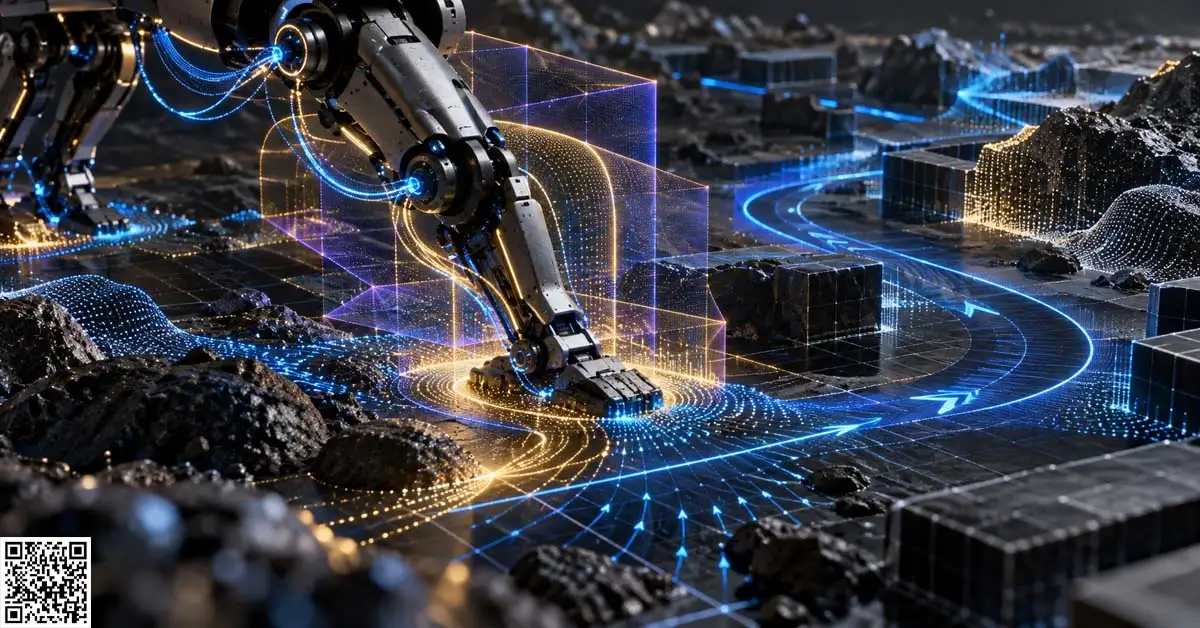
Embodied and situated intelligence represent foundational approaches to understanding intelligent behaviour as a product of continuous interaction among an agent’s computational or biological processes, its physical or functional embodiment, and the environment in which it operates.
Unlike approaches that treat intelligence primarily as the manipulation of abstract representations within an isolated processing system, embodied intelligence emphasizes the contribution of bodily structure, sensory capabilities, movement, material properties, and sensorimotor interaction to cognition.
Situated intelligence emphasizes that intelligent behaviour occurs within particular environmental, social, temporal, and operational circumstances. Perception, action, reasoning, and decision-making are shaped by the opportunities, constraints, and information available in those circumstances.
Together, these approaches challenge the assumption that intelligence can always be adequately understood by separating a decision-making mechanism from the world in which its decisions acquire meaning.
A mobile robot navigating an unfamiliar room must interpret sensor information, estimate its position, respond to obstacles, and continuously modify its actions. A human manipulating an unfamiliar object learns about its properties through touch, movement, and feedback. An artificial agent interacting with software must interpret interface states, identify available operations, and adapt when external conditions change.
These examples illustrate a central principle: intelligent behaviour depends not only on the information an agent possesses, but also on how it perceives, acts within, and adapts to its environment.
Embodied and situated intelligence are essential foundations for robotics, autonomous vehicles, developmental AI, adaptive control, human–robot interaction, simulation-based learning, vision-language-action models, and the emerging development of more broadly capable physical AI systems.
However, embodiment does not automatically produce intelligence, and successful performance in one environment does not establish general intelligence or robust adaptation to unfamiliar conditions.
The scientific challenge is to identify how cognitive capabilities emerge from agent–environment interactions, which computational and physical mechanisms support those capabilities, and how such systems can be evaluated and deployed safely.
1. DEEP DEFINITION
1.1. What Is Embodied Intelligence?
Embodied intelligence refers to intelligent behaviour in which an agent’s physical or functionally situated structure, sensory systems, action capabilities, and interactions with its environment play important roles in producing cognition and adaptive performance.
In biological organisms, embodiment includes the nervous system, sensory organs, musculoskeletal structure, physiological capabilities, and bodily interactions with the world.
In artificial systems, embodiment commonly involves sensors, actuators, mechanical structures, computational controllers, and the physical dynamics governing their operation.
Examples include:
- A robot using tactile feedback to adjust its grasp.
- An autonomous vehicle interpreting camera and lidar information while navigating traffic.
- A robotic arm learning how different objects respond to manipulation.
- A walking robot exploiting the mechanical properties of its legs.
- A human learning an unfamiliar physical skill through repeated movement and feedback.
- An assistive robot adapting its actions to a changing home environment.
The central claim is that an agent’s body is not merely an output mechanism controlled by a detached computational system.
Its structure and interaction with the environment can influence which problems the agent encounters, what information becomes available, and how difficult particular control or reasoning tasks are.
Pfeifer and Bongard developed this perspective extensively, emphasizing how bodily morphology and material properties can enable or constrain intelligent behaviour [12].
1.2. What Is Situated Intelligence?
Situated intelligence refers to intelligent behaviour understood in relation to the immediate and broader circumstances in which an agent operates.
These circumstances may include:
- Physical location.
- Available resources.
- Environmental constraints.
- Time pressure.
- Social relationships.
- Cultural expectations.
- Current task requirements.
- Interaction history.
- Available tools.
- Uncertainty and changing conditions.
Situated cognition emphasizes that reasoning and action cannot always be adequately explained through context-independent rules or fixed internal plans.
Lucy Suchman’s Plans and Situated Actions provided an influential analysis of how human action emerges through interaction with specific circumstances rather than simply following fully predetermined plans [2].
A plan may guide action, but actual behaviour often requires interpretation, improvisation, and adjustment in response to unfolding events.
For example, an AI warehouse system may have a planned route between two storage locations.
When an unexpected obstacle appears, intelligent execution requires recognizing the changed situation, evaluating alternative actions, and revising the route.
The original plan remains useful, but successful behaviour depends on situated adaptation.
1.3. Embodied Intelligence Versus Situated Intelligence
The concepts overlap but emphasize different dimensions of intelligent behaviour.
| Dimension | Embodied intelligence | Situated intelligence |
|---|---|---|
| Primary emphasis | Body, sensors, actuators, and sensorimotor coupling | Context, environment, circumstances, and interaction |
| Central question | How does an agent’s embodiment shape its cognitive capabilities? | How does the current situation shape intelligent behaviour? |
| Main mechanisms | Perception, movement, morphology, physical feedback | Context-sensitive reasoning, adaptation, environmental interpretation |
| Typical example | A robotic hand adjusting grip force | A robot modifying its plan when the situation changes |
| Environmental relationship | Physical and functional coupling | Dependence on operating circumstances |
| Application | Robotics, manipulation, locomotion, sensorimotor learning | Situated planning, adaptive agents, human–computer interaction |
| Main limitation | Physical and sensorimotor constraints | Context dependence and limited transfer |
An embodied system is necessarily situated in some operating context.
However, a situated system does not necessarily require a biological body or physical robotic form.
For example, a software agent interacting with a dynamic business application may demonstrate situated decision-making through context-sensitive interpretation and action.
That does not make the software agent physically embodied in the same sense as a mobile robot.
Physical embodiment, virtual interaction, and situational awareness should therefore be distinguished rather than treated as identical properties.
1.4. The Agent–Body–Environment Relationship
Traditional computational descriptions often represent an agent as a function that maps observations to actions.
An embodied approach expands this description by emphasizing that observations and action consequences depend on the agent’s body and the physical environment.
Let:
- xₜ represent the internal state of the agent.
- bₜ represent its bodily or mechanical state.
- eₜ represent the environmental state.
- oₜ represent available observations.
- aₜ represent selected actions.
A simplified coupled system can be expressed as:
oₜ = H(bₜ, eₜ, νₜ)
aₜ = π(xₜ, oₜ, G)
bₜ₊₁ = Fᵦ(bₜ, eₜ, aₜ, ξₜ)
eₜ₊₁ = Fₑ(eₜ, bₜ, aₜ, ζₜ)
Where:
- H represents the observation process.
- π represents the action-selection policy.
- G represents the current goal.
- Fᵦ represents bodily dynamics.
- Fₑ represents environmental dynamics.
- νₜ, ξₜ, and ζₜ represent relevant disturbances or uncertainty.
These equations provide an analytical representation rather than a universal biological model.
They illustrate that an agent’s behaviour depends on feedback between its internal processes, physical configuration, and environmental conditions.
A decision changes the environment, which affects subsequent observations, which in turn influences later decisions.
This continuous coupling is central to embodied intelligence.
1.5. The Perception–Action Loop
The perception–action loop describes the ongoing relationship between sensing and behaviour.
An embodied agent does not necessarily perceive the world once and then execute an entire sequence of actions without further observation.
Instead, perception and action can continuously influence one another.
The basic cycle is:
Observe → Interpret → Select Action → Act → Receive Feedback → Adapt
Consider a robot approaching an object.
Its camera estimates the object’s location.
The robot moves closer.
The new viewpoint provides more detailed visual information.
The robot adjusts its position.
Contact sensors detect physical interaction.
The control system modifies the applied force.
Successful manipulation emerges through the interaction of perception, action, and feedback.
This process may include both reactive control and predictive planning.
The existence of a feedback loop does not mean that every intelligent agent must reject internal representations or long-term plans.
Rather, it establishes that real-world intelligence frequently requires coordination between internal computation and ongoing environmental interaction.
1.6. Ecological Psychology and Affordances
James J. Gibson’s ecological approach to perception introduced an influential framework for understanding how organisms perceive meaningful possibilities for action within their environments [1].
A central concept is the affordance.
An affordance describes an action possibility arising from the relationship between an agent’s capabilities and environmental properties.
For example:
- A surface may afford walking for a particular organism.
- A handle may afford grasping for a suitably equipped agent.
- A passage may afford traversal for a robot of appropriate dimensions.
- A platform may afford support under suitable weight and stability conditions.
Affordances are relational.
An object does not necessarily afford the same action to every agent.
A narrow opening may be traversable by a small mobile robot but inaccessible to a larger robot.
A heavy object may be movable by an industrial manipulator but not by a small educational robot.
A conceptual affordance function can be expressed as:
A_afford(b, e) = {a ∈ A : Feasible(a | b, e)}
Where:
- b represents the agent’s bodily capabilities.
- e represents the environmental conditions.
- A represents candidate actions.
- Feasible identifies actions permitted by the relevant physical and functional constraints.
This is an engineering abstraction rather than Gibson’s original formal notation.
It captures the idea that opportunities for action depend on both the environment and the agent.
1.7. Grounded Cognition and Sensorimotor Representation
Grounded cognition refers to approaches proposing that cognitive processes are substantially connected to perception, action, bodily states, and situated experience.
Lawrence Barsalou’s review examined evidence and theories supporting relationships between conceptual knowledge and systems involved in perception, action, and simulation [13].
For example, human understanding of physical actions may draw partly upon neural systems associated with movement and perceptual experience.
However, grounded cognition encompasses different theoretical positions.
Not all researchers agree on the extent to which abstract concepts depend on sensorimotor representations.
Nor does grounded cognition establish that symbolic representations are unnecessary for every form of reasoning.
A useful distinction is:
Grounding: Connecting representations or computational outputs to relevant perceptual, action-related, or environmental information.
Embodiment: The contribution of bodily structure and sensorimotor capabilities to cognition and behaviour.
Situatedness: The dependence of cognition and action on the circumstances in which they occur.
These concepts can reinforce one another, but none should be treated as a perfect synonym for the others.
1.8. Morphological Computation
Morphological computation refers to the contribution of a system’s physical structure and material dynamics to functions that might otherwise require more explicit computational control.
For example, the shape and mechanical properties of a robotic gripper can simplify object manipulation.
A compliant material may adapt passively to an object’s surface.
Mechanical properties can absorb disturbances or stabilize movement.
The physical design therefore affects how much computational control is required.
A simplified engineering relationship can be represented as:
Task Performance = F(Controller, Morphology, Environment, Interaction)
This expression emphasizes functional dependence rather than implying that task performance is necessarily additive.
Tad McGeer’s research on passive dynamic walking demonstrated how suitably designed mechanical systems can generate walking behaviour under particular conditions through their physical dynamics, without the continuous active control normally associated with powered locomotion [4].
Such results demonstrate that the body can contribute substantially to behavioural organization.
However, passive dynamics alone do not provide unrestricted navigation, general reasoning, or robust adaptation to every environment.
1.9. Embodiment and Physical Intelligence
The term physical AI commonly describes artificial intelligence systems that perceive, reason about, or act within physical environments.
It is particularly associated with robotics, autonomous machines, sensorimotor models, and learned control policies.
Embodied intelligence and physical AI overlap substantially.
However, physical AI is usually an engineering-oriented category, while embodied cognition is also a broader theoretical approach to understanding intelligence.
A physical AI system may contain:
- Visual perception.
- Spatial representations.
- Object detection.
- Depth estimation.
- State estimation.
- Motion planning.
- Control policies.
- Tactile feedback.
- Physical constraints.
- Language-conditioned task execution.
The relevant capability is not simply the ability to generate instructions about physical actions.
It is the ability to connect information processing with physical behaviour and its consequences.
1.10. Embodiment Is Not Equivalent to Consciousness
Embodied behaviour does not establish consciousness.
A robot may respond effectively to sensory information, manipulate objects, or coordinate movement without those capabilities demonstrating subjective experience.
Similarly, a biological organism’s embodiment does not provide a simple universal measurement of its cognitive sophistication.
Embodiment concerns the organization of perception, action, and physical interaction.
Consciousness concerns subjective experience and awareness under the applicable theoretical definition.
The relationship between these topics remains scientifically and philosophically contested.
A rigorous account should therefore distinguish observable sensorimotor competence from claims about consciousness, self-awareness, or human-like understanding.
1.11. Historical Foundations
The scientific foundations of embodied and situated intelligence emerged through ecological psychology, cybernetics, philosophy, cognitive science, developmental psychology, robotics, and artificial intelligence.
1979 — Ecological perception
James J. Gibson’s The Ecological Approach to Visual Perception established an influential framework connecting perception with environmental structure and possibilities for action [1].
1986 — Behaviour-based robotics
Rodney Brooks introduced a layered control architecture for mobile robots, emphasizing distributed behavioural modules and interaction with real-world conditions [3].
1987 — Situated action
Lucy Suchman’s Plans and Situated Actions challenged approaches that treated human action as the straightforward execution of fully predetermined plans [2].
1990 — Passive dynamic walking
Tad McGeer demonstrated how mechanical morphology and physical dynamics could support coordinated walking behaviour [4].
1991 — Intelligence without conventional internal representations
Brooks argued for building intelligent systems through incremental, parallel behavioural structures closely coupled to perception and action [5].
His work challenged dominant assumptions about the necessity of detailed centralized world models for every intelligent behaviour.
1994 — Epistemic action
David Kirsh and Paul Maglio distinguished actions performed to change the world from actions performed to obtain information or simplify cognitive processing [6].
1994 — Developmental dynamical systems
Esther Thelen and Linda Smith developed a dynamic-systems perspective connecting cognitive development with perception, movement, and environmental interaction [7].
1995 — Distributed and situated cognition
Edwin Hutchins examined cognition within socially organized activities and material environments, demonstrating the importance of tools, communication, and cultural practices [8].
1995 — Coupled agent–environment dynamics
Randall Beer developed a dynamical-systems framework for understanding autonomous behaviour through coupled interactions between agents and environments [9].
1997 — Brain, body, and world
Andy Clark’s Being There synthesized research on cognition as an interaction among neural processes, bodily structure, and environmental resources [10].
2002 — Multiple embodied-cognition theories
Margaret Wilson distinguished six influential claims about embodied cognition and emphasized that some were more controversial than others [11].
2006–2008 — Embodied and grounded intelligence
Pfeifer and Bongard examined the role of morphology in intelligence, while Barsalou reviewed theories and evidence concerning grounded cognition [12][13].
2017 — Simulation-to-reality transfer
Tobin and colleagues investigated domain randomization for transferring learned visual models from simulated environments to physical robotics applications [14].
2023 — Embodied multimodal and vision-language-action models
Research including PaLM-E and RT-2 explored integration of language, visual information, robot observations, and action-oriented learning [15][16].
2024 — Cross-embodiment robotic learning
The Open X-Embodiment Collaboration assembled robotic datasets across multiple platforms and investigated transferable robot policies [17].
These developments establish embodied and situated intelligence as a continuing research tradition connecting classical perception–action theories with contemporary machine learning and robotics.
2. TECHNICAL MECHANICS
2.1. The Embodied Agent Architecture
An embodied artificial agent typically integrates perception, state estimation, decision-making, and action execution.
Its main components may include:
Sensors: Cameras, depth sensors, lidar, microphones, tactile sensors, force sensors, inertial measurement units, and position encoders.
Perception system: Converts sensor measurements into task-relevant features or representations.
State estimator: Maintains estimates of the robot’s configuration and relevant environmental conditions.
Decision system: Selects tasks, plans, or actions according to goals and constraints.
Controller: Converts desired actions into executable commands.
Actuators: Motors, wheels, joints, grippers, or other mechanisms producing physical movement.
Feedback mechanisms: Monitor physical outcomes, disturbances, errors, and progress.
Safety controls: Enforce operational limits and manage potentially hazardous actions.
These components need not form one rigid linear sequence.
Some systems use multiple asynchronous feedback loops.
For example, a high-frequency motor controller may operate independently of a slower language-based planning process.
This separation can reduce latency and preserve stable control during complex reasoning.
2.2. Sensorimotor State Representation
The internal state of an embodied agent may include its physical configuration, velocity, sensory observations, and task context.
A simplified state vector can be written as:
sₜ = [qₜ, vₜ, pₜ, oₜ, gₜ]
Where:
- qₜ represents joint or configuration variables.
- vₜ represents velocities.
- pₜ represents estimated spatial position or pose.
- oₜ represents relevant observations.
- gₜ represents the active goal.
This is an illustrative representation.
Actual systems may use probability distributions, feature maps, neural embeddings, occupancy grids, or other structured representations.
The key requirement is that the internal state contain information sufficient for the intended decision process.
If the environment is partially observable, the system may need to maintain uncertainty about hidden states.
2.3. Perception–Action Coupling
Perception and action can influence one another.
A camera mounted on a moving robot receives observations that depend on the robot’s location and orientation.
Moving the camera changes the available visual information.
A robotic arm approaching an object creates new opportunities for tactile observation.
An action policy may therefore depend on both current observations and the effects of previous actions.
A general representation is:
aₜ = π(o₀:ₜ, a₀:ₜ₋₁, g)
Where the policy receives observation and action histories together with the task goal.
In practice, a learned recurrent state, belief state, or other compressed representation may replace the complete interaction history.
This distinction matters because physical agents often operate with limited memory, incomplete information, and strict computational deadlines.
2.4. Coupled Dynamical Systems
Embodied intelligence can be studied using dynamical-systems theory.
In continuous time, consider an agent with internal and bodily state x and an environment with state e.
A simplified coupled model is:
dx/dt = f(x, e, u)
de/dt = g(e, x, u)
Where:
- f describes the agent’s dynamics.
- g describes environmental dynamics.
- u represents the applied control input.
The two systems are coupled because the agent’s state influences the environment and environmental conditions influence the agent.
Randall Beer’s framework emphasized the importance of considering agent–environment interactions when explaining autonomous behaviour [9].
This perspective can be particularly useful for understanding locomotion, stability, rhythmic movement, and other behaviours that emerge through continuous feedback.
However, dynamical analysis does not require abandoning all computational representations.
Many contemporary robotics systems combine dynamical control models with learned representations and symbolic planning.
2.5. Morphology and Passive Physical Dynamics
The mechanical structure of a robot affects its control requirements.
Consider a simplified mechanical system:
M(q)q̈ + C(q, q̇)q̇ + G(q) = τ + J(q)ᵀf_ext
Where:
- q represents generalized coordinates.
- M(q) is the mass or inertia matrix.
- C(q, q̇) represents velocity-dependent effects.
- G(q) represents gravitational forces.
- τ represents applied actuator forces or torques.
- J(q) maps external forces into generalized coordinates.
- f_ext represents external contact forces.
The dynamics depend on the physical configuration and contact conditions.
Design choices involving joint geometry, mass distribution, compliance, and friction can change the effort required for control.
McGeer’s passive dynamic walking experiments demonstrated that appropriately structured mechanical systems can exploit physical dynamics to support coordinated locomotion [4].
However, passive mechanical advantages are often specific to particular environments and operating conditions.
A design that is efficient on a shallow slope may not provide reliable mobility on irregular terrain.
2.6. Reactive Control and Behaviour-Based Robotics
Reactive control selects actions according to current observations or local state information.
A simplified reactive controller is:
aₜ = π(oₜ)
In a behaviour-based robotics system, multiple behavioural modules may respond to different environmental conditions.
Examples include:
- Obstacle avoidance.
- Wall following.
- Target tracking.
- Emergency stopping.
- Exploration.
- Docking.
Rodney Brooks’s subsumption architecture organized control through layers of behaviour that could suppress or influence lower-level outputs while preserving their operation [3].
The approach demonstrated that useful robotic behaviour could be constructed without relying exclusively on a single centralized planning representation.
However, reactive control has limitations.
A robot that responds only to immediate observations may become trapped in a locally unsuccessful pattern.
Long-horizon tasks may require memory, mapping, prediction, and deliberate planning.
Modern architectures often combine reactive control with higher-level reasoning.
2.7. Planning in Situated Environments
Planning identifies actions expected to achieve a goal.
However, a physical environment may change while the plan is being executed.
Situated planning therefore requires mechanisms for revising action sequences in response to new information.
A robot may begin with:
Plan = [Approach Object, Grasp Object, Move Object, Release Object]
If the object moves unexpectedly, the original plan may no longer be valid.
The system may need to estimate the new location, reconsider the grasp strategy, or terminate the action.
A situated agent should distinguish:
Plan generation: Selecting an anticipated course of action.
Execution monitoring: Determining whether current conditions still support that plan.
Replanning: Updating the action sequence when assumptions change.
Recovery: Responding to failed or incomplete actions.
This distinction reflects the broader insight that plans can guide activity without fully determining what occurs in a changing world [2].
2.8. Model Predictive Control
Model predictive control (MPC) repeatedly solves an optimization problem using a model of future system dynamics.
At each control step, the system predicts possible outcomes over a finite horizon.
A simplified objective is:
min Σₖ₌₀ᴴ⁻¹ ℓ(xₖ, uₖ) + φ(xᴴ)
Subject to:
xₖ₊₁ = f(xₖ, uₖ)
xₖ ∈ X_safe
uₖ ∈ U_allowed
Where:
- ℓ measures stage cost.
- φ measures terminal cost.
- H is the prediction horizon.
- X_safe represents acceptable states.
- U_allowed represents permitted control inputs.
Only the first planned action may be executed before the optimization is repeated using updated observations.
This receding-horizon structure makes MPC useful for systems operating under changing conditions.
However, safe performance depends on the model, constraint formulation, optimization reliability, and available computation time.
A model that poorly approximates the actual environment may produce unsafe or ineffective plans.
2.9. Active Perception
Active perception concerns selecting actions partly to improve the information available for subsequent decisions.
A robot may move its camera to reduce uncertainty about an object.
A mobile agent may approach a doorway to inspect what lies beyond it.
A manipulator may adjust an object’s orientation to reveal previously hidden surfaces.
These actions may not immediately advance the physical goal.
Instead, they improve the system’s knowledge.
A conceptual action-selection objective is:
a = argmaxₐ [Expected Information Gain(a) − λCost(a)]*
Where information gain measures the expected reduction in uncertainty.
For a random environmental state S and future observation O:
Information Gain = H(S) − H(S | O)
Where H denotes entropy.
Kirsh and Maglio distinguished epistemic actions, which improve cognitive processing or information availability, from pragmatic actions, which directly advance an external objective [6].
This distinction is important in embodied AI because useful physical actions may serve both informational and task-execution purposes.
2.10. Tactile Perception and Grasp Control
Object manipulation requires more than visual identification.
A robotic system may need to estimate:
- Object position.
- Geometry.
- Contact location.
- Surface friction.
- Weight.
- Orientation.
- Applied forces.
- Grasp stability.
Tactile sensors can provide information unavailable from cameras alone.
For example, a robot may initially grasp an object using visual estimates.
If tactile feedback indicates slipping, the controller may adjust the applied force.
A simplified feedback rule is:
uₜ = Kₚeₜ + KᵢΣₖ₌₀ᵗeₖΔt + Kd(de/dt)
Where:
- eₜ is the control error.
- Kₚ, Kᵢ, and Kd are proportional, integral, and derivative gains.
This illustrates a conventional feedback-control mechanism.
More advanced manipulation systems may combine learned policies, force control, visual servoing, and model-based planning.
Importantly, sensorimotor success depends on both the controller and the physical properties of the gripper and object.
2.11. Localization and Mapping
A mobile robot must often estimate its position relative to its environment.
Localization can be expressed as estimating:
P(xₜ | o₀:ₜ, a₀:ₜ₋₁)
Where xₜ represents the robot’s pose or other relevant state.
Mapping concerns constructing representations of the environment.
Simultaneous localization and mapping (SLAM) addresses the coupled problem of estimating the robot’s trajectory while developing a map from available observations.
An embodied agent may use:
- Visual features.
- Lidar measurements.
- Inertial sensors.
- Wheel odometry.
- Landmarks.
- Occupancy grids.
- Probabilistic state estimation.
Localization errors can propagate into planning errors.
A robot may select a collision-free route in an inaccurate map while still encountering an obstacle in the real world.
Robust systems therefore require uncertainty estimation, map updates, and appropriate responses when localization confidence deteriorates.
2.12. Reinforcement Learning for Embodied Agents
Reinforcement learning provides methods for learning policies through interaction with simulated or physical environments.
A policy may map observations or estimated states to actions:
aₜ ∼ πθ(· | sₜ)
A common objective is to maximize expected discounted reward:
J(π) = Eπ[Σₜ₌₀ᵀ γᵗrₜ]
Where:
- rₜ represents task reward.
- γ is the discount factor.
- T is a finite task horizon when applicable.
In robotics, reward functions may represent task completion, energy use, stability, movement efficiency, or other objectives.
However, an agent can learn unintended strategies when the reward function incompletely represents the desired outcome.
A robotic arm rewarded only for moving quickly may produce unsafe motions unless safety constraints are independently enforced.
Physical exploration also introduces costs and risks that may not arise in simulation.
Consequently, learning methods must account for sample efficiency, physical wear, operational limits, and safe execution.
2.13. Simulation-to-Reality Transfer
Training physical agents directly in the real world can be expensive, slow, and potentially hazardous.
Simulated environments can support repeated experimentation without exposing physical hardware to every exploratory action.
However, differences between simulation and reality create a reality gap.
These differences may involve:
- Lighting.
- Surface textures.
- Sensor noise.
- Object mass.
- Friction.
- Contact dynamics.
- Actuator delays.
- Mechanical tolerances.
- Unmodeled obstacles.
A policy trained in simulation may exploit unrealistic properties that do not exist in physical deployment.
Tobin and colleagues investigated domain randomization as a method for improving transfer from simulated visual data to real-world robotic perception [14].
Domain randomization varies properties of the simulated environment during training.
The objective is to expose the model to sufficiently diverse conditions that it becomes less dependent on specific simulation details.
However, domain randomization does not guarantee successful transfer.
Some physical differences cannot be adequately represented through simple visual variation.
Real-world validation remains essential.
2.14. Domain Randomization and Robustness
Let ξ represent simulation parameters such as lighting, camera position, textures, or physical properties.
Instead of training under one fixed configuration, a system samples:
ξ ∼ P_train(ξ)
The optimization objective becomes:
maxθ Eξ∼P_train [J(πθ; ξ)]
This encourages performance across a distribution of simulated conditions.
The method can improve robustness when the training variations capture relevant sources of deployment uncertainty.
However, the selected parameter distribution matters.
If real-world conditions lie outside the simulated range, performance may still deteriorate.
An overly broad distribution may also make learning unnecessarily difficult.
A suitable validation framework should compare training-domain performance with independent physical tests.
2.15. Developmental and Sensorimotor Learning
Developmental approaches investigate how cognitive capabilities emerge through interaction among maturation, perception, action, and experience.
Thelen and Smith developed a dynamical-systems perspective on cognitive and motor development, emphasizing interactions among multiple evolving components [7].
In artificial systems, developmental robotics explores how agents may acquire sensorimotor capabilities progressively.
A conceptual developmental sequence includes:
- Basic sensory discrimination.
- Motor exploration.
- Sensorimotor coordination.
- Object interaction.
- Spatial learning.
- Task-directed behaviour.
- More complex planning and adaptation.
This sequence is illustrative rather than a universal developmental law.
The relevant learning progression depends on the robot, training environment, task structure, and algorithmic design.
Developmental approaches are particularly useful for studying how increasingly complex behaviour can emerge from simpler interactions.
2.16. Situated Language and Semantic Grounding
Language-based AI systems may possess extensive statistical knowledge about words and descriptions without having directly interacted with the physical objects those descriptions refer to.
Embodied language systems attempt to connect linguistic representations with sensor information, spatial relationships, objects, and actions.
For example, a robotic system receiving the instruction:
“Place the red cup on the table.”
May need to identify:
- Which visible object is the red cup.
- Where the table is located.
- Whether the cup can be reached.
- How the object should be grasped.
- Whether the planned motion is safe.
- Whether the final position satisfies the instruction.
Correct language interpretation is only one component of successful physical task execution.
The system must also solve perception, localization, manipulation, control, and verification problems.
Grounding therefore requires connecting descriptions with operationally relevant environmental evidence.
2.17. Embodied Multimodal Language Models
Embodied multimodal models integrate linguistic information with sensory or state representations.
PaLM-E provides a research example of incorporating visual observations and continuous state information into a language-model-based architecture [15].
The model was investigated across tasks involving embodied reasoning, robotic manipulation planning, and visual question answering.
A simplified architecture can be expressed as:
z = F(E_text(x), E_vision(o), E_state(s))
Where:
- E_text encodes language.
- E_vision encodes visual observations.
- E_state encodes relevant physical state information.
- F combines the representations.
The resulting representation may support reasoning or task-conditioned output generation.
However, interpreting sensory data through a language model does not guarantee that all proposed physical actions are feasible or safe.
Low-level control and runtime constraints remain necessary.
2.18. Vision-Language-Action Models
Vision-language-action (VLA) models integrate visual observations, language instructions, and action prediction.
A simplified VLA policy is:
aₜ = πθ(oₜ, l, hₜ)
Where:
- oₜ represents visual observations.
- l represents the language instruction.
- hₜ represents relevant interaction history.
The model predicts an action or an action representation intended to advance the task.
RT-2 investigated how vision-language models trained on large-scale data could be adapted to robotic control by representing robotic actions within a token-based learning framework [16].
The research demonstrated improved performance and generalization in the evaluated robotic tasks.
However, the results do not establish unrestricted physical intelligence.
The model’s capabilities remain dependent on training data, robot morphology, environmental conditions, task structure, and execution safeguards.
2.19. Cross-Embodiment Learning
Different robots possess different physical configurations.
A single-arm manipulator, a dual-arm platform, and a mobile robot may have substantially different action spaces.
Cross-embodiment learning investigates whether experience collected using one robot can improve performance on another.
This requires addressing differences in:
- Joint structure.
- Sensor placement.
- Gripper geometry.
- Available actions.
- Workspace dimensions.
- Control frequency.
- Physical capabilities.
- Task execution strategies.
The Open X-Embodiment Collaboration assembled a large standardized robotic learning dataset and investigated policies trained across multiple robot platforms [17].
The research included data from 22 robot embodiments and demonstrated positive transfer within evaluated settings.
These results support investigation of more transferable robotic models.
However, cross-robot transfer remains a difficult problem, and shared training does not eliminate platform-specific requirements.
2.20. Safe Embodied Action Selection
Physical AI systems can cause real-world consequences.
A robot can collide with objects, damage equipment, or injure people.
An autonomous vehicle can make decisions that affect road users.
A manipulation system can apply excessive force.
Consequently, action selection should be subject to constraints that are independent of the model’s apparent confidence.
Let A(s) represent the set of technically available actions.
Let A_safe(s) represent the subset permitted under applicable safety and authority requirements.
Then:
A_safe(s) ⊆ A(s)
The executable action must satisfy:
aₜ ∈ A_safe(sₜ)
A practical safety architecture may include:
- Collision avoidance.
- Force limits.
- Speed limits.
- Workspace boundaries.
- Emergency stopping.
- Human override.
- Sensor-health monitoring.
- Uncertainty thresholds.
- Execution logging.
- Failure recovery.
These mechanisms must be validated under relevant operating conditions.
A model-generated action should not bypass independent controls merely because it appears semantically appropriate.
2.21. Evaluating Embodied Intelligence
Embodied systems should be evaluated through actual interaction with relevant environments.
Important performance measures include:
Task success rate
Success Rate = Successful Episodes / Evaluated Episodes
Collision rate
Collision Rate = Episodes With Collisions / Evaluated Episodes
Execution efficiency
Efficiency = Useful Task Output / Resources Consumed
Recovery rate
Recovery Rate = Successfully Recovered Failures / Recovery Attempts
Generalization performance
Performance across environments, objects, tasks, and conditions not represented identically during training.
Physical robustness
The ability to maintain acceptable operation under relevant disturbances.
Safety compliance
The frequency and severity of violations of operational constraints.
Human intervention
The extent to which a system requires assistance, override, or manual recovery.
A successful evaluation should report both average performance and failure behaviour.
A robot may achieve a high task-success rate while exhibiting unacceptable risks in rare but consequential situations.
Therefore, evaluation must consider environmental diversity, repeatability, uncertainty, and the consequences of failure.
3. ARCHITECTURAL TEXT MAP
3.1. Integrated Architecture of an Embodied Intelligent Agent
The following architecture represents the core components and information flows of a modern embodied AI system.
LAYER 1 — PHYSICAL AND SOCIAL ENVIRONMENT
Objects, surfaces, obstacles, people, environmental dynamics, available resources, and operating conditions.
↓
LAYER 2 — EMBODIED SENSOR SYSTEM
Cameras, lidar, depth sensors, tactile sensors, force sensors, inertial measurements, and proprioception.
↓
LAYER 3 — PERCEPTION AND SENSOR FUSION
Object recognition, spatial interpretation, feature extraction, sensor integration, and uncertainty estimation.
↓
LAYER 4 — STATE ESTIMATION
Robot configuration, localization, environmental representations, belief states, and interaction history.
↓
LAYER 5 — GOAL INTERPRETATION
Task objectives, language instructions, operational constraints, and success criteria.
↓
LAYER 6 — REASONING AND PLANNING
Action selection, affordance evaluation, motion planning, predictive models, and task decomposition.
↓
LAYER 7 — SAFETY AND AUTHORIZATION
Collision constraints, force limits, permitted actions, human approval, and emergency controls.
↓
LAYER 8 — SENSORIMOTOR CONTROL
Motion commands, trajectory tracking, grasp control, locomotion, and reactive adjustments.
↓
LAYER 9 — PHYSICAL ACTUATION
Motors, joints, wheels, grippers, mechanical systems, and interaction with external objects.
↓
LAYER 10 — ENVIRONMENTAL RESPONSE
Movement, contact, physical consequences, disturbances, and new observations.
↓
LAYER 11 — FEEDBACK AND ADAPTATION
Goal progress, error detection, state updates, replanning, recovery, and termination.
3.2. Closed-Loop Sensorimotor Intelligence
The core operational cycle is:
Perceive → Estimate → Plan → Validate → Act → Observe Consequences → Adapt
This cycle can operate continuously during a task.
The perception stage interprets sensor information.
State estimation determines the robot’s likely configuration and relevant environmental conditions.
Planning identifies feasible actions.
Validation applies authorization and safety requirements.
Control converts approved actions into physical movement.
Feedback measures the consequences of execution.
Adaptation determines whether the system should continue, revise its plan, recover from failure, or stop.
3.3. Behaviour-Based Robotic Architecture
A simplified behaviour-based robot can contain multiple parallel control mechanisms.
SENSORY INPUT
Environmental measurements and internal robot state.
↓
PARALLEL BEHAVIOURAL MODULES
Obstacle avoidance.
Boundary following.
Target tracking.
Exploration.
Emergency response.
↓
BEHAVIOUR PRIORITIZATION AND ARBITRATION
Selection or coordination of control outputs according to system rules.
↓
AUTHORIZED MOTOR COMMANDS
Validated control signals transmitted to actuators.
↓
PHYSICAL ACTION AND FEEDBACK
Environmental consequences influence subsequent module activity.
This architecture illustrates how sophisticated behaviour can emerge from interacting modules without requiring every action to pass through a single detailed global plan.
3.4. Vision-Language-Action Architecture
HUMAN TASK INSTRUCTION
A goal expressed through natural language or another authorized command format.
↓
VISUAL AND PHYSICAL OBSERVATIONS
Camera images, robot state, depth measurements, and relevant environmental information.
↓
MULTIMODAL REPRESENTATION
Combination of language, visual, and state information.
↓
ACTION POLICY
Prediction of candidate robotic actions or action sequences.
↓
PHYSICAL FEASIBILITY CHECK
Kinematic limits, collision constraints, force limits, and workspace restrictions.
↓
LOW-LEVEL CONTROLLER
Conversion of approved actions into executable physical commands.
↓
ROBOT EXECUTION
Movement or object manipulation.
↓
FEEDBACK AND TASK VERIFICATION
New observations determine whether the goal has been achieved or further action is necessary.
3.5. Simulation-to-Reality Training Architecture
TASK AND ROBOT SPECIFICATION
Robot morphology, action space, sensors, goals, and safety constraints.
↓
SIMULATION ENVIRONMENT
Physics models, virtual objects, sensors, and task scenarios.
↓
ENVIRONMENTAL VARIATION
Randomized visual conditions, object configurations, dynamics, and disturbances.
↓
POLICY TRAINING
Supervised learning, imitation learning, reinforcement learning, or other appropriate methods.
↓
SIMULATION EVALUATION
Task success, robustness, safety constraints, and failure analysis.
↓
CONTROLLED PHYSICAL VALIDATION
Testing on actual hardware under defined operating conditions.
↓
REAL-WORLD PERFORMANCE ANALYSIS
Comparison between simulated and physical outcomes.
↓
MODEL OR ENVIRONMENT REVISION
Improved simulations, updated training data, revised controllers, or adjusted policies.
3.6. The Role of the Environment in Cognitive Processing
The environment is not merely a passive location in which actions occur.
It can also provide:
- Information through sensory feedback.
- Constraints on possible actions.
- Physical support for movement.
- External memory through markings or artifacts.
- Opportunities for exploration.
- Signals used for coordination.
- Feedback for learning.
- Resources that reduce internal computational demands.
Kirsh and Maglio’s work on epistemic action illustrates how manipulating external objects can help solve problems that might otherwise require more extensive internal computation [6].
Hutchins’s work further demonstrates how tools, representations, and social organization can participate in real-world cognitive activity [8].
These findings support a broader understanding of intelligent systems as interactions among agents, tools, bodies, and environments.
4. USE-CASES & LIMITATIONS
4.1. Autonomous Mobile Robots
Mobile robots provide a direct application of embodied and situated intelligence.
Their tasks may include navigation, inspection, delivery, exploration, and environmental monitoring.
A robot must integrate sensor observations with physical movement and changing environmental conditions.
For example, a warehouse robot may need to avoid workers, recognize blocked aisles, locate storage areas, and adapt to changing obstacles.
Potential benefits: Autonomous navigation, consistent task execution, reduced manual effort, and operation in suitable structured environments.
Limitations: Localization errors, sensor degradation, dynamic obstacles, mechanical failure, and uncertainty about the intentions of nearby people.
A successful route in one warehouse does not establish reliable navigation in every building or operating condition.
4.2. Robotic Manipulation and Industrial Automation
Embodied intelligence supports robotic systems that interact directly with physical objects.
Applications include:
- Assembly.
- Packaging.
- Sorting.
- Inspection.
- Grasping.
- Material handling.
- Precision manipulation.
A manipulation system must coordinate perception, object recognition, movement planning, force control, and feedback.
Limitations: Unfamiliar objects, uncertain friction, variable object geometry, incorrect grasp planning, and unexpected physical contact.
A visual model may identify an object correctly while still selecting an ineffective or unsafe manipulation strategy.
4.3. Autonomous Transportation
Autonomous transportation requires continuous adaptation to dynamic physical environments.
Relevant information includes vehicle position, road geometry, surrounding traffic, weather, pedestrian behaviour, and applicable operational restrictions.
Embodied intelligence contributes sensorimotor control.
Situated intelligence contributes context-sensitive planning and responses to unexpected events.
Limitations: Sensor occlusion, adverse weather, unusual road configurations, environmental distribution shifts, and uncertain human behaviour.
A system’s demonstrated capabilities must be interpreted within its validated operational design domain.
4.4. Assistive and Rehabilitation Robotics
Assistive robots may support mobility, communication, object manipulation, or activities of daily living.
Embodied interaction can allow these systems to respond to physical objects and user movements.
A rehabilitation system may use sensors to estimate movement and provide feedback.
Potential benefits: Increased independence and task assistance under appropriately validated conditions.
Limitations: User variability, calibration requirements, safety risks, privacy concerns, and the difficulty of interpreting human intentions accurately.
The appropriate degree of automation depends on user preferences, functional needs, clinical circumstances, and operating constraints.
4.5. Agricultural Robotics
Agricultural robots may perform crop inspection, harvesting, monitoring, or targeted interventions.
Their environments contain substantial natural variability.
Lighting, terrain, vegetation, object shape, and weather can differ from one location to another.
Embodied systems must coordinate perception with physical navigation and manipulation.
Limitations: Unpredictable terrain, variable crops, occlusion, weather exposure, equipment cost, and uncertain object properties.
Training on a limited agricultural dataset may not produce robust performance across different regions or seasons.
4.6. Search-and-Rescue Robotics
Robots can assist in dangerous or difficult-to-access environments.
Potential applications include exploration of damaged structures, environmental assessment, mapping, and delivery of essential supplies.
Situated intelligence is particularly important because conditions may be unfamiliar, unstable, and partially observable.
Limitations: Communication loss, debris, uncertain structural stability, limited power, localization failures, and inability to model every hazard.
A robot should not be assumed safe merely because it can navigate ordinary obstacles.
High-risk deployments require scenario-specific validation and human supervision.
4.7. Space and Planetary Robotics
Planetary exploration systems operate under substantial environmental and communication constraints.
Remote operation may be affected by signal delay, limited bandwidth, and unpredictable terrain.
Embodied autonomy can support local navigation, obstacle avoidance, and selected scientific activities.
Limitations: Irreversible hardware damage, limited repair opportunities, sensor uncertainty, environmental extremes, and restricted computational resources.
Autonomy must be matched to the system’s validated competence and mission requirements.
4.8. Human–Robot Collaboration
Collaborative robots operate near or alongside people.
Successful interaction may require understanding shared workspaces, interpreting relevant human movements, and adjusting actions appropriately.
An industrial robot may slow or stop when a person enters a restricted area.
An assistive robot may adjust its movement to avoid obstructing a user.
Limitations: Ambiguous human intentions, sensor errors, unexpected movements, communication failures, and excessive reliance on machine predictions.
Safety should not depend solely on a language model’s interpretation of human behaviour.
Independent physical control mechanisms remain important.
4.9. Embodied AI in Education and Research
Embodied agents can support educational demonstrations and experimental research involving perception, navigation, control, and learning.
Students may investigate how physical design affects robot behaviour.
Researchers may compare symbolic planning, reactive control, reinforcement learning, and multimodal policies.
Potential benefits: Direct experimentation with the relationship between computation and physical interaction.
Limitations: Hardware expense, maintenance demands, safety requirements, limited reproducibility, and differences between simulated and physical results.
Educational conclusions should distinguish behaviour demonstrated by the robot from broader claims about intelligence.
4.10. Virtual and Digital Situated Agents
Some intelligent systems operate in digital rather than physical environments.
Examples include agents interacting with:
- Web applications.
- Software interfaces.
- Simulated worlds.
- Virtual environments.
- Digital workflows.
- Interactive games.
Such systems can demonstrate situated behaviour because their decisions depend on changing environmental states and available actions.
However, a digital interface is not physically equivalent to a robotic body.
The term virtual embodiment may be useful for discussing a software agent’s structured interaction capabilities, but its meaning should be explicitly defined.
Physical embodiment and digital situatedness involve different sensor, action, and safety constraints.
4.11. The Symbol-Grounding Problem
A language-processing system may manipulate symbolic descriptions without directly connecting those descriptions to the physical properties of objects.
For example, an AI model may correctly describe how a cup should be grasped without being able to execute the action.
Physical task success requires additional capabilities.
These may include object localization, geometric reasoning, force control, and feedback.
Embodied learning provides one approach to connecting representations with sensorimotor interaction.
However, embodiment does not automatically solve every semantic or conceptual grounding problem.
A robot may learn to associate a command with a successful action without possessing a broad understanding of the command’s meaning across unfamiliar contexts.
4.12. The Reality Gap
Simulation can provide large quantities of training experience, but simulated environments inevitably simplify aspects of the physical world.
Differences in lighting, materials, friction, collisions, and actuator behaviour may reduce transfer performance.
Domain randomization can help address selected differences [14].
However, simulated diversity is not equivalent to complete physical realism.
A system may perform reliably in many virtual environments and still fail under unmodeled physical conditions.
Evaluation should therefore report real-world performance separately from simulation performance.
4.13. Embodiment-Specific Generalization
A policy trained on one robot may not transfer directly to another.
Differences in joint structure, sensor configuration, gripper shape, and available actions can require substantial adaptation.
Cross-embodiment learning attempts to reduce this dependence through shared training and transferable representations.
Research from the Open X-Embodiment Collaboration demonstrated encouraging results across evaluated robotic platforms [17].
However, these results should not be interpreted as proving universal robot compatibility.
A generalizable representation must still be connected to the specific physical capabilities and constraints of the target platform.
4.14. Morphology as Both an Advantage and a Constraint
Mechanical design can simplify control.
A compliant gripper may adapt naturally to irregular objects.
A walking mechanism may exploit passive dynamics.
However, physical specialization can also restrict flexibility.
A gripper optimized for one class of objects may be unsuitable for others.
A robot designed for smooth floors may perform poorly on stairs or rough terrain.
This creates a design trade-off between specialization, mechanical efficiency, and general-purpose capability.
Morphology should therefore be optimized in relation to the intended task distribution rather than treated as an independent measure of intelligence.
4.15. Sensor Noise and Partial Observability
Physical sensing is imperfect.
Cameras may be affected by shadows, glare, or occlusion.
Lidar may provide incomplete or degraded measurements under particular conditions.
Tactile sensors may produce noisy contact estimates.
Position encoders may accumulate estimation errors.
An intelligent controller must account for measurement uncertainty.
A system that treats every observation as exact may select inappropriate actions.
Possible safeguards include sensor fusion, probabilistic state estimation, redundant measurements, and explicit uncertainty thresholds.
4.16. Real-Time Computational Constraints
Embodied systems often operate under strict timing requirements.
A mobile robot may need to react to an obstacle before a high-level planning process finishes.
A manipulation controller may require frequent updates to maintain stable physical contact.
A large multimodal model may be too slow for certain low-level control tasks if used without an appropriate execution architecture.
Consequently, production systems often separate:
High-level reasoning: Goal interpretation, planning, and semantic analysis.
Mid-level control: Trajectory generation and action coordination.
Low-level control: Time-sensitive actuator commands and stabilization.
The correct timing architecture depends on the physical system and task.
A sophisticated planning model cannot compensate for an inadequate emergency response mechanism.
4.17. Reward Hacking in Physical Environments
Reinforcement learning agents may discover behaviours that maximize measured rewards without achieving the intended objective.
For example, a simulated robot may exploit errors in the physics engine.
A navigation agent may learn a strategy that collects progress rewards while avoiding actual task completion.
Such outcomes illustrate the difference between reward optimization and legitimate success.
In physical environments, reward hacking can create operational risks.
Mitigation requires appropriate objective design, independent verification, environment validation, and action constraints.
A task should not be considered successfully completed solely because a training reward threshold has been reached.
4.18. Data Bias and Environmental Coverage
Embodied AI datasets may overrepresent certain objects, environments, robot configurations, or interaction conditions.
For example, a manipulation dataset collected primarily in controlled laboratories may contain limited variation in lighting, clutter, object materials, or human activity.
Models trained on such data may perform poorly in other settings.
Cross-embodiment datasets can expand diversity, but they do not automatically eliminate coverage gaps.
Evaluation should examine which environments, objects, actions, and populations are represented.
Failure to document these limitations can lead to unrealistic deployment expectations.
4.19. Physical Safety and Irreversible Consequences
Unlike purely informational outputs, physical actions can produce direct material consequences.
A robot can drop an object, collide with a person, damage equipment, or obstruct an emergency route.
Some consequences may be difficult or impossible to reverse.
Consequently, embodied intelligence requires safety evaluation at the system level.
Relevant controls may include:
- Physical emergency stops.
- Restricted operating zones.
- Force and speed limits.
- Collision monitoring.
- Hardware interlocks.
- Human supervision.
- Verified recovery procedures.
- Independent safety controllers.
A neural-network prediction should not be treated as sufficient authorization for high-risk physical execution.
4.20. The Limits of Vision-Language-Action Models
Vision-language-action models represent an important direction in embodied AI research.
They can connect linguistic instructions and visual observations to robotic actions.
However, impressive laboratory demonstrations do not establish reliable performance across every physical task.
Challenges remain concerning:
- Long-horizon execution.
- Precise manipulation.
- Robust contact dynamics.
- Unexpected obstacles.
- Novel object properties.
- Action feasibility.
- Uncertainty estimation.
- Safety verification.
- Cross-robot transfer.
- Real-time computational demands.
Research such as RT-2 demonstrates measurable advances within evaluated task distributions [16].
It does not establish unrestricted competence in physical environments.
The distinction between reported benchmark success and independently demonstrated deployment reliability remains essential.
4.21. Situated Intelligence and Social Context
Situated cognition is not limited to physical geometry.
Human behaviour is influenced by social relationships, organizational roles, cultural practices, and available tools.
Hutchins’s research demonstrated how real-world cognitive activities can be distributed across people, representations, and material systems [8].
For artificial agents operating in social environments, situational understanding may require interpreting:
- User intentions.
- Roles and responsibilities.
- Communication conventions.
- Relevant organizational policies.
- Available resources.
- Interaction history.
- Decision authority.
A system that correctly identifies objects may still fail if it misunderstands the social or operational significance of its actions.
Physical competence and social competence therefore require related but distinguishable forms of evaluation.
4.22. Embodied Cognition and the Limits of Strong Theoretical Claims
Embodied cognition encompasses several theoretical positions.
Some emphasize the practical importance of sensorimotor information.
Others argue that bodily and environmental processes are constitutive elements of cognition rather than merely influences upon it.
Wilson distinguished multiple claims under the embodied cognition framework and emphasized that their evidential status differs [11].
Therefore, the observation that movement affects reasoning does not automatically establish that all cognition requires ongoing physical movement.
Similarly, demonstrating that external tools improve problem-solving does not prove that every cognitive process extends beyond the nervous system.
The scientific task is to identify which mechanisms are necessary, which are supportive, and under what conditions particular theoretical claims hold.
4.23. Embodiment Is Not Sufficient for General Intelligence
A robot may possess sensors, motors, and a sophisticated physical body while remaining limited to a narrow task.
A simple reactive controller may operate effectively in a familiar environment without possessing broad reasoning capabilities.
An embodied language model may follow complex instructions while failing when the required physical action differs from its training experience.
Therefore, physical embodiment should not be treated as a substitute for learning, reasoning, memory, planning, or generalization.
Likewise, disembodied computational systems may possess substantial capabilities in mathematics, software development, or symbolic reasoning.
Embodiment changes the nature of the agent’s interaction with the world, but it does not alone determine the breadth of its intelligence.
4.24. Measuring Meaningful Generalization
A robust embodied AI evaluation should distinguish between several forms of generalization.
Object generalization: Performance on unfamiliar objects.
Environment generalization: Performance in new rooms, buildings, or physical settings.
Task generalization: Ability to perform unfamiliar instructions or objectives.
Morphological generalization: Transfer across robots with different physical configurations.
Disturbance robustness: Performance under noise and environmental perturbations.
Long-horizon reliability: Performance across extended sequences of dependent actions.
Safety generalization: Maintenance of operational constraints under unfamiliar conditions.
These categories should be evaluated separately.
A system that generalizes across object colours may still fail when object weight or friction changes.
A robot that performs several individual skills may fail when those skills are combined into a longer task.
Generalization claims should therefore specify the relevant distributions, metrics, and experimental conditions.
4.25. Principles for Responsible Embodied and Situated Intelligence
A rigorous engineering framework should satisfy several foundational requirements.
Design for the actual environment. Sensors, controllers, and physical structures should correspond to the conditions in which the system will operate.
Treat perception and action as interconnected. Decisions should incorporate relevant feedback from environmental consequences.
Model bodily constraints. Action selection must account for physical feasibility, mechanical limitations, and available resources.
Use context-sensitive planning. Plans should be revised when environmental assumptions no longer hold.
Exploit morphology carefully. Physical design can simplify control but may reduce flexibility outside intended conditions.
Distinguish simulation from deployment. Simulated performance must be validated against physical reality.
Measure uncertainty. Incomplete observations should not be treated as definitive evidence.
Separate high-level reasoning from safety-critical control. Slow or uncertain reasoning processes should not bypass time-sensitive safeguards.
Validate real-world generalization. Benchmark success should be tested across relevant environmental variation.
Preserve legitimate authority. Physical actions should remain within authorized and verified operational limits.
Maintain human intervention capabilities. High-impact systems require appropriate override, monitoring, and recovery mechanisms.
Avoid unsupported claims about consciousness. Sensorimotor sophistication does not establish subjective experience.
The central scientific conclusion is that embodied and situated intelligence emerge from the interaction of computational or biological processes with the physical, functional, and contextual conditions of an agent’s existence and activity.
Embodiment influences what an agent can perceive and do. Situatedness influences what information is relevant and which actions are appropriate in a particular context.
Together, they reveal why intelligence cannot always be understood through internal computation alone.
Modern robotics and embodied AI increasingly combine this foundational perspective with neural networks, probabilistic estimation, reinforcement learning, multimodal representation, predictive control, and language-conditioned action policies.
The resulting systems demonstrate how perception, reasoning, bodily structure, and environmental feedback can be integrated into increasingly sophisticated forms of adaptive behaviour.
Nevertheless, real-world intelligence must be evaluated through reliable action, successful generalization, appropriate safety controls, and demonstrable performance under the conditions in which a system is authorized to operate.
The long-term significance of embodied and situated intelligence lies in establishing a more complete scientific understanding of intelligence as an adaptive relationship among agents, bodies, actions, representations, and the environments that make purposeful behaviour possible.
5. RELATED ENCYCLOPEDIA TOPICS
Machine and Hybrid Intelligence
Collective and Social Intelligence
6. REFERENCES
- Gibson, J. J. (1979). The Ecological Approach to Visual Perception. Houghton Mifflin. Reissued in the Psychology Press Classic Editions series.
- Suchman, L. A. (1987). Plans and Situated Actions: The Problem of Human–Machine Communication. Cambridge University Press.
- Brooks, R. A. (1986). A Robust Layered Control System for a Mobile Robot. IEEE Journal on Robotics and Automation, 2(1), 14–23. DOI: 10.1109/JRA.1986.1087032.
- McGeer, T. (1990). Passive Dynamic Walking. The International Journal of Robotics Research, 9(2), 62–82. DOI: 10.1177/027836499000900206.
- Brooks, R. A. (1991). Intelligence Without Representation. Artificial Intelligence, 47(1–3), 139–159. DOI: 10.1016/0004-3702(91)90053-M.
- Kirsh, D., & Maglio, P. (1994). On Distinguishing Epistemic from Pragmatic Action. Cognitive Science, 18(4), 513–549. DOI: 10.1207/s15516709cog1804_1.
- Thelen, E., & Smith, L. B. (1994). A Dynamic Systems Approach to the Development of Cognition and Action. MIT Press. DOI: 10.7551/mitpress/2524.001.0001.
- Hutchins, E. (1995). Cognition in the Wild. MIT Press. DOI: 10.7551/mitpress/1881.001.0001.
- Beer, R. D. (1995). A Dynamical Systems Perspective on Agent–Environment Interaction. Artificial Intelligence, 72(1–2), 173–215. DOI: 10.1016/0004-3702(94)00005-L.
- Clark, A. (1997). Being There: Putting Brain, Body, and World Together Again. MIT Press.
- Wilson, M. (2002). Six Views of Embodied Cognition. Psychonomic Bulletin & Review, 9, 625–636. DOI: 10.3758/BF03196322.
- Pfeifer, R., & Bongard, J. (2006). How the Body Shapes the Way We Think: A New View of Intelligence. MIT Press. DOI: 10.7551/mitpress/3585.001.0001.
- Barsalou, L. W. (2008). Grounded Cognition. Annual Review of Psychology, 59, 617–645. DOI: 10.1146/annurev.psych.59.103006.093639.
- Tobin, J., Fong, R., Ray, A., Schneider, J., Zaremba, W., & Abbeel, P. (2017). Domain Randomization for Transferring Deep Neural Networks from Simulation to the Real World. IEEE/RSJ International Conference on Intelligent Robots and Systems (IROS). DOI: 10.1109/IROS.2017.8202133.
- Driess, D., et al. (2023). PaLM-E: An Embodied Multimodal Language Model. Proceedings of the 40th International Conference on Machine Learning, Proceedings of Machine Learning Research, 202, 8469–8488.
- Zitkovich, B., et al. (2023). RT-2: Vision-Language-Action Models Transfer Web Knowledge to Robotic Control. Proceedings of the 7th Conference on Robot Learning, Proceedings of Machine Learning Research, 229, 2165–2183.
- Open X-Embodiment Collaboration. (2024). Open X-Embodiment: Robotic Learning Datasets and RT-X Models. IEEE International Conference on Robotics and Automation (ICRA), 6892–6903. arXiv:2310.08864.
- Sutton, R. S., & Barto, A. G. (2018). Reinforcement Learning: An Introduction. Second Edition. MIT Press.
- Tabassi, E. (2023). Artificial Intelligence Risk Management Framework (AI RMF 1.0). National Institute of Standards and Technology, NIST AI 100-1. DOI: 10.6028/NIST.AI.100-1.