
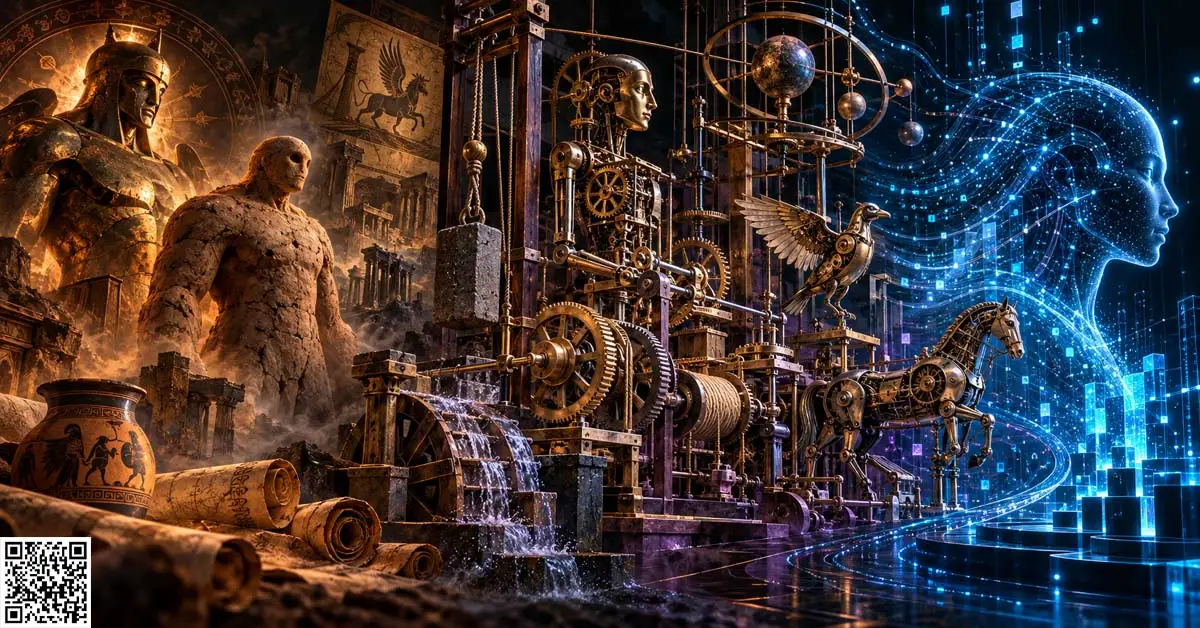
Long before artificial intelligence became a scientific discipline, human civilizations imagined beings created through craftsmanship, divine intervention, magic, mechanical ingenuity, or other extraordinary processes that appeared capable of moving, communicating, obeying instructions, protecting their creators, or acting independently.
These imagined entities occupy an important position in the intellectual history of artificial intelligence because they reveal enduring questions about the creation of artificial life, the imitation of human abilities, the automation of labour, and the relationship between constructed objects and intelligent behaviour.
Ancient Greek mythology described artificial attendants, animated statues, and extraordinary mechanical guardians. Chinese philosophical literature presented accounts of lifelike artificial performers. Jewish traditions developed complex narratives about the golem, an artificially formed being associated with questions of creation, language, protection, and responsibility. Medieval European and Islamic traditions explored marvelous mechanisms, artificial servants, and the boundaries between natural and manufactured activity.
These traditions differed substantially in cultural setting, religious significance, chronology, and purpose. They should not be treated as interchangeable accounts of one technological invention.
Nor should they be interpreted as evidence that ancient civilizations possessed modern robotics, machine learning, electronic computation, or artificial general intelligence.
The central distinction is between imagined artificial agency, historically documented mechanical automation, and modern computational intelligence.
An artificial being described in mythology may possess speech, judgment, consciousness, or independent action through supernatural means. A historically constructed automaton may perform a predetermined sequence of movements through gears, weights, water pressure, or other physical mechanisms. A modern AI system may infer outputs from data, adapt through learning, or select actions through computational policies.
These categories can resemble one another at the level of observable behaviour while differing fundamentally in their underlying mechanisms.
The historical significance of myths about artificial beings therefore lies primarily in the questions and possibilities they articulated, rather than in the existence of technologies they supposedly demonstrated.
These narratives asked whether intelligence could be manufactured, whether an artifact could imitate life, whether obedience could be engineered, and whether a creator could control something capable of apparently independent action.
Some also examined the social consequences of artificial labour, the dangers of excessive confidence in technical mastery, and the responsibilities associated with creating powerful entities.
Modern AI raises related questions through machine learning, robotics, artificial agents, foundation models, human–AI interaction, and automated decision-making. The relationship is intellectually meaningful, but it must be established through careful historical analysis rather than unsupported claims of direct technological descent.
This article examines the mythological, philosophical, mechanical, and cultural origins of artificial-being narratives, distinguishes their documented historical significance from modern technological interpretations, and explains how their recurring themes can inform contemporary AI research and governance.
1. DEEP DEFINITION
1.1. What Are Myths of Artificial Beings?
Myths of artificial beings are traditional, religious, literary, or culturally transmitted narratives describing entities whose existence, animation, behaviour, or apparent intelligence results from intentional creation rather than ordinary biological reproduction.
The means of creation may include:
- Divine craftsmanship.
- Human artistic or technical skill.
- Ritual or sacred language.
- Supernatural intervention.
- Magical transformation.
- Mechanical construction.
- Alchemical experimentation.
- Fictional scientific processes.
- Combinations of natural and extraordinary mechanisms.
Such beings may be represented as servants, guardians, companions, performers, warriors, advisers, or threats.
Some resemble humans.
Others appear as animals, statues, tools, machines, or forms that do not correspond to ordinary living organisms.
The concept is broader than modern robotics.
A supernatural creature animated through a ritual is not necessarily a mechanical automaton.
A lifelike statue created by a deity is not evidence of an engineered artificial nervous system.
Similarly, a fictional being described as intelligent does not establish that its creator possessed a computational theory of intelligence.
The relevant historical question is what the narrative reveals about the society’s conception of life, agency, craftsmanship, and human responsibility.
Adrienne Mayor’s Gods and Robots provides a comparative examination of ancient narratives involving artificial life, animated artifacts, and technological imagination across several cultural traditions [1].
1.2. What Is an Automaton?
An automaton is an artifact or constructed mechanism capable of performing actions through an internal arrangement of components or stored energy, often with limited or no continuous human manipulation during its operation.
Historically, automata have included:
- Moving mechanical figures.
- Animated theatrical devices.
- Water-powered clocks.
- Mechanical musicians.
- Self-moving decorative objects.
- Hydraulic fountains.
- Mechanical animals.
- Programmed sequences of physical movement.
- Devices that respond to specific physical triggers.
The word automaton derives from Greek terminology associated with acting or moving of itself.
However, the ancient meaning should not be assumed to be identical to modern mathematical automata theory.
In engineering, an automaton may involve gears, cams, counterweights, ropes, valves, or hydraulic mechanisms.
In theoretical computer science, an automaton refers to an abstract computational structure operating according to formally specified states and transitions.
The relationship between these meanings is conceptually useful but historically complex.
A mechanical automaton can produce movement without learning or reasoning.
A mathematical automaton can describe computational behaviour without possessing a physical body.
Therefore, automation, agency, intelligence, and consciousness must be distinguished.
1.3. Mythical Beings Versus Historical Machines
A foundational historical distinction separates imagined artifacts from demonstrated mechanisms.
| Category | Defining characteristic | Example | Evidential status |
|---|---|---|---|
| Mythical artificial being | Created entity animated through supernatural or extraordinary means | Hephaestus’s golden attendants | Literary or mythological account |
| Legendary artificial guardian | Created entity performing protective functions | Talos | Mythological tradition |
| Animated artistic creation | Crafted figure acquiring life through divine intervention | Pygmalion’s statue | Literary narrative |
| Ritual artificial being | Entity associated with mystical creation traditions | Golem | Religious and folkloric tradition |
| Mechanical automaton | Artifact animated by physical mechanisms | Hydraulic theatrical device | Engineering description or historical artifact |
| Deceptive pseudo-automaton | Device appearing autonomous while concealing human operation | Mechanical Turk | Historical performance and deception |
| Modern intelligent robot | Engineered system integrating sensing, control, and computational capabilities | Autonomous mobile robot | Contemporary technological system |
The difference is not simply whether an entity moves.
It concerns the mechanism attributed to the movement and the evidence supporting the claim.
Historians should distinguish what a text describes from what an artifact can be shown to have accomplished.
1.4. Artificial Life Versus Artificial Intelligence
Artificial life concerns the creation, simulation, or study of systems exhibiting properties associated with living organisms, such as adaptation, self-organization, reproduction, or evolutionary dynamics.
Artificial intelligence concerns systems capable of performing functions involving learning, reasoning, perception, prediction, generation, planning, or goal-directed behaviour.
The two fields overlap but are not equivalent.
An artificial organism may exhibit lifelike behaviour without possessing advanced reasoning abilities.
A modern AI system may perform sophisticated mathematical tasks without being biologically alive.
An ancient myth may describe an artificial figure as both alive and intelligent, but this does not mean that the narrative uses contemporary scientific definitions of life or intelligence.
These distinctions are important when interpreting myths involving animated statues, crafted humans, or supernatural servants.
1.5. Agency, Autonomy, and Obedience
Many artificial-being narratives focus on the relationship between a created entity and its creator.
The central questions include:
Agency: Can the being initiate actions that appear purposeful?
Autonomy: Can it act without continuous direction?
Obedience: Does it follow the intentions or commands of its creator?
Control: Can its behaviour be stopped, redirected, or restricted?
Responsibility: Who bears responsibility when the entity causes harm?
Moral status: Does the entity possess characteristics that might make its treatment ethically significant?
These questions do not require modern computational terminology to become meaningful.
Ancient and later narratives explored comparable problems through religious symbolism, literature, political philosophy, and reflections on craftsmanship.
However, modern technical autonomy is generally evaluated according to observable control structures and delegated permissions.
A fictional being acting independently through divine animation is not equivalent to a computational agent operating under an executable policy.
1.6. A Modern Analytical Model of Artificial Agency
Although ancient myths were not written using computational equations, their described behaviours can be examined through modern conceptual models.
Consider a hypothetical constructed entity with:
- A set of observable conditions O.
- An internal or represented state S.
- A set of possible actions A.
- A behavioural policy π.
- An operating environment E.
A modern agent framework may represent action selection as:
aₜ = π(sₜ, oₜ, g)
Where:
- aₜ is the selected action.
- sₜ is the internal state.
- oₜ is the current observation.
- g is the relevant goal.
The environment may then change according to:
eₜ₊₁ = T(eₜ, aₜ)
This is a retrospective analytical framework.
It does not imply that ancient storytellers possessed this mathematical model or implemented its components.
Its value is comparative.
It allows researchers to distinguish narratives describing fixed obedience from those portraying flexible response, independent action, or apparent judgment.
1.7. Degrees of Artificial Agency
Artificial beings can be compared according to the forms of behaviour attributed to them.
Animated appearance: The artifact resembles a living organism.
Self-motion: It moves without visible continuous external manipulation.
Task execution: It performs a specified function.
Environmental response: Its behaviour changes when a relevant condition changes.
Goal-directed behaviour: Its actions appear directed toward an objective.
Adaptive behaviour: It modifies its strategy according to experience or feedback.
Reflective judgment: It evaluates alternatives or reasons about consequences.
Subjective experience: It possesses consciousness or experience under the relevant philosophical definition.
These properties do not form an automatic progression.
Movement does not establish understanding.
Obedience does not establish learning.
Adaptation does not establish consciousness.
A mythology may attribute all these qualities to an artificial being without describing any physically realizable mechanism.
Contemporary AI research must evaluate such properties independently.
1.8. Hephaestus and the Artificial Servants of Greek Mythology
One of the most influential ancient descriptions of manufactured artificial attendants appears in Homer’s Iliad.
In Book 18, Hephaestus, the divine craftsman, is associated with extraordinary manufactured devices.
The narrative describes self-moving tripods capable of traveling to and from the gatherings of the gods.
It also describes golden female attendants assisting Hephaestus, whose capacities are represented as resembling those of living young women [2].
These passages are important because they imagine artificial entities combining manufactured bodies with useful capabilities.
The golden attendants are not described merely as decorative statues.
They possess qualities that permit them to assist their creator.
The self-moving tripods represent another dimension: automated movement in response to an intended purpose.
In a modern conceptual comparison, these stories raise questions concerning:
- Constructed bodily form.
- Autonomous movement.
- Humanlike assistance.
- Mechanical or divine craftsmanship.
- Functional agency.
- The relationship between an artifact and its maker.
However, the descriptions belong to epic poetry and mythology.
They do not provide evidence that ancient engineers built intelligent humanoid robots.
Nor do they specify modern machine-learning or control algorithms.
Their importance is historical and imaginative, not proof of ancient artificial intelligence.
1.9. Talos: The Artificial Guardian of Crete
Talos is among the most prominent artificial guardians in Greek mythology.
In Apollonius Rhodius’s Argonautica, Talos appears as a bronze guardian associated with the protection of Crete.
The account describes his extraordinary physical nature, territorial guarding activity, and vulnerability associated with a particular bodily feature [3].
The narrative combines several concepts that remain recognizable in modern discussions of autonomous systems.
Persistent objective: Protecting a designated territory.
Environmental interaction: Responding to approaching outsiders.
Physical embodiment: A constructed or extraordinary metallic body.
Operational boundary: A geographically defined protective function.
Critical vulnerability: A point of weakness capable of disabling the guardian.
Talos can therefore be examined as an early fictional representation of an artificial security agent.
However, the comparison must remain explicitly interpretive.
The myth does not establish the existence of a functional autonomous patrol robot.
Its descriptions of bodily animation and vulnerability reflect the narrative traditions of Greek mythology, not a documented engineering specification.
1.10. Daedalus and the Problem of Moving Statues
The legendary craftsman Daedalus became associated with remarkable artistic skill and representations of animated sculpture.
In Plato’s Meno, Socrates refers to statues of Daedalus in a discussion of the relationship between true opinion and knowledge [4].
The passage presents the image of statues that must be restrained to prevent their movement.
Its philosophical purpose is not primarily to describe robotics.
Plato uses the imagery to discuss why knowledge is more stable and valuable than an ungrounded correct belief.
The comparison illustrates how animated-artifact traditions could become resources for philosophical argument.
Aristotle also refers to moving artifacts associated with Daedalus and Hephaestus in Politics [5].
The philosophical significance lies partly in the possibility of tools performing useful functions without continuous human labour.
Daedalus therefore represents more than a story about lifelike sculpture.
The tradition connects artistry, movement, functional imitation, and philosophical reflection on what distinguishes living and manufactured activity.
1.11. Aristotle and the Idea of Self-Acting Tools
Aristotle’s Politics, Book I, contains an especially important historical passage concerning tools capable of performing their own functions.
Aristotle imagines a condition in which instruments could carry out their tasks automatically, referring to moving artifacts associated with Daedalus and Hephaestus [5].
The discussion occurs within Aristotle’s treatment of household organization, labour, property, and slavery.
It should therefore be interpreted within that historical and political context rather than presented as an unqualified celebration of technological progress.
Nevertheless, the passage reveals an early philosophical recognition of a possibility that later became central to automation:
What happens to the organization of human labour when manufactured instruments can perform tasks without continuous human assistance?
This question remains relevant to industrial automation and contemporary AI.
Modern AI systems can automate some cognitive and administrative functions, while robotics can automate selected physical activities.
However, Aristotle did not present a modern theory of computer-controlled automation.
His remarks are best understood as a philosophical thought experiment concerning self-acting instruments and their potential implications for labour.
1.12. Pygmalion and the Creation of Artificial Life
The Pygmalion narrative provides another influential account of a crafted object acquiring life.
In Ovid’s Metamorphoses, Pygmalion creates an ivory statue of extraordinary beauty.
The statue subsequently becomes living through divine intervention [6].
This differs substantially from the Hephaestus narratives.
Pygmalion’s creation is not presented as a mechanically engineered servant operating through physical components.
The transformation concerns the relationship between artistic representation, desire, divine power, and animation.
Its relevance to the history of artificial-being concepts lies in the boundary between representation and life.
The narrative raises questions about the human tendency to attribute living qualities to manufactured forms.
Modern systems can also produce highly realistic humanlike appearances and interactions.
However, visual realism or convincing dialogue does not establish that an artificial system possesses biological life, consciousness, or independent emotional experience.
Pygmalion therefore provides a valuable historical comparison for anthropomorphism, while remaining a literary and mythological narrative.
1.13. Artificial Performers in Chinese Traditions
Chinese philosophical literature also contains narratives concerning lifelike artificial beings.
A notable example appears in the Liezi, particularly in the account involving the craftsman Yan Shi and King Mu of Zhou.
The story describes a constructed humanlike performer whose movements and responses impress the royal audience.
The narrative portrays craftsmanship as capable of producing an artifact resembling a living person.
It is important to distinguish the time in which the story is set from the dating of the surviving textual tradition.
Although the narrative is situated in the era of King Mu, the received Liezi is generally associated with a much later compilation history, often placed around the early medieval period.
It should not be presented as direct archaeological evidence of a functioning humanoid automaton from the Zhou dynasty.
Mayor’s comparative study discusses ancient Chinese traditions of artificial life and technological imagination within a broader cross-cultural framework [1].
The historical importance of the Yan Shi narrative lies in its exploration of imitation, humanlike movement, and the limits of craftsmanship.
It demonstrates that questions about artificially created performers were not confined to Greek mythology.
1.14. Artificial Beings in Indian Narrative Traditions
South Asian traditions also contain narratives involving extraordinary constructed beings and artificial guardians.
Some Buddhist literary traditions describe mechanical guardians associated with the protection of sacred relics.
The accounts belong to particular religious and literary settings and should be interpreted accordingly.
Comparative scholarship has examined these narratives alongside Greco-Roman and other traditions of artificial beings [1].
However, the presence of similar motifs across cultures does not independently establish direct technological transmission.
Determining influence requires evidence concerning chronology, textual relationships, translation, travel, and cultural contact.
The most defensible conclusion is that multiple traditions explored the possibility of manufactured or extraordinary entities performing tasks usually associated with living beings.
Specific claims of borrowing or technological continuity require separate historical support.
1.15. The Golem and the Creation of an Artificial Servant
The golem occupies an important position within Jewish religious, mystical, and folkloric traditions.
Golem narratives concern the artificial formation or animation of a humanlike being, commonly associated with earth or clay and, in some traditions, sacred language or ritual practices.
These accounts carry religious, cultural, and philosophical meanings that should not be reduced simply to a prediction of modern robotics.
They engage with questions concerning:
- The nature of creation.
- Human participation in acts of making.
- Language and animation.
- The boundaries of legitimate power.
- Protection and community.
- Obedience and control.
- Responsibility for a created entity.
The Jewish Museum Berlin documents the diversity of golem traditions and their later cultural development [10].
A particularly influential modern association concerns Rabbi Judah Loew, known as the Maharal, and the city of Prague.
However, the familiar Prague narrative is not securely documented as a sixteenth-century historical event.
Dekel and Gurley’s research examines how the Prague-associated golem legend emerged and developed in the nineteenth century [11].
This distinction matters.
The historical existence of Rabbi Loew is not evidence that he constructed an animated golem.
The narrative should be treated as folklore and cultural history, not as a verified account of artificial life creation.
1.16. The Golem as a Control and Responsibility Narrative
Some modern interpretations compare golem narratives with autonomous machines.
The comparison is useful because the stories often concern an entity created to serve a purpose whose behaviour must remain subject to control.
A retrospective engineering interpretation may identify:
Creation: The establishment of an artificial entity.
Activation: The beginning of its operational behaviour.
Task assignment: A function expected by its creator.
Operational conduct: The entity’s behaviour while active.
Control problem: The possibility of unintended or uncontrolled consequences.
Deactivation: A means of ending its activity.
However, these are modern analytical categories.
They are not a universally established sequence shared by all golem traditions.
Different versions present different mechanisms, purposes, and outcomes.
The most responsible comparison is therefore conceptual rather than literal.
Golem narratives can illuminate enduring concerns about created agency and accountability, but they do not contain executable computer-security or robotics protocols.
1.17. The Difference Between Mythological Animation and Mechanical Automation
The transformation from an inert artifact into an apparently active entity can be explained differently across cultural narratives.
Divine animation: A supernatural power grants movement or life.
Magical animation: Ritual or extraordinary practices are represented as enabling activity.
Mechanical animation: Physical components produce motion using energy and control mechanisms.
Computational control: Algorithms process information and select outputs or actions.
Learned adaptation: A system updates relevant representations or policies through data or experience.
These mechanisms differ fundamentally.
A mythology can describe a being moving intelligently without explaining how its action is physically generated.
A mechanical automaton can move through an ingenious arrangement of components without possessing adaptive reasoning.
A modern AI agent can process information and select actions while operating entirely within a digital environment.
Therefore, resemblance in outward behaviour is insufficient to establish equivalence in underlying capabilities.
1.18. From Artificial Beings to Questions About Intelligence
Artificial-being narratives provide a historical setting for several questions that later became central to AI research.
Can a manufactured entity imitate a human?
Can purposeful behaviour arise from constructed mechanisms?
Can a nonhuman system perform useful work independently?
Does humanlike appearance imply humanlike understanding?
Can intelligence be separated from biological origin?
Can a creator reliably control an apparently autonomous entity?
What responsibilities arise when created systems affect other beings?
These questions became scientifically tractable in different ways as formal logic, mechanical engineering, statistics, computation, control theory, and machine learning developed.
However, it would be historically inaccurate to claim that modern AI emerged directly from any one myth.
The relationship is one of recurring intellectual questions, evolving technical possibilities, and selected cultural influences.
1.19. The Central Historical Interpretation
A rigorous analysis should preserve three separate conclusions.
First: Ancient and medieval cultures imagined artificial beings displaying qualities associated with life, agency, or intelligence.
Second: Historical engineers constructed actual mechanisms capable of performing predetermined movements and selected automated functions.
Third: Modern AI developed through later advances in mathematical logic, algorithms, computing machinery, statistics, and electronic computation.
These histories intersect intellectually and culturally.
They are not identical technological histories.
A scholarly encyclopedia must distinguish imaginative anticipation from demonstrated implementation.
2. TECHNICAL MECHANICS
2.1. How Mythical Artificial Beings Differ From Engineered Devices
A fictional artificial being may be described as possessing sophisticated abilities without an account of their implementation.
A historically documented automaton, by contrast, can often be analyzed through identifiable physical mechanisms.
Relevant engineering properties include:
- Energy source.
- Mechanical structure.
- Control mechanism.
- State transitions.
- Input triggers.
- Motion transmission.
- Output behaviour.
- Operating duration.
- Reset or termination method.
- Dependence on human intervention.
These categories help distinguish descriptions of technological devices from stories involving supernatural agency.
However, they are modern analytical tools.
Applying them to a myth does not transform the myth into an engineering specification.
2.2. Energy and Motion in Historical Automata
Mechanical automata require energy to produce physical work.
Historical devices have used:
Gravity: Falling weights drive mechanical movement.
Water pressure: Flowing water supplies force or controls timing.
Air pressure: Pneumatic mechanisms generate motion.
Stored elastic energy: Springs or other components release accumulated energy.
Human winding or preparation: An operator provides initial energy or sets a mechanism in motion.
Thermal effects: Heat influences pressure or movement in particular devices.
Energy may be transferred through ropes, gears, levers, pulleys, cams, valves, and other components.
The presence of a hidden energy source does not imply hidden intelligence.
A mechanism can appear self-moving because the energy source and control components are concealed from observers.
This explains why historical automata often inspired wonder.
Their apparent independence could exceed an audience’s understanding of their construction.
2.3. Deterministic Mechanical Sequences
A simple automaton may produce a fixed sequence of actions.
Let:
Q = {q₀, q₁, …, qₙ}
represent possible mechanical or operational states.
A transition function may be written as:
qₜ₊₁ = δ(qₜ, uₜ)
Where:
- qₜ is the current state.
- uₜ represents an input or trigger.
- δ determines the next state.
A corresponding output function may be:
yₜ = λ(qₜ, uₜ)
This resembles a finite-state machine or Mealy-machine formulation.
Such models are useful for reconstructing the logic of sequential mechanisms.
However, they were developed much later than the ancient devices being analyzed.
The notation should therefore be treated as a modern mathematical reconstruction, not an equation used by their original designers.
2.4. A Hypothetical Self-Moving Tripod
Consider an imaginary reconstruction inspired by the self-moving tripods of Hephaestus.
Suppose the mechanism must:
- Remain stationary.
- Receive a trigger.
- Travel to a designated location.
- Stop.
- Receive a return trigger.
- Move back to its starting position.
Its conceptual states might be:
Q = {Idle, Outbound, Waiting, Returning}
The transitions might be:
Idle → Outbound
Outbound → Waiting
Waiting → Returning
Returning → Idle
This is a contemporary engineering exercise.
It does not describe a historically documented Homeric machine.
It illustrates how a fictional behaviour can be translated into a simple computational control problem.
The translation also exposes missing technical information.
The myth does not specify how the device detects its location, avoids obstacles, stores energy, or responds to unexpected conditions.
Those questions would need to be answered before constructing a functional physical robot.
2.5. Fixed Automation Versus Adaptive Intelligence
A predetermined sequence can be represented as:
aₜ = π(qₜ)
Where qₜ is a programmed or mechanically defined state.
An environmentally responsive controller may instead use:
aₜ = π(qₜ, oₜ)
Where oₜ is an observation.
An adaptive controller may additionally update its parameters:
θₜ₊₁ = U(θₜ, oₜ, aₜ, rₜ)
Where:
- θₜ represents current parameters.
- U represents an update procedure.
- rₜ represents feedback or reward.
These equations distinguish three possible capabilities.
Sequenced automation: Performing predetermined operations.
Responsive control: Modifying actions according to observations.
Learning-based adaptation: Updating behaviour through experience.
A historical automaton can exhibit the first and sometimes the second without necessarily implementing the third.
The categories should not be confused merely because their outputs appear lifelike.
2.6. Hero of Alexandria and Mechanical Theatre
Hero of Alexandria provides one of the most important documented technical traditions concerning ancient automata.
His works describe mechanisms involving physical principles such as pressure, weights, and mechanical motion.
A University of Glasgow research project has examined Hero’s theatrical automata, including mobile and stationary devices, their textual descriptions, reconstruction, and technical feasibility [7].
These devices are historically significant because they move beyond purely mythological description.
They provide technical accounts that can be evaluated through engineering analysis.
Mechanical theatre could create a sequence of apparent events through controlled movement and timing.
The audience might observe a dramatic performance without seeing the complete internal mechanism.
However, such devices should not automatically be classified as intelligent robots.
Their sophistication lay in mechanical design, sequencing, and control rather than demonstrated machine learning or general reasoning.
2.7. Mechanical Programming Before Electronic Computers
A mechanical sequence may be encoded through the geometry and arrangement of components.
For example:
Cam profile: Determines how a follower moves over time.
Gear ratio: Determines relative speed or rotational relationships.
Valve position: Determines when fluid can pass.
Rope length: Controls movement range.
Counterweight: Supplies energy and affects mechanical timing.
Pin or stop position: Determines whether a component can proceed.
A cam-driven movement can be represented as:
y(t) = f(θ(t))
Where:
- θ(t) is the cam’s angular position.
- f is the cam profile.
- y(t) is the resulting follower displacement.
The cam shape physically encodes a motion relationship.
This provides a useful analogy to programmed behaviour.
However, it does not establish that every cam-based automaton is a general-purpose computer.
Mechanical programmability and universal computation are distinct concepts.
2.8. Mechanical Feedback
Some physical mechanisms respond automatically to changing conditions.
A float-based regulator, for example, can alter a valve position according to fluid level.
Let h(t) represent the water level.
A simplified controller may apply:
u(t) = K[h_target − h(t)]
Where:
- u(t) is the control action.
- K is a proportional gain.
- h_target is the desired level.
This illustrates feedback control.
It is a modern mathematical model, not a direct transcription of a particular ancient design.
A device can use feedback without learning.
Its operation may be determined entirely by physical structure.
Feedback demonstrates environmental responsiveness but is not sufficient evidence of general intelligence or consciousness.
2.9. The Banū Mūsā and Ingenious Mechanical Devices
The Banū Mūsā brothers—Muḥammad, Aḥmad, and al-Ḥasan ibn Mūsā ibn Shākir—made important contributions to the medieval Islamic engineering tradition.
Their ninth-century Kitāb al-Ḥiyal, commonly translated as The Book of Ingenious Devices, described numerous mechanisms involving fluid control and mechanical ingenuity.
The Smithsonian Institution’s Lemelson Center documents the work and its importance to the history of invention [8].
These designs provide valuable evidence of sophisticated mechanical thinking.
They also demonstrate why a history of automata and related devices should not be restricted to European technological traditions.
However, the devices should be assessed according to what their mechanisms actually accomplished.
Fluid regulation and automated movement do not establish the existence of machine consciousness or modern artificial intelligence.
The historical contribution is real and significant without requiring anachronistic claims.
2.10. Al-Jazarī and Complex Mechanical Automata
Al-Jazarī’s Book of Knowledge of Ingenious Mechanical Devices, completed in the early thirteenth century, is another major source in the history of mechanical automation.
Its descriptions include water clocks, fountains, vessels, and other elaborate mechanisms.
The Smithsonian’s National Museum of Asian Art preserves illustrated manuscript material associated with this technical tradition [9].
Some devices included animated figures whose movements were coordinated with mechanical events.
The engineering significance includes:
- Mechanical sequencing.
- Hydraulic control.
- Energy transmission.
- Timing mechanisms.
- Functional integration.
- Automated physical responses.
- Visual presentation of mechanical processes.
These features are relevant to the broader history of automation.
However, they should not be confused with evidence of autonomous symbolic reasoning or adaptive machine learning.
The distinction preserves both historical accuracy and the significance of the engineering achievement.
2.11. Medieval Automata and the Relationship Between Art and Mechanism
Medieval traditions combined technical artifacts with stories about magical, mechanical, and extraordinary creations.
E. R. Truitt’s Medieval Robots examines the relationship among real and imagined automata, craftsmanship, natural philosophy, political authority, and literary representation [12].
The historical distinction between mechanism and marvel was not always expressed through modern scientific categories.
An artifact could be understood as an ingenious construction, an extraordinary wonder, or an object associated with cosmic or supernatural forces.
A modern researcher must avoid imposing contemporary distinctions without examining the relevant historical context.
The existence of descriptions involving moving statues does not necessarily imply that the machines existed as described.
Likewise, an artifact’s inclusion in a courtly or religious setting does not eliminate its possible mechanical sophistication.
Historical analysis requires attention to both material evidence and cultural meaning.
2.12. Appearance Versus Actual Autonomy
An observer may perceive a machine as autonomous even when its actions are predetermined or secretly controlled.
A useful analytical distinction is:
Observed Autonomy: The degree to which an artifact appears to act independently.
Operational Autonomy: The degree to which the artifact actually selects and executes actions without continuous external direction.
These concepts may differ substantially.
For example, an elaborate mechanical figure can create a convincing appearance of intentional movement while following a fixed sequence.
Similarly, a digital avatar can produce expressive dialogue without possessing humanlike consciousness.
The observer’s interpretation is part of the phenomenon being studied, but it is not direct evidence of the system’s internal capabilities.
2.13. The Mechanical Turk and Deceptive Intelligence
The Mechanical Turk, exhibited beginning in 1770 by Wolfgang von Kempelen, appeared to be a chess-playing automaton.
Its public presentation created the impression that a mechanical figure could compete intellectually with human opponents.
However, the apparatus concealed human operation.
It was therefore not an independently intelligent chess machine.
The Mechanical Turk is historically important because it demonstrates the difference between an apparently intelligent interface and the actual source of intelligent behaviour.
This distinction remains relevant to modern technology demonstrations.
A polished product may appear autonomous while depending heavily on concealed human assistance, predefined scripts, or external computation.
The correct scientific question is not simply whether the observed result appears impressive.
It is which mechanisms and participants actually produce that result.
2.14. A Model of Apparent Versus Verified Agency
The distinction can be represented conceptually through:
B_observed = F(M, H, E)
Where:
- B_observed is the behaviour seen by an observer.
- M represents the mechanism.
- H represents human intervention.
- E represents environmental conditions.
An audience may observe B_observed without knowing the contributions of M or H.
This can produce an attribution error.
The observer may assign independent intelligence to the mechanism when human intervention is essential.
A rigorous evaluation should therefore document:
- Human involvement.
- Preprogrammed behaviour.
- External information.
- Hidden communication.
- Control interfaces.
- Environmental constraints.
- Actual decision-making authority.
This framework is a modern analytical tool.
It should not be interpreted as a historical equation used by automaton designers.
2.15. Frankenstein and the Ethics of Creation
Mary Shelley’s Frankenstein; or, The Modern Prometheus, first published in 1818, introduced an influential literary exploration of creating a living being through an extraordinary scientific undertaking [13].
The creature is not a conventional mechanical robot.
The novel concerns the creation of life, the consequences of abandonment, social rejection, and the responsibilities of the creator.
Its relevance to modern AI is therefore primarily ethical and philosophical.
It raises questions concerning:
Creator responsibility: What obligations follow from creating a powerful or vulnerable entity?
Unanticipated consequences: How should creators respond when outcomes differ from expectations?
Social treatment: How do human attitudes influence the experiences and behaviour of created beings?
Control versus care: Is a created entity merely an instrument, or does its fictional moral status create additional obligations?
These themes remain relevant to debates about AI development.
However, the novel does not provide a technically validated account of artificial intelligence or consciousness.
2.16. R.U.R. and the Modern Word Robot
Karel Čapek’s play R.U.R. (Rossum’s Universal Robots), published in 1920 and performed in 1921, had a profound influence on modern robot terminology [14].
The word robot is associated with the Czech term robota, referring to forced or compulsory labour.
Čapek credited his brother Josef with suggesting the term.
Importantly, the robots in the play are manufactured artificial workers with biological characteristics.
They are not simply modern electromechanical robots.
This distinction is often overlooked in popular accounts of robotics history.
The play explores industrial production, exploitation, dependence on artificial workers, and the consequences of creating entities whose interests may diverge from those of their creators.
Its lasting importance lies in both its terminology and its treatment of the social implications of artificial labour.
2.17. Asimov and Fictional Rules for Robot Behaviour
Isaac Asimov’s robot stories developed influential fictional rules governing the behaviour of artificial agents.
The Three Laws of Robotics were explicitly presented together in the 1942 story Runaround [15].
Their broader significance lies in the attempt to imagine constraints on robot behaviour and conflicts among competing requirements.
However, Asimov’s laws are literary constructs.
They are not a sufficient technical specification for safe autonomous systems.
Natural-language rules can contain ambiguities.
Real-world environments contain uncertain and conflicting information.
A machine may also require permissions, physical safeguards, independent monitoring, and defined escalation procedures.
Thus, fictional robot laws are useful for philosophical discussion and ethical thought experiments, but responsible engineering requires substantially more detailed control and verification mechanisms.
2.18. A Modern Safety-Control Interpretation
A contemporary autonomous system may select actions according to:
a = argmaxₐ∈A_safe(s) E[U(a, s)]*
Where:
- a* is the selected action.
- A_safe(s) represents actions satisfying the relevant constraints.
- U represents the specified utility or task objective.
- s represents the operational state.
The system should not simply select the action with the highest estimated utility when that action violates authorization or safety requirements.
A separate validation rule may be:
Execute(a) only if Authorized(a, s) = true
This is a modern engineering formulation.
It does not derive mechanically from any specific mythological narrative or fictional law.
Its relevance is that ancient and later artificial-being stories repeatedly dramatized the consequences of powerful creations acting outside intended limits.
Modern AI engineering addresses related risks through executable safeguards and evidence-based evaluation.
2.19. Turing and the Transition to Computational Questions
Alan Turing’s Computing Machinery and Intelligence, published in 1950, represents a major development in the scientific discussion of machine intelligence [16].
Instead of treating artificial intelligence primarily as a story about manufacturing lifelike bodies, Turing examined machine behaviour through a computational framework.
His discussion included the imitation game, objections to machine intelligence, and possible learning machines.
The distinction is historically important.
Earlier narratives often focused on whether artifacts could become alive or behave like people.
Modern AI research increasingly asked how computational systems could produce particular capabilities through algorithms, representations, and learning procedures.
However, the transition was not a simple replacement of mythology by science.
Philosophical and fictional questions continued to influence debates about intelligence, consciousness, imitation, and human–machine interaction.
2.20. The Difference Between Mechanical Automata and Modern AI Agents
| Technical property | Historical mechanical automata | Modern AI agents |
|---|---|---|
| Primary mechanism | Physical components and predefined controls | Computational policies and system architecture |
| Input | Mechanical triggers or limited sensor mechanisms | Digital, sensory, or environmental observations |
| State | Mechanical configuration | Computational and possibly physical state |
| Action | Physical movement or operation | Digital or physical actions |
| Learning | Generally absent from classical mechanisms | May be present, but is not universal |
| Planning | Usually predetermined sequences | May involve dynamic planning |
| Feedback | Possible through mechanical regulation | Can use complex computational feedback |
| Generalization | Typically constrained by physical design | Depends on models, training, and evaluation |
| Execution authority | Determined by physical mechanism and operator | Determined by software permissions and controls |
| Consciousness | Not established by automation | Not established by computational performance |
The comparison illustrates how artificial agents differ from historical automata.
It does not imply that every modern robot possesses broad intelligence or that every historical mechanism lacked sophistication.
2.21. Morphological Design and Apparent Intelligence
The physical structure of an automaton can produce behaviour that appears more sophisticated than the controller itself.
A compliant mechanism may adjust passively to contact.
A carefully balanced figure may maintain motion under favorable conditions.
A cam profile may produce lifelike gestures.
This resembles the modern concept of morphological computation, in which physical design contributes to useful behaviour.
A conceptual relationship is:
Behaviour = F(Control, Body, Environment)
The expression highlights the interaction among control, physical structure, and environmental conditions.
It does not imply that every historical automaton performs computation in the contemporary technical sense.
The broader lesson is that complex outward behaviour can emerge from the organization of relatively simple components.
2.22. The Limits of Retrospective Mathematical Models
Modern mathematics can help researchers analyze historical automata.
However, such models introduce a risk of anachronism.
A finite-state representation may describe the behaviour of a mechanism without reflecting the terminology, design intentions, or scientific knowledge of its original creator.
Similarly, representing Talos as a territorial security agent can illuminate the narrative structure without establishing that ancient storytellers developed autonomous-navigation algorithms.
Retrospective formalization is useful when it:
- Clarifies observable functions.
- Identifies missing mechanical assumptions.
- Supports comparison.
- Distinguishes different levels of autonomy.
- Preserves uncertainty.
- Avoids claiming undocumented historical knowledge.
It becomes misleading when a modern analytical vocabulary is presented as direct evidence of ancient technological capability.
2.23. Historical Evidence and Reconstruction
Engineering historians may reconstruct a described device to test its physical feasibility.
A rigorous reconstruction should distinguish:
Primary textual evidence: What the historical document explicitly states.
Material evidence: What surviving artifacts demonstrate.
Interpretive assumptions: What the researcher must infer.
Reconstruction choices: Which materials or mechanisms are selected.
Experimental results: What the reconstructed device actually performs.
Historical uncertainty: Which features remain unverified.
The University of Glasgow project on Hero’s theatrical automata illustrates the value of combining textual study with experimental reconstruction [7].
A successful modern reconstruction establishes that a proposed mechanism can work under the tested conditions.
It does not necessarily prove that the historical device was built in precisely the same form.
2.24. A Historical Classification Framework
The relationship between artificial-being narratives and engineering can be summarized through four evidential categories.
Narrative possibility
A text describes an artificial being or extraordinary device.
Technical description
A document explains identifiable mechanical operations.
Material corroboration
Physical artifacts or independent evidence support the existence of a device.
Reproducible reconstruction
A proposed mechanism can be tested through a documented reconstruction.
The categories may overlap but should not be collapsed.
A myth may provide detailed imagery without engineering evidence.
A technical manuscript may describe a plausible machine without a surviving original specimen.
A modern reconstruction may demonstrate feasibility while leaving uncertainties about historical implementation.
This framework helps avoid unsupported claims about ancient technological achievements.
3. ARCHITECTURAL TEXT MAP
3.1. Historical Development of Artificial-Being Concepts
The following architecture traces the broad conceptual development of artificial beings and automata.
It is a comparative historical map rather than a claim that every tradition directly influenced the next.
LAYER 1 — HUMAN IMAGINATION AND CULTURAL QUESTIONS
Life, intelligence, craftsmanship, obedience, agency, labour, and responsibility.
↓
LAYER 2 — MYTHOLOGICAL ARTIFICIAL BEINGS
Animated statues, divine attendants, artificial guardians, and supernatural creations.
↓
LAYER 3 — PHILOSOPHICAL REFLECTION
Questions concerning life, movement, knowledge, craftsmanship, and self-acting tools.
↓
LAYER 4 — HISTORICAL MECHANICAL AUTOMATION
Hydraulic devices, mechanical figures, clocks, theatrical mechanisms, and regulated physical motion.
↓
LAYER 5 — LITERARY ARTIFICIAL-LIFE NARRATIVES
Created beings, artificial workers, control conflicts, and responsibility for consequences.
↓
LAYER 6 — COMPUTATIONAL INTELLIGENCE
Formal models, electronic computers, algorithms, symbolic reasoning, and machine learning.
↓
LAYER 7 — CONTEMPORARY ARTIFICIAL AGENTS
Perception, planning, tool use, action selection, feedback, and operational constraints.
↓
LAYER 8 — RESPONSIBLE AI GOVERNANCE
Testing, accountability, security, human oversight, and correction mechanisms.
These layers represent broad conceptual relationships.
They should not be treated as a single uninterrupted technological lineage.
3.2. Mythical Artificial-Being Narrative Architecture
CREATOR
Deity, craftsperson, ritual practitioner, or fictional inventor.
↓
CREATIVE PROCESS
Craftsmanship, divine power, ritual, magic, or extraordinary transformation.
↓
ARTIFICIAL ENTITY
Manufactured or animated form.
↓
ATTRIBUTED CAPABILITIES
Movement, speech, obedience, protection, assistance, or independent conduct.
↓
ENVIRONMENTAL INTERACTION
The entity encounters people, places, commands, or obstacles.
↓
NARRATIVE CONSEQUENCES
Successful assistance, conflict, danger, transformation, or loss of control.
↓
CULTURAL INTERPRETATION
Questions concerning creation, power, responsibility, life, and agency.
This architecture describes recurring narrative functions.
It is not a claim that all myths possess the same structure.
3.3. Historical Mechanical Automaton Architecture
ENERGY INPUT
Falling weight, fluid pressure, stored mechanical energy, or operator preparation.
↓
CONTROL MECHANISM
Valves, cams, gears, ropes, stops, or trigger components.
↓
SEQUENCE REGULATION
Timing and ordering of mechanical operations.
↓
MOTION TRANSMISSION
Levers, shafts, pulleys, joints, or other connected components.
↓
VISIBLE ARTIFACT BEHAVIOUR
Movement, sound, dispensing, signaling, or theatrical action.
↓
MECHANICAL FEEDBACK, IF PRESENT
Physical response to changing pressure, position, or environmental conditions.
↓
COMPLETION OR RESET
Termination, energy exhaustion, or preparation for another cycle.
3.4. Myth Versus Mechanism Versus AI
MYTHOLOGICAL ARTIFICIAL BEING
Extraordinary animation and attributed intelligence.
↓
HISTORICAL ANALYSIS
Examine textual origins, cultural context, and evidential status.
↓
MECHANICAL AUTOMATON
Physical components produce specified movements or responses.
↓
ENGINEERING ANALYSIS
Identify energy, mechanisms, inputs, state, and control.
↓
COMPUTATIONAL AGENT
Algorithms process observations and select outputs or actions.
↓
AI EVALUATION
Measure task competence, adaptation, reliability, and constraints.
↓
RESPONSIBLE DEPLOYMENT
Authorize operations and monitor actual consequences.
This map distinguishes interpretive comparison from claims of technological continuity.
3.5. An Ancient Automaton Reconstruction Workflow
HISTORICAL SOURCE
Original or translated manuscript, description, or surviving object.
↓
SOURCE CRITICISM
Dating, authorship, textual transmission, and historical context.
↓
MECHANISM EXTRACTION
Identify explicitly described components and operations.
↓
ASSUMPTION DOCUMENTATION
Record missing details and interpretive choices.
↓
ENGINEERING MODEL
Represent forces, timing, movement, and possible state transitions.
↓
PHYSICAL OR DIGITAL RECONSTRUCTION
Build or simulate a proposed mechanism.
↓
EXPERIMENTAL TESTING
Evaluate whether the device performs the described functions.
↓
HISTORICAL INTERPRETATION
Distinguish demonstrated feasibility from verified historical construction.
3.6. Artificial-Agent Control Architecture
AUTHORIZED PURPOSE
Defined task objective and operating limits.
↓
SENSORY OR DIGITAL INPUT
Information from the environment.
↓
STATE ESTIMATION
Determine the relevant operating conditions.
↓
ACTION POLICY
Select a candidate action.
↓
SAFETY AND PERMISSION CHECK
Verify feasibility and authorization.
↓
ACTION EXECUTION
Perform the permitted operation.
↓
ENVIRONMENTAL FEEDBACK
Observe the consequences.
↓
VERIFICATION AND CORRECTION
Continue, revise, recover, escalate, or terminate.
This architecture represents modern technical practice rather than a mechanism found in ancient mythology.
3.7. Creator Responsibility and the Control Cycle
CREATION
Develop or deploy an artificial system.
↓
PURPOSE DEFINITION
Specify legitimate objectives and expected functions.
↓
CAPABILITY ASSESSMENT
Determine what the system can actually perform.
↓
AUTHORITY ALLOCATION
Establish permitted and prohibited actions.
↓
DEPLOYMENT
Operate within validated conditions.
↓
OUTCOME MONITORING
Observe actual effects and failures.
↓
CORRECTION
Intervene, update, restrict, or stop the system.
↓
ACCOUNTABILITY
Document responsibility for design, operation, and consequences.
This modern governance cycle addresses concerns that artificial-being narratives often dramatize through the relationship between creators and their creations.
4. USE-CASES & LIMITATIONS
4.1. Understanding the Cultural Origins of AI
Artificial-being narratives provide valuable evidence concerning long-standing human interest in manufactured intelligence and autonomous activity.
They demonstrate that questions about intelligent artifacts predate electronic computing by many centuries.
Historical research can therefore explain why modern AI provokes fascination, anxiety, and philosophical debate.
However, cultural anticipation should not be mistaken for technological invention.
Principal limitation: Similar ideas across centuries do not prove direct scientific influence or historical continuity.
4.2. Explaining the Difference Between Automation and Intelligence
Historical automata provide accessible examples of automated behaviour without requiring machine learning.
A mechanical figure may repeat a complex sequence reliably.
A modern AI model may perform inference without controlling any physical mechanism.
A contemporary robot may combine both.
These comparisons help explain why movement, apparent purpose, and intelligence should be evaluated separately.
Principal limitation: The absence of learning does not make historical automation technically trivial, and the presence of learning does not automatically establish broad intelligence.
4.3. Robotics Education
Ancient and medieval automata can provide engaging educational examples for robotics.
Students may reconstruct simplified mechanisms to investigate:
- Energy transfer.
- Timing.
- State transitions.
- Mechanical sequencing.
- Feedback.
- Control.
- Human–machine interaction.
A hypothetical model of Hephaestus’s tripods could become an exercise in finite-state control and navigation.
A reconstruction inspired by Hero could demonstrate mechanical programming.
However, students should be explicitly told when a model is speculative or modernized.
Principal limitation: A reconstructed demonstration should not be presented as an authenticated historical artifact without supporting evidence.
4.4. History of Mechanical Engineering
Documented automata contribute to the history of engineering through their treatment of motion, timing, energy, and functional integration.
Research on Hero, the Banū Mūsā, and al-Jazarī demonstrates the importance of studying mechanical traditions across multiple regions and periods [7][8][9].
These histories broaden understanding of technological innovation beyond simplistic narratives centered on one civilization.
Principal limitation: Historical technical sophistication should be established through documents and artifacts rather than exaggerated claims about modern technological equivalence.
4.5. Human–Robot Interaction
Human observers can attribute agency, emotion, or understanding to systems that display lifelike behaviour.
Animated figures and humanoid forms may encourage these interpretations.
Modern conversational interfaces, social robots, and digital avatars can produce comparable attribution effects.
The historical study of artificial beings therefore contributes to understanding anthropomorphism.
Principal limitation: Human perceptions of intelligence do not directly establish the system’s actual cognitive capabilities.
4.6. Artificial Intelligence and Labour
Aristotle’s discussion of self-acting tools and Čapek’s treatment of artificial workers provide historically distinct perspectives on automation and labour [5][14].
They raise questions concerning:
- Replacement of human tasks.
- Ownership of productive systems.
- Distribution of economic benefits.
- Dependence on automation.
- Worker agency.
- Social inequality.
- Responsibility for technological change.
These themes remain relevant to contemporary debates about AI and employment.
However, the texts belong to different historical and political circumstances.
Their social assumptions should be critically examined rather than adopted as timeless principles.
4.7. Creator Responsibility and AI Governance
Artificial-being narratives frequently dramatize situations in which creators cannot adequately manage the consequences of their creations.
This is especially visible in later literary traditions such as Frankenstein and R.U.R. [13][14].
Modern AI governance addresses responsibility through system design, risk assessment, operational boundaries, monitoring, and accountability.
The NIST AI Risk Management Framework provides a contemporary structure for examining AI risks across development and deployment [17].
Principal limitation: Literary narratives can illuminate ethical questions but do not substitute for formal technical standards, empirical safety evaluation, or applicable legal requirements.
4.8. Autonomous Security and the Talos Analogy
Talos can be interpreted as a fictional territorial guardian.
This makes the narrative relevant to contemporary discussions of automated surveillance, security systems, and autonomous enforcement.
Possible comparison points include:
- Protected boundaries.
- Intrusion detection.
- Action triggers.
- Operational rules.
- Human authorization.
- System vulnerabilities.
However, such comparison is conceptual.
Talos does not provide evidence of an ancient autonomous surveillance technology.
Modern security systems also require safeguards that cannot be derived from myth.
Principal limitation: An automated security system’s technical ability to detect or respond to an event does not establish legitimate authority to use force or impose consequences.
4.9. Artificial Companions and Social Robotics
Some artificial-being narratives describe companions or attendants possessing humanlike qualities.
Modern social robots and conversational agents can also be designed to interact through language, movement, or expressive behaviour.
These systems may be useful in education, accessibility, entertainment, or selected support contexts.
However, their interfaces can create misleading impressions of emotional understanding or consciousness.
Principal limitation: Humanlike speech, appearance, or responsiveness does not establish subjective experience, personal attachment, or human-equivalent social understanding.
4.10. The Golem and the Problem of Control
Golem narratives have been interpreted in relation to the challenges of creating entities whose behaviour may exceed human expectations.
They provide a culturally significant way to discuss questions of instruction, control, and responsibility.
However, there is substantial variation among the traditions.
The familiar Prague story developed through a particular historical process documented by modern scholarship [10][11].
Principal limitation: Reducing a religious and cultural tradition to a simple modern safety metaphor can distort its meaning and history.
Responsible comparison requires contextual sensitivity.
4.11. The Mechanical Turk and AI Transparency
The Mechanical Turk illustrates how demonstrations can conceal the actual source of performance.
The broader lesson applies to AI products and public evaluations.
A system may rely on:
- Human operators.
- External databases.
- Remote services.
- Prewritten responses.
- Hidden tools.
- Manual corrections.
- Restricted demonstration conditions.
These arrangements are not inherently improper.
However, their role should be disclosed when relevant to capability claims.
Principal limitation: A convincing interface demonstration does not establish independent autonomous intelligence.
4.12. Ancient Myths Are Not Engineering Documentation
Myths may describe extraordinary technical abilities without explaining how they are achieved.
They may omit energy sources, mechanisms, failure conditions, and operational limits.
These omissions are not necessarily defects in the narratives.
Their purposes may be religious, philosophical, dramatic, or literary rather than instructional.
A modern engineering analysis cannot assume that missing technical details were known but intentionally concealed.
Principal limitation: An imagined mechanism is not a verified technological achievement.
4.13. Problems of Historical Dating
Ancient narratives frequently describe events set long before the surviving text was composed.
A story about a legendary ancient ruler may be preserved in a manuscript compiled centuries later.
Similarly, a religious legend associated with a historical figure may acquire familiar features only in much later retellings.
The Yan Shi tradition and the Prague golem narrative illustrate the importance of distinguishing narrative setting from documentary evidence.
Principal limitation: The date assigned to a legendary event should not automatically be treated as the date of a real technological invention.
4.14. Cultural Transmission and Independent Similarity
Similar stories about artificial beings appear across multiple traditions.
However, similarity can arise through different processes.
These include:
- Direct borrowing.
- Translation.
- Trade and cultural exchange.
- Shared philosophical problems.
- Independent imaginative development.
- Later reinterpretation.
A historical claim of direct transmission requires evidence.
Researchers should examine manuscript chronology, linguistic relationships, documented contacts, and relevant cultural conditions.
Principal limitation: Parallel motifs do not independently establish a single origin or transmission route.
4.15. The Risk of Eurocentric AI History
A history focused exclusively on Greek mythology and modern European literature overlooks significant traditions from other parts of the world.
Chinese artificial-performer narratives and medieval Islamic mechanical engineering provide important comparative material.
South Asian traditions also contribute to the broader study of artificial beings.
A balanced history should include these traditions according to the strength of available evidence.
However, inclusiveness should not depend on making exaggerated technical claims.
Principal limitation: Correcting historical omissions requires careful scholarship, not unsupported assertions that every civilization independently invented modern AI.
4.16. The Difference Between Artifice and Consciousness
A manufactured being may appear conscious in a narrative.
A mechanical automaton may produce realistic gestures.
A contemporary AI system may generate convincing language about emotions or subjective states.
None of these observations, by itself, provides conclusive evidence of consciousness.
The scientific and philosophical study of consciousness requires additional definitions, theories, and evidence.
Principal limitation: Observable imitation should not be equated automatically with subjective experience.
4.17. Mythological Obedience Versus Technical Alignment
Artificial-being stories frequently describe entities expected to obey their creators.
Modern AI alignment concerns whether system behaviour remains appropriately connected to intended objectives, constraints, and human values.
These topics are related at a broad conceptual level.
However, alignment is not simply obedience.
A legitimate instruction may conflict with a safety requirement.
An ambiguous instruction may require clarification.
A system may also need to refuse unauthorized operations.
Thus, safe AI behaviour requires more than following instructions literally.
Principal limitation: A fictional obedience rule cannot replace tested authorization, safety, and oversight mechanisms.
4.18. Fictional Safety Rules Are Not Complete Specifications
Asimov’s Three Laws are influential literary devices.
Their narratives often explore conflicts or ambiguities that arise when apparently simple rules interact.
In real engineering, a safety requirement must be operationally defined.
It may require measurable thresholds, specific permissions, independent checks, and verified emergency behaviour.
A rule prohibiting harm is difficult to implement without defining relevant conditions, uncertainty, authority, and the consequences of actions.
Principal limitation: Broad moral principles cannot be assumed to translate directly into executable safety guarantees.
4.19. Historical Reconstruction and Missing Evidence
A modern reconstruction may demonstrate that a described automaton could have worked.
However, physical feasibility does not prove historical construction.
The reconstruction may use materials, tolerances, or mechanisms unavailable to the original designer.
It may also incorporate assumptions not explicitly supported by the source.
Responsible historical experiments should report these differences.
Principal limitation: Demonstrated feasibility is not equivalent to verified historical existence.
4.20. Misleading Claims About Ancient Artificial Intelligence
Popular discussions sometimes describe Talos, Hephaestus’s attendants, or other mythical figures as literal ancient AI robots.
Such expressions can be useful as metaphors, but they can become misleading when presented as historical facts.
Ancient narratives did not document neural networks, electronic computers, training datasets, probabilistic models, or modern autonomous software.
Their importance does not require those technologies to have existed.
Principal limitation: The vocabulary of modern AI should not be projected onto antiquity without explicit qualification.
4.21. Automation Versus Intelligence in Public Understanding
A machine capable of sophisticated physical motion may appear intelligent.
A conversational system may appear knowledgeable.
A system producing a persuasive explanation may appear to understand its subject.
However, reliable evaluation requires examining its actual computational and operational mechanisms.
Relevant questions include:
Does it learn from experience?
Can it generalize beyond familiar examples?
Does it respond to environmental feedback?
Can it reason under specified rules?
Does it select actions according to goals?
Can it recover from unexpected failures?
Is its apparent intelligence dependent on hidden human assistance?
These questions help distinguish technical capability from superficial resemblance.
4.22. Artificial Beings as Educational Thought Experiments
Mythological narratives can support conceptual exercises in AI engineering.
For example, Talos may inspire a discussion about autonomous boundary enforcement.
Hephaestus’s attendants may inspire a comparison of helpful assistants and independent task execution.
Pygmalion may support a discussion about anthropomorphism.
The golem may provide a context for examining responsibility and deactivation.
These comparisons become useful when the historical and contemporary elements remain clearly separated.
Principal limitation: A thought experiment provides conceptual insight, not empirical evidence that a particular technology works.
4.23. AI Ethics and Cultural Representation
Using historical traditions in AI education requires cultural sensitivity.
Religious narratives may carry meanings that differ from contemporary technological metaphors.
Literary accounts may include assumptions about gender, slavery, class, or power that require critical interpretation.
For example, discussions of artificial servants should acknowledge the relationship between their portrayal and historical ideas about labour and social hierarchy.
Similarly, the golem should not be reduced to a generic monster or machine without recognizing its place within Jewish cultural and religious traditions.
Principal limitation: Technological reinterpretation should not erase the original cultural significance of a narrative.
4.24. Modern AI and the Myth of Total Autonomy
Popular portrayals of artificial beings often emphasize complete independence.
However, contemporary AI systems generally depend on designed architectures, training processes, data, infrastructure, permissions, and external environments.
A model may generate plans without executing them.
An agent may execute tasks only through authorized tools.
A robot may operate independently within a restricted environment while requiring human intervention elsewhere.
Therefore, autonomy is best treated as a contextual and measurable property.
Principal limitation: Apparent independent behaviour does not establish unrestricted competence or authority.
4.25. Creator Responsibility in Production AI
Modern system creators and operators can influence the conditions under which AI systems act.
Responsibilities may include:
- Defining intended use.
- Evaluating capabilities.
- Documenting limitations.
- Implementing access controls.
- Testing failure modes.
- Monitoring real-world outcomes.
- Maintaining recovery procedures.
- Protecting user information.
- Providing appropriate human oversight.
- Correcting known defects.
The NIST AI Risk Management Framework provides a contemporary foundation for organizing AI-related risk management [17].
Principal limitation: Responsibility cannot be assigned accurately without considering the roles of developers, deployers, operators, and other relevant participants.
4.26. Artificial-Beings Narratives and Research Communication
Historical myths can make technical questions accessible to broad audiences.
They provide memorable examples for explaining agency, control, autonomy, and the relationship between appearance and mechanism.
However, research communication should identify when a comparison is metaphorical.
A responsible explanation might describe Talos as a mythological artificial guardian that resembles certain modern conceptions of autonomous security systems.
It should not declare that Talos was a documented functioning robot.
Principal limitation: Engaging language should not compromise historical or scientific accuracy.
4.27. The Relationship Between Imagination and Innovation
Imagination can expand the range of technologies that people consider possible.
Literature, philosophy, and art can articulate questions that later become relevant to engineering.
However, the historical relationship between a particular myth and a particular invention must be demonstrated rather than assumed.
An engineer may independently solve a mechanical problem without drawing inspiration from an ancient story.
A fictional narrative may resemble a later invention without having caused it.
Therefore, thematic similarity and historical influence should be evaluated separately.
Principal limitation: Chronological precedence does not automatically establish causation.
4.28. A Critical Framework for Evaluating Ancient AI Claims
Claims concerning artificial intelligence in antiquity should be examined through several questions.
What is the earliest relevant source?
When was the source composed or compiled?
Does it describe a fictional or documented device?
What mechanism, if any, is specified?
Does a surviving artifact support the account?
Can independent evidence corroborate the claim?
Does the account describe actual learning, reasoning, or only movement?
Are modern terms being used metaphorically or literally?
What uncertainties remain?
This framework prevents historical imagination from being mistaken for technological proof.
It also allows genuine early engineering achievements to be appreciated accurately.
4.29. Why Myths Remain Relevant to Advanced AI
Although mythical artificial beings do not constitute modern AI technologies, the questions they raise remain important.
Human societies continue to debate:
- What makes intelligence meaningful.
- Whether intelligence requires a biological body.
- How artificial agents should be governed.
- Whether machines should imitate human behaviour.
- What happens when automation transforms labour.
- How creators should respond to unintended consequences.
- Whether convincing behaviour establishes genuine understanding.
- How responsibility should be distributed when artificial systems act.
These are not exclusively engineering questions.
They involve philosophy, cultural history, economics, ethics, law, and social institutions.
The history of artificial beings provides a way to understand why AI has always been more than a technical subject.
4.30. Principles for Responsible Historical Interpretation
A rigorous scholarly treatment should follow several principles.
Separate mythology from documented engineering. Literary descriptions should not be presented as archaeological proof.
Distinguish artificial life from artificial intelligence. Lifelike behaviour and computational reasoning are different concepts.
Preserve historical chronology. The date of a story’s setting may differ from the date of its surviving text.
Recognize cultural diversity. Greek, Chinese, South Asian, Jewish, Islamic, and European traditions should be interpreted within their own historical contexts.
Avoid false technological equivalence. A mechanical automaton is not automatically an adaptive AI agent.
Identify modern analogies explicitly. Retrospective comparisons should not be disguised as original technical knowledge.
Use primary sources where available. Ancient texts and historical artifacts should form the evidential foundation.
Distinguish reconstruction from authentication. A working modern replica does not automatically prove the existence of an identical historical device.
Respect religious and cultural meanings. Historical traditions should not be reduced to technological metaphors.
Examine power and labour. Artificial-servant narratives often reflect broader social structures.
Separate agency from consciousness. Movement, speech, and obedience do not establish subjective experience.
Recognize the limits of fictional safety rules. Modern AI governance requires operationally defined safeguards.
Evaluate claims of influence critically. Similarity does not automatically establish historical causation.
Preserve uncertainty. Unresolved scholarly questions should remain visible.
Connect historical questions to modern evidence responsibly. Contemporary AI capabilities must be evaluated through documented technical performance.
4.31. The Historical Significance of Imagined Artificial Intelligence
The history of artificial beings and automata demonstrates that the desire to construct entities resembling living or intelligent beings is much older than modern computing.
Mythological traditions imagined artificial attendants, protectors, and companions.
Philosophers considered the implications of self-acting tools and manufactured behaviour.
Engineers developed ingenious mechanical devices capable of performing controlled sequences without continuous human manipulation.
Later literature explored the responsibilities, uncertainties, and social consequences of artificial creations.
Modern AI transformed selected aspects of these questions into computational research problems involving representation, learning, reasoning, perception, planning, and action.
Nevertheless, the relationship between the ancient imagination and contemporary AI is not a simple technological progression.
The existence of a myth does not establish a machine.
The existence of a machine does not establish intelligence.
The existence of intelligence-related behaviour does not establish consciousness.
The central scientific conclusion is that myths of artificial beings and automata represent foundational evidence of humanity’s long-standing intellectual engagement with artificial agency, while the actual history of artificial intelligence depends on demonstrable advances in mathematics, computation, control, and engineering.
Ancient narratives remain relevant because they reveal questions that societies continue to confront as artificial systems become more capable.
What should a created entity be permitted to do?
What distinguishes imitation from understanding?
How much independence should an artificial system possess?
What obligations follow from creating a system capable of influencing the world?
Who is responsible when the system behaves unexpectedly?
These questions cannot be answered through mythology alone, but their historical persistence helps explain the cultural and philosophical importance of contemporary artificial intelligence.
The lasting significance of artificial-being traditions lies in their ability to illuminate the relationship between imagination and invention, machinery and agency, creation and responsibility, and the enduring human ambition to construct systems that act intelligently within the world.
5. RELATED ENCYCLOPEDIA TOPICS
Ancient Logic and Formal Argument
Mechanical Calculators and Automata
Probability and Early Statistics
6. REFERENCES
- Mayor, A. (2018). Gods and Robots: Myths, Machines, and Ancient Dreams of Technology. Princeton University Press. DOI: 10.2307/j.ctvc779xn.
- Homer. (Ancient Greek epic; English translation by A. T. Murray, 1924). The Iliad, Book 18. Harvard University Press. Perseus Digital Library, Tufts University. Relevant passages: Book 18, approximately lines 369–420.
- Apollonius Rhodius. (Third century BCE; English translation by R. C. Seaton, 1912). Argonautica, Book IV. Loeb Classical Library translation. Relevant passage: the encounter with Talos, beginning around line 1638.
- Plato. (Fourth century BCE; English translation by W. R. M. Lamb, 1924). Meno. Harvard University Press. Perseus Digital Library. Relevant passage: 97d–98a.
- Aristotle. (Fourth century BCE; English translation by H. Rackham, 1944). Politics, Book I. Harvard University Press. Perseus Digital Library. Relevant passage: 1253b–1254a.
- Ovid. (First century CE; English translation by Brookes More, 1922). Metamorphoses, Book X: Pygmalion and the Statue. Perseus Digital Library, Tufts University. Relevant passage: Book X, lines 243–297.
- University of Glasgow. (Research project). Hero of Alexandria and His Theatrical Automata. School of Humanities, Classics Research. Interdisciplinary investigation of Hero’s automata, historical context, engineering feasibility, and reconstruction.
- Smithsonian Institution, Lemelson Center for the Study of Invention and Innovation. (2020). Ingenious Devices. National Museum of American History. Historical examination of the Banū Mūsā and their ninth-century Kitāb al-Ḥiyal.
- Smithsonian Institution, National Museum of Asian Art. (Collection record). Folio from the Book of Knowledge of Ingenious Mechanical Devices by al-Jazarī. Freer Gallery of Art Collection. Manuscript evidence concerning al-Jazarī’s historical mechanical devices.
- Jewish Museum Berlin. (Museum exhibition and historical interpretation). Golem: From Mysticism to Minecraft. Jewish Museum Berlin. Cultural and historical examination of golem traditions and their later interpretations.
- Dekel, E., & Gurley, D. G. (2013). How the Golem Came to Prague. The Jewish Quarterly Review, 103(2), 241–258. Historical analysis of the emergence of the Prague-associated golem legend.
- Truitt, E. R. (2015). Medieval Robots: Mechanism, Magic, Nature, and Art. University of Pennsylvania Press. DOI: 10.9783/9780812291407.
- Shelley, M. W. (1818). Frankenstein; or, The Modern Prometheus. First edition. Public-domain digital edition available through Project Gutenberg. A foundational literary examination of artificial creation and creator responsibility.
- Čapek, K. (1920; English translation published subsequently). R.U.R. (Rossum’s Universal Robots). Project Gutenberg digital edition. The play introduced the modern term robot and examined manufactured labour, agency, and the social consequences of artificial workers.
- Asimov, I. (1942). Runaround. Astounding Science Fiction, March 1942. Early explicit formulation of the fictional Three Laws of Robotics.
- Turing, A. M. (1950). Computing Machinery and Intelligence. Mind, 59(236), 433–460. DOI: 10.1093/mind/LIX.236.433.
- Tabassi, E. (2023). Artificial Intelligence Risk Management Framework (AI RMF 1.0). National Institute of Standards and Technology, NIST AI 100-1. DOI: 10.6028/NIST.AI.100-1.
- Jordan, J. M. (2019). The Czech Play That Gave Us the Word ‘Robot’. The MIT Press Reader. Historical and literary examination of Čapek’s R.U.R. and its influence on modern robot terminology.